Photo by Johannes Plenio from Pexels

Tag: edci568 Assignment 1a

My New Chair 568 (1A- Week #3)

My New Chair

I bought a new chair recently, it’s a bright baby blue color and it sits in my room. On the chair sits a small plain cushion. Both look a little strange still in the corner of my room; often I wander in and am surprised to see them there. And then I remember, my decision to bring Twitter and my Public blog into my life. I remember my commitment to try it out, to experiment and to be open to seeing what it could become.

And so, my continued journey with social media this week has been…. engaging, educational and surprisingly friendly. My tweet asking for some ideas around teaching was responded to quickly and with unanticipated enthusiasm.

My tweet to a researcher regarding her research; I received not one but a multitude of responses followed by a kind offer to continue dialogue through e-mail.

Surprised, shocked and very pleased, my mind begins shifting into a comfortable spot on this brand-new baby blue chair; with my pillow snuggled beside me.  While I’m sure this is due to the very small and specific group I follow; nevertheless, it is a nice foray into a new world.

And then, another guest speaker; Bonnie Stewart. An expert on Twitter, and passionate about education, Bonnie completed her PHD on Twitter and currently holds the role of Assistant Professor of Online Pedagogy and Workplace Learning at the University of Windsor. Bonnie expresses many of her ideas through her blog, “The TheoryBlog” and continues to engage others in discourse around technology and education through Twitter.  It’s all very fascinating. The discussion moves from “The shifting consequences of Twitter scholarship” to U-Tube algorithms (scary) and bots and suddenly, a remark is made about the quantity of researcher responses a classmate and I received; and, “maybe it was a bot” was stated,  twitters ensue (the laughter kind), and my mind starts playing back scenes from “ I Robot” and “The Matrix”.  I move uncomfortably on my chair. Bonnie goes on to talk briefly about bots and some of the roles they play online as the wheels continue turning in my heard.
 Source:(https://gypsyastronaut.tumblr.com/post/32539375713)

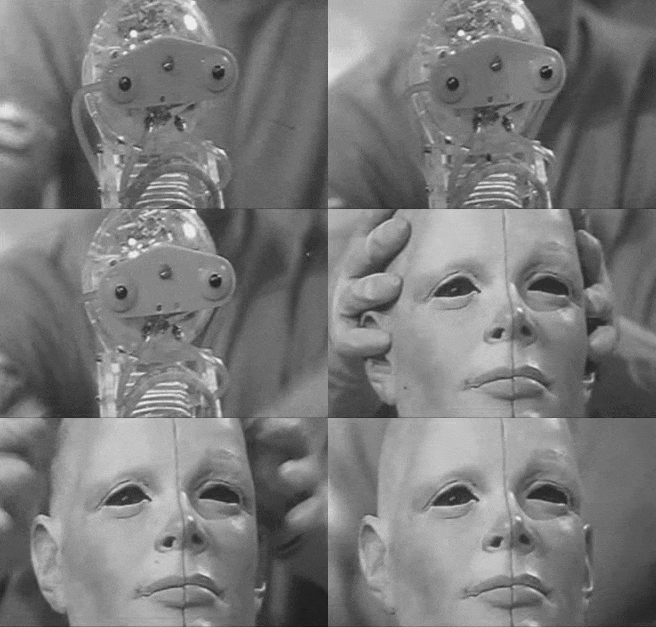
“You just can’t differentiate between a robot and the very best of humans,” argues Dr. Lanning, director of U.S. Robots lab in Isaac Asimov’s I, Robot. This, stated in a movie, made in 2004 has become a reality.  Ten years after “ I Robot”  was produced,  according to the article , Turing Test success marks milestone in computing history” , the Turing test was passed. This test, named after Alan Turing, requires computers to engage in conversation with human participants. If 30% or more of the humans believe the computer is a real person, the test has been passed.  In 2014, the 13-year-old bot called Eugene was able to convince 33% of the judges that he was human. Professor Kevin Warwick made the following comment.

“Of course, the Test has implications for society today. Having a computer that can trick a human into thinking that someone, or even something, is a person we trust is a wake-up call to cybercrime. The Turing Test is a vital tool for combatting that threat. It is important to understand more fully how online, real-time communication of this type can influence an individual human in such a way that they are fooled into believing something is true…when in fact it is not.”

The overly trusting slightly naïve part of me is feeling a few twinges of concern. My baby blue perch not feeling as comfortable as before, I sit up and click the next link…… https://hapgood.us/2019/03/28/network-heuristics/

A few moments later I am reading an article written by Mike Caulfield on a researcher named Maisy Kinsley. I begin and am led into a tale of deception. Maisy Kinsley does not exist. Fake profiles on multiple social networking sites and an image generated by machine learning has brought Maisy Kinsley into existence. Caufield goes on to detail how easy it is to create a fake identity online and explains how people believe that they can tell if it is fake or not, but often their biases get in the way. He then goes on to discuss how he would make a point to show colleagues or students a site, ask them to identify why it was fake (to which they would list off a multitude of reasons ) and would then go on to tell them that in fact the site was real. Incredibly, a percentage of the people he did this to would not believe that it was a real site despite all the evidence he presented. In fact, they would vehemently disagree.

As this point, I get out of the chair and begin to pace the room.

Bots, trolling bots, bots that communicate like people, algorithms, biases, fake identities, hashtag activism, call out culture, echo chamber….and the list goes on.

I regress back to another article I read, “The Rise of Social Bots”. This article looks specifically at social bots, discussing the helpful or benign ones and then leading into a discussion of the malicious one and the damage they can cause: influencing the stock market, influencing the election, cybercrime, reputation destruction. According to the article, “These  bots  mislead,  exploit,  and  manipulate  social  media  discourse  with  rumors,  spam,  malware,  misinformation,  slander,  or  even  just  noise.”


The article claims that bots can:

  1. Search the web for information to build fake profiles.
  2. Post material to their profiles in a manner similar to humans.
  3. Converse with people through social media
  4. Strategically gather new followers.

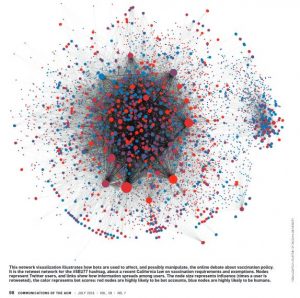
The image below shows, ” the retweet network for the #SB277 hashtag, about a recent California law on vaccination requirements and exemptions.” The red dots are highly likely to be bot accounts.….scary….


And I pause again…….

I filter through all the information I have read and received over the week and glance over at the blue chair in the corner. And suddenly I come to a realization. I need more, now than ever to be engaged on Twitter, to continue to educate myself on social media, to continue to share and to be a part of the discourse around these issues.

I now know that best thing I can do for my students in regard to this is to keep engaging on Twitter, to keep learning and to pass this knowledge to them.  As Mike Cadfield said,


“knowing what is trustworthy as a sign on the web and what is not is, unfortunately, uniquely digital knowledge. You need to know how Google News is curated and what inclusion in those results means and doesn’t mean. You need to know followers can be bought, and that blue checkmarks mean you are who you say you are but not that you tell the truth. You need to know that it is usually harder to forge a long history than it is to forge a large social footprint, and that bad actors can fool you into using search terms that bring their stuff to the top of search results.”…………..“they need to be taught. Years into this digital literacy adventure, that’s still my radical proposal: that we should teach students how to read the web explicitly, using the affordances of the network.”

Network Heuristics (2019)

Students need to be taught these skills at schools in classrooms. This is important. This is digital literacy. This is discourse connected to content that affects students, that will affect their futures. Educating students creates knowledge and critical thinking skills that will help them to be better prepared for the 21 century.

I head back and resettle myself in my chair; tuck my pillow, that now shows a hint of color, beside me and get ready to learn, share and educate.

When I wander into the room now, I am no longer surprised.  It looks like the chair is here to stay

Recourses for Educating Students.

https://webliteracy.pressbooks.com/

https://www.aascu.org/AcademicAffairs/ADP/DigiPo/

Machine Learning: Create a fake identity

Publication

Web Literacy for Student Fact-Checkers  (Caulfield, 2017)

Additional Readings (retrieved from Web Literacy for Students site)

Evaluating information: The cornerstone of civic online reasoning. — Stanford History Education Group. November 21, 2016.

Why students can’t Google their way to the truth: Fact-checkers and students approach websites differently. — Sam Wineburg and Sarah McGrew. Ed Week. November 1, 2016.

The challenge that’s bigger than fake news: Civic reasoning in a social media environment.— Sara McGrew, Teresa Ortega, Joel Breakstone, and Sam Wineburg. American Educator. Fall 2017.


Knowledge is Power: “Scientia Est Potentia (1A:Week 2)

Reflection on the use of social media, video, animation, research methods and literature reviews through a discussion and analysis of, Public comment sentiment on educational videos: Understanding the effects of presenter gender, video format, threading, and moderation on YouTube TED talk comments”. Veletsianos, G., Kimmons, R., Larsen, R., Dousay, T. A., & Lowenthal, P. R. (2018). 

The topics and research reviewed this week led me to a discussion of this paper as I made connections with the ideas presented and discovered applications that would be useful in guiding my future research as well as current teaching practices. In addition to this, this paper reflected specific topics presented and discussed throughout course discourse this week, leading me to the belief that it would be particularly useful and relevant to discuss multiple aspects of this research.

We were able to have a face to face visit with one of the authors of this paper, George Veletsianos. The visit was beneficial in many ways as we were given the opportunity to engage with him regarding his research through questions and discussions. When discussing the 4 R’s this is directly relevant as it gave insight into who George is a researcher and what has led him to become involved in the work he does. According to his “About Me” page on his blog, one of the larger influences for his work was his parents’ direct experiences with war and their beliefs in education. Veletsianos shared as part of class discourse how within his research he wants to know people and hear their stories. “My research aims to understand and improve teaching, learning, and participation in digital environments” (Veletsianos.com/About Me).  This study does exactly that.

In the introduction, Veletsianos et al (2018) reviewed current literature to provide background research justifying why this study was important and needed.  The discussion of relevant literature led to the conclusion that there was a gap in the research and this experiment was justified in that manner. As a reader, I found this literature review to be interesting in a new way as I was now reading through it with a deepened understanding of what a literature review was. 

After exposing this gap, their research object was stated as follows.

“To investigate these issues, we examined the strength of positive and negative sentiment expressed in response to TEDx and TED-Ed talks posted on YouTube (n = 655), the effect of several variables on comment and reply sentiment (n = 774,939), and the projected effects that sentiment-based moderation would have had on posted content.” (Veletsianos et al,.2018)

The importance of this research is discussed in a practical manner as more and more students, teachers and others are encouraged to go online and to build online digital identities. Further research that outlines these ideas as well as a discussion around the practical implications and application of the findings of this study are discussed. Based on discussions and topics covered this week in class regarding Twitter, Blogging, using social media in the classroom and creating professional online digital identities; I agree, this research and future connected research is needed.  

Sentiment is the topic [term] primarily under investigation for this study and as such Veletsianos et al (2018) spend time discussing the term so the reader is familiar with it. In addition to the discussion of sentiment,  Veletsianos et al, (2018) go on to explore the concept of moderation in depth. Again, as a reader, I am connecting to the literature that is reviewed through these sections.

……I wonder why people choose to post negative comments, I wonder why these begat further negative comments, I wonder about the ease with which one person can post a comment that can make or break another human, I wonder about the disassociation with humanity, the lack of kindness/of thoughtfulness, and then I wonder about the rich and deep connections people build…..

This literature review gives an overview of some of the current and past research associated with both sentiment and moderation as well as some of the general findings resulting from this research further establishing the necessity of the research they are conducting. This is important because it not only gives the reader (myself, and other educators, researchers) a broader understanding of the terms, it also addresses connected and relevant research.

The research investigated Ted-X and Ted-ed talks and resulting comments to answer their research questions. Those researched were not directly impacted in anyway; only data they had posted or responded to was included; personal interviews, questionnaires or any other form of communications with those involved was not a part of this study.  Interestingly, this contrasts with another Veletsianos study we investigated this week: Women scholars’ experiences with online harassment and abuse: Self-protection, resistance, acceptance, and self-blame by George Veletsianos, Shandell Houlden, Jaigris Hodson and Chandell Gosse. This study focused on a small group of participants who were interviewed individually.  In this study, both the researcher and the researched would have been impacted through their participation in these interviews. For the researchers, conducting this research may have provided a sense of connection with these women and a deeper understanding of the issues they had faced/were facing. It may have impacted them on an emotional/personal level. For those researched, the interviews may have become a coping skill itself as their voices are heard (their stories are important) or it may have been therapeutic or may have created further anxiety. Given Veletsianos’s background information as well as insights gained in class, I am curious about his experiences with both studies as the research methodology differed.  I am also curious about whether the unknowing participants of the Ted-X and Ted-ed study would have been affected had the result of this study been shared with them. What, if anything would they change going forward? This would be interesting to explore further.

 Within this study, justification is given for using only Ted-x and Ted- ed talks; however, I do find it to be a limiting factor as they look at only one type of video and arguably, one type of audience. The three research questions for this study were then given:

RQ1. What is the strength of positive and negative sentiment in response to TEDx and TED-Ed Talks posted on YouTube?

RQ2. How does the gender of the video presenter, the delivery format (presentation vs. animation),

and comment threading influence the sentiment of comments and subsequent replies?

RQ3. What would be the likely impact of moderating negative comments upon community participation?

One thing I wondered about these questions is: Are three questions too many to address within a piece of research? Does it make more sense or is it more appropriate to delve deeply into one question? It makes some sagacity to include the first two questions are they are explicitly connected. I do wonder about the reasoning and validity of including the third question as this seems to begat its own study.

My other question, as mentioned previously, was the limiting factor of only using one type of video for the study. I questioned whether it had to do with the amount of data being analyzed but upon further examination of the methods of analyzing the data I noticed that they used a piece of statistical software called “SentiStrength”. “We then generated sentiment scores for all comments and replies in the dataset, by using the open source sentiment analysis tool SentiStrength” (Veletsianos et al., 2018). According to http://sentistrength.wlv.ac.uk/, SentiStrength is capable of analyzingup to 16,000 social web texts per second with up to human level accuracy for English”. In this case, why not analyze a larger data set that includes multiple types of educational videos? Perhaps this had to do with the manual coding that also took place as well as the fact that they were examining both quantitative and qualitative data. This limitation was addressed within their study leading me to the belief that the researchers felt, that despite this limitation, the study would still provide valuable information. Upon reading through their results, I would agree.

 The results of their study are listed below:

1.      Overall, comments and replies were categorized as neutral.

2.      Some video topics were more likely to lead to positive comments and replies (beauty, passion, career) and some were more likely to lead to negative comments and replies (cancer, college, pain).

3.      Male presenters were more likely to receive neutral comments and replies.

4.      Female presenters were more likely to receive positive and negative replies.

5.      “Animations neutralized both the negativity and positivity of replies at a very high rate” 

6.      Positive responses were more likely to lead to further positive responses. The same was true for negative responses.

7.      Comment moderation did not significantly reduce negative responses.

The conclusions went on to discuss each found phenomena in further detail along with potential applications and a call for more research in some of these areas. These results, as the reader and an educator impacted me in multiple ways.  I was surprised, especially given pre-existing research, that the results found for comments overall were categorized as neutral overall. I wonder if the researchers had chosen to view multiple types of educational videos, if these results would be the same. I also wonder, if other educational videos were examined, perhaps the same results would be found as it may be that all educational videos would have the same specific type of viewer. I found the results regarding topics interesting. This could lead to a greater understanding of what topics may cause negative or positive responses within the classroom OR when educational videos are viewed. The information regarding gender is applicable in many ways, both as a female venturing into the online world …..this can feel scary at times…. and as a teacher with both male and female students. It is important to understand that online experiences for males and females is not the same. It is also important to remember that social media as a tool can be both a positive and a negative experience. This reminds me of a recent twitter feed post:

Relevant read from this week’s classes. #tiegrad @veletsianos @ChristineYH
This is important. When I teach about academic blogging now, I highlight the benefits of social media but also mention the drawbacks and make it clear that no one should feel obliged to engage with social media. #femedtech twitter.com/KAMWright/stat…


I think this post contains vital information. It is so very important to remember that no one should feel obliged to engage with social media.  I view this idea with a new lens now as recently, as a result of discussions and readings in class, I had begun thinking of the ways I could incorporate social media in my blended and online classes as a means to engage, promote discussion and community within the online learning environment.  Keeping this idea close as I begin to explore the use of social media in my classes is very important. This also connects to concepts and ideas presented this week in class through both the readings on privacy and through the information shared by the guest speaker Jesse Miller from Mediated Reality

One idea for application that arose as part of this study is student use of animations to share information rather than a video or live presentation of themselves. This eliminates the male/female phenomena and, according to research presented as part of this study, also creates anonymity which can increase overall participation. This would benefit the student as they would be given a voice. This would benefit other students in the class as they would have new ideas to listen to.  And with that I circle back to my thoughts at the beginning and my purpose for writing; that of knowledge.

Knowledge is power. Education is power.  

Media, Social Media, Apps, Social Network, Facebook

Image from Pixabay