
Photo by Johannes Plenio from Pexels

Month: December 2019

Reflecting on Theories and Practice in Online Learning


GIF from @GIFY by @criswiegandt

It was with great earnest that I began to survey the weeks reading’s, questing for the magical bean that would thereby only need to be planted to sprout into something of enormity that would transform the landscape and potentially lead to magical kingdoms in the sky.  And, while the readings produced some concepts of interest that may begat further study, the magical bean was left uncovered.  The sections below are my attempt to make sense of this literature and to determine its potential usefulness or,……. uselessness.

Key Reading Points:

Reading 1: Learning Design and Open Education

This article, by Conole (2018) examined the design of open education (MOOC’s and OER’s) and, the author argues that more engaging designs are needed, a comment I would agree with.   A comprehensive look at the in’s and out’s of both provides the reader with an understanding of how each works, who uses each, what the barriers are and finally, why they are important.  Also included is a detailed discussion around learning theories. One visual by Millwood that was included in this article and posted below; while, overwhelming to say the least, outlines these theories.  If you are finding this hard to read and digest, it is more than just the terrible pixelation; here is a direct link, should you wish to peruse each in further detail.   Learning Theory Diagram
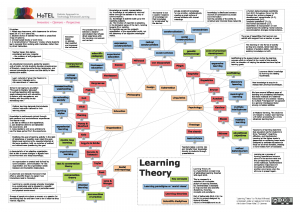


What is even more amazing is the number of pieces represented within this diagram; it truly illustrates the complexity of teaching and learning.


Reading 2: Pedagogical Models for E-Learning: A Theory-Based Design Framework

“This paper presents a theory-based design framework for E-Learning that emphasizes the transformative interaction between  pedagogical models, instructional  strategies, and learning technologies” (Dabbagh,. 2005, p.25).   After reviewing a number of theories, Dabbagh argues for distributed cognition to be used as the basis for E-learning.  Dabbagh names three interconnected components required for effective implementation of E-Learning in connection with this : (1) pedagogical models or constructs, (2) instructional and learning strategies, and (3)  pedagogical tools or online learning technologies.  Dabbagh goes on to list a vast array of strategies, strategies that one could argue could also be connected to effective teaching in any situation, online or otherwise:

“(a) promoting or  supporting  authentic  learning  activities;  (b)  facilitating  problem-solving,  exploration,  and  hypothesis  generation;  (c)  promoting  collaboration  and  social  negotiation;  (d)  supporting or facilitating role-playing activities; (e) promoting articulation and reflection; (f)  supporting  multiple  perspectives;  (g)  supporting  modeling  and  explaining;  and (h) providing  scaffolding.” (p.33)

This paper also illustrates the complexity of teaching, and the quest to find a fitting framework for E-Learning.  As a nice addition, the author provides specific examples for each strategy.  These specific examples may be helpful for all teachers, not only those who teach in an E-Learning environment.

Reading 3:  Teaching online is different:  Critical perspectives from the literature

Although based on higher education, this paper by Shé Ní, C., Farrell, O., Brunton, J., Costello, E., Donlon, E., Trevaskis, S., and Eccles, S. (2019) posited some interesting discussions and information connected to online teaching, online learning and the online teacher.  While many of the strategies mentioned would be applicable regardless of the teaching environment, the authors do include aspects that would be unique to the online environment.  One large consideration, when teaching online, are the skills needed, not only to run the class, but also to build and change courses.  While we received little connected training on this at the school I currently work at, I am curious if other schools provide training, or if this is something typically only provided to those teaching higher education.

Also, as an online teacher, I found that some of the points made within this paper did not apply to my situation. For example, discussions around the inflexibility of the curriculum; not an issue in my workplace as we have full control over the content and the teacher has the authority to add, omit and adjust as needed.  I believe that the larger challenge here is the teacher time it takes to create and modify courses, and the little time given to teachers to do this.  Another point I connected with that was brought up within this paper, something that can be a quite a challenge, is accessibility.  While this paper speaks to the importance of the accessibility of the teacher, one might argue that the accessibility of the student is equally important when it comes to success within the course.  In the Moodle learning management system (LMS) we use, teachers and students have the ability to message each-other through the Moodle message system; however, one may wonder if there is a more effective messaging system that could be used as messages are often not responded to (in my experience with messaging ‘absent’ students).  As students are not in front of you, it can become very challenging to help them to complete and submit assignments; perhaps a more effective messaging system or other forms of collaboration/community building could help with this.  While these may be applicable and perhaps even necessary in high-school education, I wonder about the applicability of collaboration and community building within higher education, and would argue that while specific courses and programs lend themselves to this, others may not.  I found it interesting that within this paper, as has been mentioned in a number of papers viewed recently, the TPACK model was mentioned as a possible construct for online learning and teaching. To see more of my thoughts and further details on this model, follow the link here.

Reading 4:  Mapping Pedagogy and Tools for Effective Learning Design. 

This paper by Conole, G., Dyke, M., Oliver, M., and Seale, J. (2004), looked at effective pedagogy and design by examining existing theories and models and their application to E-Learning.  Within the discussion, overview charts were included that contained specific details connected to a variety of theories and models. The framework in Figure 2 below,  was used in conjunction with learning theories mentioned: behaviourism, pre-conscious learning, reflective learning, experiential learning, learning in HE, conversational framework and communities of practice. The concluding thoughts presented are that the provision of a model such as this will give teachers a practical framework to help them navigate the many existing theories and models which may result in more thoughtfully informed pedagogy within an online construct.  One benefit this framework may have is its apparent simplicity.
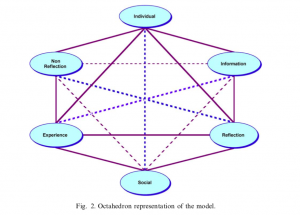
 

(p.24)


Now WHAT?

After reflecting on this week’s readings, I would like to spend further time exploring some of the strategies included within these papers, a perceivably daunting task, to see if I can find ways to further develop, embed and include them within both the face-to face classes I teach and the online courses. While I often reflect on the pedagogy and strategies I use within the classroom, my reflection connected to the online components has primarily been connected to the content.  Advances within the constructs and capabilities of the LMS system we use as well as thoughtful changes in the way I deliver both the face-to-face and online content, may allow for the creation of learning experiences that are more authentic, collaborative and engaging; and, that combine elements of the online and face-to face world in an effective, pedagogically based construct.

Perhaps the magical bean will be uncovered.


References

Conole, G., Dyke, M., Oliver, M., & Seale, J. (2004). Mapping pedagogy and tools for effective learning design. Computers & Education, 43(1–2), 17–33. Retrieved from https://doi.org/10.1016/j.compedu.2003.12.018

Conole, G. (2018). Learning Design and Open Education. International Journal of Open Educational Resources. Retrieved from https://www.ijoer.org/learning-design-and-open-education_doi-10-18278-ijoer-1-1-6/

Dabbagh, N. (2005). Pedagogical Models for E-Learning: A Theory-Based Design Framework. International Journal of Technology in Teaching and Learning, 1(1), 25–44. http://citeseerx.ist.psu.edu/viewdoc/download?doi=10.1.1.475.4593&rep=rep1&type=pdf

Huston, L (2019). Drip, drip, drop…. Models for technology integration (TPACK and SAMR). Teacher Talking Technology. Retrieved from https://teachertalkingtechnology.opened.ca/2019/09/23/drip-drip-drop-models-for-technology-integration-tpack-and-samr/preview_id=342&preview_nonce=20a83893c3&post_format=standard&_thumbnail_id=-1&preview=true

Millwood, R (n.d). Learning theory.  Retrieved from https://proto-knowledge.blogspot.com/2015/09/overview-of-theories-of-learning.html

Shé Ní, C., Farrell, O., Brunton, J., Costello, E., Donlon, E., Trevaskis, S., & Eccles, S. (2019). Teaching online is different: Critical perspectives from the literature. Retrieved from Dublin City University website: http://doras.dcu.ie/23890/

Wiegandt, C (n.d). Tree growing GIF. Retrieved from https://giphy.com/gifs/plant-leaves-world-environment-day-ZZweDJbmPPLYiwQuf9

 

Openness: A philosophy

Photo by Alexandre Godreau on Unsplash

“Open education is a philosophy about the way people should produce, share, and build on knowledge.” – What is Open Education?

My post this week was inspired by the articles:

Reflecting on the Impact of the Open Education Movement and Open Educational Resources: New Possibilities for Change and Sustainability

My purpose for writing this post is to begin to explore open education more thoroughly, to look at debates around open education and to the determine the importance of it and the reasons for fighting to to keep it around. My feelings, after reading these two articles is that open education is important from a practical as well as a philosophical point of view and, it is important to keep around. If, in fact , the sustainability of open educational resources is in question as mentioned by the article,  Open Educational Resources: New Possibilities for Change and Sustainability what can be done to ensure its continued success?

As if my thoughts were somehow overheard by the Twitterverse,  or is it Twittersphere?……. my twitter feed seemed to suddenly erupt with tweets connected to this very topic. Whether this was coincidental, the watching bots or, more likely that I was more attuned to anything that popped into my sphere connected to open learning is is yet to be discovered ; however, it did lead me to search Twitter for some open Ed resources I could follow. These are listed below.

Open Praxis
@ICDEOP Peer reviewed journal from @icde_org hosted by @uned
“Creative, innovative research; challenges, lessons, achievements in the practice of distance and e-learning”
ICDE International Council for Open & Distance Ed.
“International Council for Open and Distance Education. Global membership organization for online, open, distance and flexible education.”
Open Education at UCL
“Embedding #OpenEducation practices and piloting OpenEd@UCL,@UCL’s repository for #OER.”
Center for Open Education Research (COER)
“Increase international collaborative research projects, innovation & understanding in #OER, #edtech, #lifelonglearning & international education.”
COT Open Education
“Future = open education. Democratizing textbooks”
KPU Open Education
“KPU is BC’s leading adopter of Open Textbooks and home of Canada’s first Zero Textbook Cost programs: kpu.ca/ztc
OER Commons
“Public library of open educational resources w/platform for content authoring & remixing. Educators empowering educators to share & improve OER since 2007.”
Una Daly
“Director, Community College Consortium for Open Educational Resources, Open Education Consortium. Instructional Design and Accessibility Interest.”
OEConsortium
The Open Education Consortium is a worldwide community of hundreds of universities and associated organizations committed to advancing Open Education worldwide
Open Education Week
Open Education Week is a global, community event that seeks to raise awareness of the benefits of Open Educational Resources and open educational practices.
Open Educational Resources (OERs)
Collection of Open Educational Resources #OER #OERs


I’m anticipating that my understanding around open access will broaden as a result of following these feeds; along with the associated websites/blogs.

I think that most would be hard pressed to argue against quality education for all,  shared knowledge, reduced costs to students (open textbooks), richer and more diverse resources and the other benefits that come with the open movement; however, there are critics and, there are reasons why articles question the sustainability of openness.  It appears that the largest issue connected to the open movement is money.  If we are talking about someone’s livelihood, how do we ensure that the individual receives monetary compensation while still allowing for free access to quality materials/ resources? How do operating costs get paid? Where does the money come from?

I am curious to see what will transpire in the future.


Into the past: Exploring open and distance learning

“Study the past if you would define the future.”
― Confucius

This weeks research articles all contained historical aspects connected to open and e-learning; it makes sense to explore and understand the history of something before touching on the more current research. Whilst delving through these readings, posting and responding to the reading and comments on hypothes.is, I realized that before compiling this week’s post, I needed a better understanding of the definitions and terminology presented. While I have a good understanding of the terms online learning, distance and blended learning, particularly due to the school I work in (U-Connect); some of the other terms, I had rather fuzzy understandings of.

The first web page I encountered in my search appeared to contain the information I was seeking, so I decided to start here. I would like to reflect back on these terms to see if I would add anything to them or adjust them in any manner as I go through the material in the course.

e-Learning: I found it interesting that within this page, Bates ( 2008) identified it as encompassing all types of learning that have a digital component.

MOOC’s: “massive, open, online courses” (Bates, 2008).  These courses are free to take (although you may have to pay for a certificate at the end) and have no academic requirements but do not allow users to gain any credits (although it appears that for some you may receive a certificate). It seems to me these courses would be useful or certain things but also limiting as, based on this definition you would not be able to obtain a degree through the use of a MOOC. I am going to add onto this definition with some more specifics from one of the articles read this week;   Mapping research trends from 35 years of publications in Distance Education  where Zawack-Richter and Naidu (2016)  discuss two types of MOOC’s: cMOOC’s ( collaboration between teachers and learners) and, x MOOC’S run by experts (contains lecture videos, forums and quizzes).

Open Learning: This seems to be more of a philosophy for education where barriers are removed thus giving everyone an equal opportunity to learn.

Open Educational Resources (OER) Free digital learning material. This seems to be very connected to open learning in that if everyone has access to learning materials, it gives everyone an equal opportunity to learn.

Distance Education: “Students can study in their own time, at the place of their choice and without face-to face contact with a teacher” (Bates). An important distinction is made by Bates when he states that “distance education programs may not be open”. One example he gives is of UBC where students must meet the same admission requirements as a student attending a traditional face-to face class.

Flexible Learning: Creates increased access and openness as if allows for flexibility for the learner. May manifest in a variety of different ways.

I also looked up open university and retrieved this information from Wikipedia.

“An open university is a university with an open-door academic policy, with minimal or no entry requirements.[1] Open universities may employ specific teaching methods, such as open supported learning or distance education. However, not all open universities focus on distance education, nor do distance-education universities necessarily have open admission policies.[2] “  

This sounds pretty fuzzy to me still………but it appears the big factor for an open university is the lack of admission requirements.

One of the articles we looked at, Mapping research trends from 35 years of publications in Distance Education by Olaf Zawacki-Richter and Som Naidu (2016) found trends in the research around distance education connected to “professionalization and institutional consolidation (1980–1984), instructional design and educational technology (1985–1989), quality assurance in distance education (1990–1994), student support and early stages of online learning (1995–1999), the emergence of the virtual university (2000–2004), collaborative learning and online interaction patterns (2005–2009), and interactive learning, MOOCs and OERs (2010–2014)” (245).  One point the authors made that seems to be consistent in all of the literature I have looked at as well, is that predominantly all of the articles looked at higher education. The challenge here is, as a high-school blended- learning teacher looking to improve my practice, often what applies in higher education does not apply in high-school.  While there are still valuable connected learnings, this is, in my opinion a gap in the literature that I hope will be addressed in the future as more high-schools take on a blended approach.

Another connection I made to the article was around their discussion of attrition rates and how high they were in distance courses as opposed to the traditional courses. This is a concern where I work as well as the students enrolled in online courses only also have a higher attrition rate than our blended students. While this shows support for adding in components like synchronous learning, the authors make a good point when they discuss how this in a way defeats the purpose of distance learning as it takes away the flexibility and openness of it. While this is true, I wonder about how to balance this out within high-school courses as we do want the kids to be successful and for some students it may be argued that too much flexibility and openness leads to a lack of structure and accountability that may be needed for them to be successful. As quoted in the article, “Early in 2000 Garrison, Anderson, and Archer developed their widely cited community of inquiry model, which posits that learning occurs through the interaction of social presence, cognitive presence and teaching presence in computer conferencing educational settings (Garrison, Anderson, & Archer, 20002001).”.  If this is the case then perhaps, for high-schoolers at least, we should find a way to build in further social presence and teacher presence in fully online classes.

A couple of other interesting points brought up within this article was (1) when the authors referred to how open learning really is when learners a) need to be able to read and write and, b) are judged by western standards; and, ( 2) the comment about how “learners and instructors use and interpret silence”  ( i.e. non-participation, confusion, or thoughtful reflection) (260 ).  This point was interesting and one this I would like to explore further to determine what online silence means. Our LMS allows for us to collect user data on what they view, how long it is viewed for, how long they were logged in, or if they have not been logging in at all. I wonder how this data could best be used to help students be more successful when working at home.  When thinking back on the reasons for silence, a student who views the same content multiple times may be confused or may need more time to fully understand a topic.  I  also wonder how the age of the learner might come into play here as the high-school students I teach could fall equally into all three categories. I would say that most often in the classroom it would be “confusion”, while most often at home it would be non-participation. I like how they talk about the interpreting silence as it is applicable in both face to face and online teaching. For me, online silence would look like; kids not viewing the course and course contents, not reading messages and not completing their assignments. I wonder what would be the best way to discover if they are confused or just choosing not to participate as sometimes students do not like to share that they are confused.

As a whole, this article, while addressing research over the 35 years, also highlights how long some of the research has been going on for. While some have changed over time, most of the concepts researched, even those from earlier time periods are still topics of research today.

For the following two articles, I have included ideas from the annotations I created in hypothes.is.

In the article, On the role of openness in education: A historical reconstruction,  (Peter & Deimann, 2013), the authors discuss open education and the history of open education. Some of the points I connected with were as follows:

  1. The exact form that learners would choose (or not) to provide support for their individual learning is hard to infer. There is a risk of assuming that all learners require, or even prefer to be part of a larger community.” ( p.12 )

I found this interesting because the mini lit review I recently completed provided support for the idea that creating a community may lead to higher levels of engagement, satisfaction and success.  But, I then wondered,  perhaps some learners only want to learn a specific skill, for example, required for their jobs; and, as a result would rather not have the interactive community component. Potentially, one could theorize that including this component would add time to the course whereas, without it once could complete the course in a more efficient timeframe.  I think this depends on the age and the course. Adult learners should be given the choice while high school students may have greater success when involved as part of a community.

2. I found the discussion around open learning and money interesting. This led me to do some further research on some of the platforms mentioned in the article.  One platform I spent a little more time looking was Coursera. Coursera earned around 140 million in 2018; according to Forbes; definitely a lot of money involved here (Shah, 2018) . I looked at the cost for courses and while not free, they appeared to be substantially less expensive than most brick and mortar courses. This got me thinking about access, as online courses create access for a larger populations than standard courses. And as they often do not require any transcripts/pre-requisites, this again creates greater access and potentially provides personalized learning as you don’t have to take A to take B. The costs involved in taking these course would then be a limiting factor as again, some may not have the money to take a course. I’m also curious about the free courses and if they are comparable to the ones that students have to pay for…. I also wonder if our government would ever fund open access so that education could be free to all who wanted it? Is this even feasible?


The final article, Twenty years of EDtech, (Weller, 2018) provides a quick overview of some of the changes in edTech from 1998-2018.

I connected with the following key points:

  1. In 2016 several people independently approached me about blockchain—the distributed, secure ledger for keeping the records that underpin Bitcoin. The question was always the same: “Could we apply this in education somehow?” ( p)

Block chain was new to me and I wondered, Would this be more applicable for higher education? Is this being used in any universities? It sounds like it’s similar to some of the other ideas mentioned, but rather than a singular component it contains multiple components in one place with higher levels of security. Is it possible for something like this to address privacy issues/concerns in education? This is a big concern within my district as I’m sure it is in many others. If the use of blockchain would allow students to privately use online apps/ social media tools etc, I could see it having a future in education.

Again, as repeated in multiple articles and, something I’ve reflected on before in my blog posts is the ideas that trying to be constantly on top of new technology and trying to incorporate the newest greatest thing may also lead to the use of technology for technologies sake rather than for pedagogical reasons.  This may also lead administrators to purchase equipment that is never, or rarely used.

As I  use a LMS within my job, I found it interesting when the authors discussed the limitations of LMS’s.  The LMS we use also has limitations which can be frustrating for teachers as some programs are not compatible/embeddable within this system. However, the options for change are limited and building a new system is something that requires time and skill.

Now What?

While portions of each article were redundant in that some of these topics are common themes within research, the historical aspect was interesting and there were some components within each that had me thinking about my teaching as well as some further directions I could take with my research.