Photo by Johannes Plenio from Pexels

Category: EdTech Research

Week # 6 Post: Journey On


Photo by Pixabay from Pexels

And the journey continues………

This week we continued to explore the role of technology in education through summarizing and discussing a few connected articles from the “Second Handbook of Information Technology in Primary and Secondary Education“. 

After viewing the videos and summaries, and reflecting back on my prior posts, a few things stood out to me, and, I believe I have, as a result of this, created a new vision for myself as far as what I want my teaching to look like as well as what direction I would like to take with my literature review and further research.

A few things I found interesting….

One thing that I found interesting, particularly given that some of the groups discussed the use of games and multimedia, was the distractions I experienced as a viewer of these videos. One video in particular that affected me this way was the one created, appropriately, by the group ” Advanced Principals in Multimedia Learning”. The video contained, what I know was a very informative dialogue; however, with all of the exciting “Star Wars” action in the background, I’m sure if asked about the video after viewing it, I would only be able to tell you that it had to do with multimedia. I wonder about the intentionality of both the assignment and the way this particular assignment was put together as I received a very practical lesson in what happens to learning when cognitive overload in one domain occurs.  Interestingly, in addition to this group, a few other groups touched on this concept as part of their topic summaries.  One other group that that discussed this was the group that covered “The Basic Principals of Multimedia Learning “.  In their discussions around the “Split Attention Principle”, “Modality Principal” and the “Redundancy Principal”, they noted the benefits of mixed mode media but also discussed the negative impact of an excessive cognitive load.  When students experience excessive cognitive load due to the amount and type of media, learning will be hampered; sometimes, presenting information using a singular mode will be the most effective. I’m sure Clarke would have some thoughts regarding this!  One other interesting point this group made was in their discussion around the ” Signaling Principal”, in connection to eye tracking and fixation in order to lessen cognitive load.  I found the topics covered by this group to be both interesting and practically applicable. I would like to explore this area further to ensure that I am using best researched practices when it comes to using multiple forms of media. 

Photo by Pixabay from Pexels

Some commonalities…

Amongst the groups and sections reviewed, there were a few other commonalities that came up connected to teachers/schools inability to keep pace with new technologies, their uses/implementations and the lack of teacher training. The section we summarized also spent time discussing this along with the mismatch between how teachers think they should be teaching and how they are teaching.  These ideas were also mentioned in connection with assessment in the sections reviewed in the Technology and Assessment in the 21st Century group.

Technology and assessment…

Assessment is arguably a current hot topic when it comes to teaching and what is best for students. I often see Tweets connected to assessment and to what makes good assessment on my Twitter feed; the section we reviewed as a group also pointed out that assessment is one of the areas that needs significant revamping when it comes to 21st Century curriculum so I felt it important to include this within my post. The group that summarized information connected to Technology and assessment in the 21st Century discussed some of the technologies available to be used for assessment, particularly those built into games. They also note that technology is underutilized when it comes to assessment. 

My connections to technology and assessment may perhaps be different from many educators due to the platform we use to manage our classes. The assessment that is built into the courses may be different than traditional assessment as some assessment and feedback is instant.  Tests that contain multiple choice, matching or true and false questions give immediate feedback to the students as they self mark as soon as they are submitted. They also give immediate feedback to the teacher as the results clearly identify mastery as well any concepts that the class as a whole may still be struggling with.  Feedback can also be given in the form of feedback files; students are able to review the work they submitted along with corresponding comments.  The group that discussed Assessment in the 21st Century, ” Using Information Technology for Assessment: Issues and Opportunities”, also discussed the use of  video, text or audio to provide feedback. The options of video or audio is something I would like to explore further as the Moodle platform we use would have the option to upload video or audio feedback files for students instead of, or in addition to, text based feedback files.  I wonder about the benefits of some of these other options.

A connected podcast I listened to this week ( “On Purpose with Jay Shetty”. Laurie Santos: ON Teaching the most popular class at Yale University) discussed grades in relation to satisfaction and concluded that students who strive for A’s are the least satisfied/happy and enjoy learning the least…...interesting...…..  .  I am curious about assessment as a whole and would like to research this area further. 

Other thoughts….

Our group in particular discussed 21st century skills and the need to keep pace with technology as well as including curriculum that prepares students for the world they live in now and the one they will live in in the further.  One of the groups mentioned that current employers and employers in the future are looking for problem solvers, a 21st century competency.  This led me to wonder about teaching kids to develop problem solving skills, and about 21st century skills and the role of assessment. I wonder how to best sort and determine what is most useful when it comes to tech so that I am not using it just for the sake of using tech; and, that I am considering cognitive overload. I wonder about digital literacy and teaching this to students; training students to filter and to be critical viewers of information. I wonder about fostering self-regulation and self-motivation. And, I wonder about how Professional Development can be changed to reflect the needs of the teachers and students.

I found myself very interested in some of the research shared by the group that examined, ” The Learner and the Learning Process”.  I would like to further explore a few of the articles included by this group: the research article connected to technology and the enabling of collaboration “Computer-supported argumentation: A review of the state of the art.”, “Location matters: Leveraging knowledge building with mobile devices and web 2.0 technology.” ;
and, the article, ” A model driven framework to address challenges in a mobile learning environment”  that examined a newer model connected to incorporating technology, specifically mobile learning.  This article may have some application possibilities for the program I work in. 

Questions…

A few questions/ideas I have connected to topics presented by groups are:

What is the best way to implement technology and to make sure that I am including it with purpose? What is the framework I could use to guide my teaching? Is there one or should a combined method work best?

What is a way I can use the Moodle course platform to build on the idea of pervasive learning? Are there other tools I can use to build pervasive learning into my courses? How can I use this to create and foster community and collaboration?

When using online platforms, how do we protect student information?

I like the idea of community building within a classroom/cohort/school conjoined with technology while simultaneously building 21st century skills ….

This all led me to…….

Collaborative Cross-curricular Instruction using Technology and Mobile (Pervasive) Learning

These are some connected articles that I would possibly like to explore further as part of my Literature Review

Teaching in a Digital Age: How Educators Use Technology to Improve Student Learning

Computers and the Collaborative Experience of Learning  



Twenty First Century Cirriculum

Continuing to journey through the vast and cavernous world of technology and education, this week, we examined a section from the “Second Handbook of Information Technology in Primary and Secondary Education“. Below is a summary of one of the articles from the second chapter.

“Twenty First Century Curriculum: Issues and Challenges”

The article, “Twenty First Century Curriculum: Issues and Challenges” by Joke Voogt and Ola Erstad (2018), addresses some important topics connected to current curriculum and future curriculums. They explore the findings of meta reviews in order to answer their key question:

1.      What should be taught and learned in school curricula in the 21st Century?

Within this question Voogt and Erstad (2018) explore what “the key competencies important for the 21st Century” are, “ roles for new technologies in the curriculum”, connected issues and challenges and “new perspectives on curriculum and curriculum development”.

Voogt and Erstad (2018) discuss rationales for curriculum change and identify a variety of key competencies, skills that should be taught and learnt in the 21st Century; these are some of the main ones they identify:

1.      Ways of thinking (Creativity and innovation, critical thinking, problem solving, decision making, leaning to learn, metacognition)

2.      Ways of working (communication, collaboration)

3.      Tools for working (Information Literacy, ICT literacy)

4.      Living in the world (citizenship, life and career, personal and social responsibility- including cultural awareness).                                                                                                  (p. 24)

They note that, “Assessment is key and important for creating these transformations” (24); that, “the core idea of what we do as educators has not changed”; and, they present an interesting point when including a study that argued that students still need to know content in order to be able to obtain deep understanding. 

In order to successfully implement these, Voogt and Erstad (2018) note that, “technology as a tool [can] support the acquisition and assessment of 21 century skills” ( 27) and can create learning that is both personalized and differentiated.

After defining what should be taught and why, Voogt and Erstad (2018), discuss the roadblocks connected to changing and implementing these ideas. They discuss the mismatch between research on how people learn and how schools are organized, the lack of professional development, the overcrowding of the curriculum, access to and availability of technologies, the differing agendas of  stake holders (public, educational and private), lack of teacher skill, issues connected to assessment and, they present the point that many barriers are “psychological, political and cultural”(23).

Voogt and Erstad, note that many countries have or are in the process of changing curriculum to meet the needs of 21st century learning, but they note progress is slow and that most uses of technology are still just a means of “increasing the effectiveness of traditional approaches”.

Some recommendations they make, based on the research, is the inclusion of interdisciplinary learning, further research and discussion around “ what can and should be attained by students of different ages and across educational levels”, the imbedding of digital literacies within all subjects, pervasive learning and the building of “strategies for implementation and assessment”

They conclude with final thoughts on the “future of the curriculum in the digital age” and discuss some important questions: “What does the implementation demand from teachers, administrators and others? What supports do teachers need? How prepared are they? How [can] Information and Communications Technology (ICT) can contribute to bridging the formal and informal? And finally, how [does] the integration changes the what and how of what is being taught?”

My Thoughts and Questions

  1. How do we bridge the gap between what teachers believe they should be teaching and what they are teaching?
  2. Would the introduction of specific technology during staff meetings by administration help to foster further use of technology in the classroom?
  3. How can professional development  PD) change so that it is better at addressing the current needs of teachers? Or is this moving to (PL)?
  4. How do we change assessment?
  5. How can teachers best determine what technology to use in the classroom?
  6. How do models like TPACK and SAMR connect to these readings? Can the use of such models help to bridge the gap?
  7. The curriculum here has changed in the last few years. Other countries, for example Norway, made the changes a decade or more earlier than here in Canada. Can lesson learnt by this country be applicable here?

This reading also left me particularly interested in assessment strategies. This may direct my further research as I would like to explore this topic further. I wonder also about the concept of “ungrading” and how this fits with 21st century curriculum and how this might connect to technology…….

Infographic below is a summary of the articles looked at within my group this week.
Summary created and complied by myself, Faune Nicolas and Rochelle Smith.


Drip, Drip, Drop…..Models for Technology Integration (TPACK and SAMR)

My last post discussed best practices for teaching in the 21st century with a focus on the necessity of including technology. It seems natural that this would be followed with a now what?  And, yes that is exactly what this post hopes to accomplish. Now what?

Integrating technology is not easy. In fact, it can be quite difficult, especially if you do not have a lot of tech know how and limited amounts of time and resources. Clearly, this is an area that I have some knowledge of, but in reality, it is a small drip. The kind that clings to the other few water molecules that are still holding firmly to the tap in an attempt to save itself from falling into the depths of the technology pool below, for who knows what lurks beneath the surface.

Well, I’ve fallen in, willingly, and am now faced with the incredible amount of technology options available. Fortunately, there are some models that may be used as navigational guides for technology integration. Two of these models are  SAMR (Substitution, Augmentation, Modification and Redefinition) and TPACK (Technological Pedagogical Content Knowledge). After reading through a few papers, and doing a little googling, these are my thoughts on these two models.

SAMR

The SAMR framework consists of four stages of integration. According to, Romrell, Kidder and Wood ( 2014),  “ the SAMR Model consists of the following four classifications of technology use for learning activities”:

  1. Substitution: The technology provides a substitute for other learning activities without functional change. An example of this might be substituting the reading of a hard copy of a text with the reading of a digital version of the text.
  2. Augmentation: The technology provides a substitute for other learning activities but with functional improvements. An example of this might be substituting the reading of a hard copy of a text with the reading of a digital version of the text but this time the text has hyperlinks and the ability to be an audiobook. So students can listen and read and connect/extend their thinking in other ways through the hyperlinks.
  3. Modification: The technology allows the learning activity to be redesigned.  An example given by   Hamilton et al. (2016) was:  “in a secondary science class an instructor shifts how students learn about light a modification that shifts from showing a diagram of light traveling to providing an interactive computer simulation of light with variables students can change.”
  4. Redefinition: The technology allows for redefinition: The technology allows for the creation of tasks that could not have been done without the use of the technology. Hamilton et al. (2016) gives the example of: “instead of assigning a social studies-based persuasive essay, a fifth-grade teacher requires students to create and present their arguments through individually created and edited videos.”

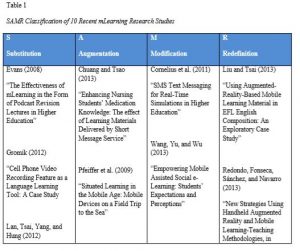
Hamilton et al. (2016 ) and Romrell et al ( 2014) both give examples for each stage of the model and illustrate them as a hierarchy with the modification and redefinition models sitting at the top of the model.  Romrell et al (2014)looked at SAMR and how it could be used to complement/guide mLearning (mobile learning). The authors clearly illustrated ideas for including mLearning across the four levels in the following chart they included as part of their discussion.

The SAMR method seems well structured and clearly defined with the ultimate goal of incorporating technology within the top two levels as often as possible ( Redefinition and Modification). When reading this paper, I felt drawn to what appeared to be a straightforward way of navigating the tech pool. I expected many other educators would agree.  A google search did not disappoint me; the structure seemed to be appealing to many educators. This paper and the ideas presented within in it had me thinking about ways I could include similar activities within my teaching practice, particularly as the students have 1:1 devices. One that resonated with me was the concept of sending messages with definitions at particular times to further facilitate the learning of terminology. While my initial impression was one of excitement and a conviction that this was model for me, further reading and analysis began to create questions and concerns in my mind.

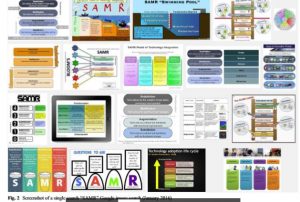
The first concern I had was connected to the push to reach the top two levels. When examining some of the examples given for the top tier as illustrated in Figure 2 above, I began to wonder about the practicality and functionality of this model.  Augmented reality tasks? With what equipment? What training? Software?  Other concerns arose while reading through the Hamilton et al. (2016) paper. While the overall concept and the levels of learning seem straightforward, the image below was included in their paper to show that there are many different interpretations of SAMR and many different illustrations for visualizing how this concept works. Suddenly this model became more complex.

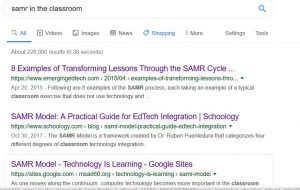
The authors argue that the variety of understandings may lead to misinterpretation. For example, they discuss Brubakers (2013) model of “ SAMR, [where] the four levels represent different types of coffee-based drinks (e.g., black coffee [Substitution]; latte [Augmentation]; caramelmacchiato [Modification]; and, pumpkin spice [redefinition]”. While they argue that the variety of understandings of SAMR may lead to confusion and misunderstandings, a google search of “ SAMR in the classroom” led me to multiple pages that all shared the same information about SAMR. While they state that the multiple modes is a negative aspect of SAMR, based on the google search and subsequent readings, I disagree as all of the models represented bore the same four levels with discussion of how to integrate technology and what each level looked like. As most teachers do not have open access to journals connected to SAMR, they likely get their information from the internet; the search I conducted resulted in a number of similar finds. 

 A few other concerns that were brought up in the Hamilton et al ( 2016) paper caught my attention. One mentioned previously is connected to the hierarchy of the model and the push to move to the top two levels. This is concerning as rather than integrating technology to increase learning or to extend and create new learning, the push to create learning in the top two levels may lead to a singular focus on the technology. They note that, ” In the SAMR model the emphasis remains on the levels of technology use teachers should align themselves with in order to move themselves along the hierarchical continuum of SAMR. This minimizes the more important focus on using technology in ways that emphasize shifting pedagogy or classroom practices to enhance teaching and learning”.  The biggest concern I had after reading this paper was the issue of context. The authors note that,

” the SAMR model includes no accommodation for context. As a result, important contextual components, such as technology infrastructure and resources, community buy-in and support, individual and collective student needs, and teacher knowledge and support for using technology are not recognized.” 

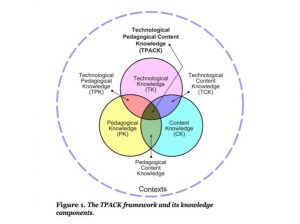
Now unconvinced that SAMR would be the best model, I began to examine TPACK.  The paper, “What is Technological Pedagogical Content Knowledge” (Koehler, M. & Mishra, P. 2009), along with the Hamilton et al. (2016) paper shed some light on the workings of this model.  My initial reaction to TPACK was, what? and how?  As I began to wrap my head around this simple, yet incredibly complex model, I found myself drawn to its underlying principles. The interconnected and overlapping circles of technology, pedagogy and content knowledge made sense to me. The image presented below clearly illustrates the components of this model (Koelher et al. 2009).


One important inclusion within this model that was not included within the SAMR model is context. The model shows that the three components overlapping within context. The authors state that, 


  “ TPACK is the basis of effective teaching with technology, requiring an understanding of the representation of concepts using technologies; pedagogical techniques that use technologies in constructive ways to teach content; knowledge of what makes concepts difficult or easy to learn and how technology can help redress some of the problems that students face; knowledge of students’ prior knowledge and theories of epistemology; and knowledge of how technologies can be used to build on existing knowledge to develop new epistemologies or strengthen old ones.”

The authors go on to discuss the method of using TPACK and clarify that it is a method that is ever changing based on the classroom.  While TPACK does not appear to have the same defined structure as SAMR, it does contain all of the components I believe are essential for effective teaching. It may be argued that the addition of context to SAMR would resolve one of the key issues of this model. In fact Hamilton et al .(2016), noted this when they stated, “this could include adding context as a formal aspect of the framework, as is the case in the TPACK framework”. However, even with the addition of context, the SAMR model still contains some concerning elements. “Moreover, [TPACK] allows teachers, researchers, and teacher educators to move beyond oversimplified approaches that treat technology as an “add-on” instead to focus again, and in a more ecological way, upon the connections among technology, content, and pedagogy as they play out in classroom contexts.”. ” ( Kohler et al., 2009)

Final Thoughts

At this point, my preference is likely quite clear.  I was initially drawn to SAMR. The nice illustrations and what appeared to be clear cut applications pulled me in whereas the fuzziness and dynamic appearance of TPACK felt intimidating, like trying to find my way through a maze with a plethora of options. After further readings, a little googling and some further contemplation, I began to see the potential possibilities of using TPACK as a framework and the limitations of SAMR.  However, while I prefer TPACK as a whole over SAMR, I still believe SAMR to be useful and believe that a combination of the two with TPACK as the guiding structure, would be most beneficial.  Now, armed with a flotation device and a map, I look around, ready to explore the depths; excited to see what lies below.


To Tech or Not To Tech….Is that the Question?


Image by Wokandapix from Pixabay

The debate

Many topics are debated within the education sphere; one that has been questioned for decades is connected to the use of technology in the classroom. Educators, parents, students and school districts all have viewpoints on: if, how much, when and what type of media should be used in education. Historically, two of the loudest debaters of this topic are arguably Richard E. Clark and Robert B. Kozma.  Clark first published “Reconsidering Research on Learning from Media”  in 1983.  About 10 years later, in 1994, Kozma published “ Will Media Influence Learning? Reframing the debate”  . A rebuttal paper, “Media will Never influence learning”  was published by Clark the same year, in the same publication.  The very date on the papers they published may be enough for anyone to disregard them as a whole, for what relevance could paper’s published in 1983 and 1994 have in 2019? In fact, were you to examine the references included to support the claims, one would see that the dates ranged from 1968-1983 (Clark) and from 1957-1994 (Kozma).  The vast changes in technology from these time periods to the current day is considerable and one might question if they are valid at all anymore due to the inclusion of data that is two to four decades old. One may also question if the points they are arguing are even relevant for today’s educational purposes and vision for student success.

After a read through of the 1994 Clark paper, “Media will never influence Learning”  and the 1994 Kozma paper, “ Will Media Influence Learning? Reframing the Debate” ,  I found, surprisingly, that I agreed with some of the points made by both authors. Clark’s point that “part of the difficulty, in my view, is that we tend to encourage students (and faculty) to begin with educational and instructional solutions and search for problems that can be solved by them” may still be commonplace with educators today.  Rather, as educators, perhaps we should be looking to see what the problems are and them look for the best ways to solve them. The needs of the students may best be served by first determining what the objective is (what do I want my student to learn? What skills to I want them to acquire?) and then determining what would be the best solutions, the best instructional strategies to use to solve them. These solutions may involve technology OR they may not. Clark makes another interesting point when he states, “only the use of adequate instructional methods will influence learning”.  I think you would be hard- pressed to find a teacher that did not support the idea that instructional methods influence learning. Today, however those “adequate instructional methods” may include technology.  For some students, the ability to receive instant feedback, to collaborate online, to manipulate an object on a screen, to have text enlarged or converted to speech may be a component of the teachers “adequate instruction”. Clark also states, “however, if learning occurs as a result of exposure to any media, the learning is caused by the instructional method embedded in the media presentation”.  I would agree with this statement in part, although for current times I would extend media presentation to include interactive forms of media as well. I wonder here about the learning that may take place as the result of using media as some skills taught through media could not be replicated with teacher instruction. One example of this is given in the paper,  “The Clark-Kozma debate in the 21st Century”(2010) when Becker says, “there are lessons that simply can not be done without the use of modern technology. It is hard to imagine the space program succeeding without the help of the simulators they used for training.”  Another example more commonly used in the classroom may be when students collaborate through a google doc. The media does not have any instructional method embedded in it; however, students learn how to use the technology and how to collaborate on a topic. Students who do not always have a voice when asked to collaborate orally are suddenly able to share and participate in a meaningful way. Perhaps Clark would argue that the teacher still directs and instructs the learning and therefore, it is the instructional method that leads to learning. While I made some connections to Clark’s paper, and agree with some of the points he is arguing, it seems to me that the arguments as a whole are based on an outdated education system and rudimentary technologies that are so drastically different from today that they cannot be compared to the current education system and its students. 

Clark’s primary opponent, Kozma, also shares points in his paper that I would agree with, although the technology examined in the study again is obsolete in comparison to the available technologies now. Kozma makes a few important points when he says in response to Clark’s 1983 publication, “missing in these studies are any mentalist notions or descriptions of the cognitive, affective, or social processes by which learning occurs”. This point is important as we have come to understand that these processes are an important part of learning. This also makes me wonder what Clark defines as “learning”. Kozma makes another point I agree with when he says, “However as we have come to understand, learning is not the receptive response to instructions delivery. Rather learning is an active, constructive, cognitive and social process.” Kozma, responded to Clark’s claims by stating, “If there is no relationship between media and learning it may be because we have not yet made one.” Clearly Kozma believes that there is a relationship between the two and that it does impact learning. Kozma goes on to say that “Perhaps we should ask, what are the actual and potential relationships between media and learning? Can we describe and understand those relationships?”

A connected study I examined in a previous post, does just this. The study, “Pervasive Learning and Technology Usage for Creativity Development in Education” (Shubina & Kulakli, 2019)  looked at pervasive learning, the benefits of creativity and the use of technology to foster and develop creativity in students by reviewing and analyzing relevant literature. The focus question was: “How [a]technology-pervasive learning environment can enhance stimulation and development of creativity among students.” What the authors concluded was that the research examined showed that there was a, “strong relationship between technology use and creativity enhancement through reinforcing students’ intrinsic motivation, self- regulation, curiosity, self efficacy and knowledge exchange”. A skill like creativity, a 21st century skill considered to be important for student to learn, would likely not have been on the list of skills educators would have taught to students during the time of Clark and Kozma’s debate.

My Thoughts

I think it would be hard to argue that media holds no use in education and I also think it would be hard to argue that we should go back to lectures and notetaking. The world we live in today and the jobs of the future demand that education provide a base understanding of these technologies so that students are able to successfully navigate and enter into adulthood. It can also be argued the use of technology helps to foster the development of 21st century soft skills. The media argument therefore may be not about whether we should use technology but rather perhaps how much should we use it, what kind/types and with what purpose. Teachers may notice that the use of media helps students to grasp a concept sooner, or helps student who are struggling to understand, to understand. Teacher’s may notice that the use of media gives quiet students a voice or engages them in a topic. I posit that it would be hard for an educator today to argue that technology has no impact on learning.  In, “The Clark-Kosma debate in the 21st Century” Becker (2010) stated, “We all know it is possible to make do with nothing but lectures and textbooks, but we acknowledge the importance of creating a learning environment that actively engages the learner in the task at hand”. I agree.

Conflicts in Research

The conflict between Clark and Kozma is not new as other researchers have had opposing viewpoints on topics. I did find it interesting how Clark and Kosma very explicitly defended their points and broke down the others points.  This does lead me to wonder how or if their personal biases about the topic influenced their research.  Sometimes we only see what we want to see, particularly if we have longstanding beliefs about something. As a researcher, it is important to be aware of these biases as they can unknowingly influence our work. In fact, according to Becker, Clark’s  recent article on serious games (2007), “contains numerous misapprehensions and errors which do more to undermine Clark’s credibility as a qualified critic than they do to support his claims. He again rehashes his ‘vehicle’ analogy and he continues to use largely outdated and selectively biased sources to support his claims”.  As a reader, one may then question if Clark’s work has any validity and in turn this may lead to more support for Kozma’s argument.  I would argue that taking this position when finding conflicting research may lead to the disregard of valid data and theories as often there may be truths that can be pulled from two opposing papers.  Viewing each piece critically and pulling information from both may lead to a more complete picture. Or after viewing both and collecting additional research, a conclusion one way or the other may be reached.  As a final note,  when it comes to educational research, as educators, we also have our own experiences and feedback from the work we do in the classroom that may provide insights into a given topic. 

In Conclusion…

This debate and the questions surrounding technology and education will continue to persist; however, there can be no question that technology is a necessary part of todays educational system and that it is here to stay. Rather than debating from a Tech or no Tech standpoint, the relevant debates and questions for the current educational system should focus on the time, place, purpose and type of technology that best meets the needs of todays students.

Technology in Education: Blog post #1 ( EDCI 570/571)

Photo by Pixabay from Pexels

Technology in Education

Schooling has changed in many ways from the days when I attended school. I recall sitting in my desk, an island in a classroom of islands, paper and pencil in front of me, half-listening to the teacher, while trying to sneak in a few more pages of the book I was reading. The one piece of technology in the entire school, the one Apple computer that existed, at least in my memory, lived in a dimly lit cubicle sized room. Most often the door was closed, but when opened the eerie glow pulsated through the shadows of the dimly lit room and the humming that emitted from the alien machine drew glances from the energetic students that chattered by. I never got more than a glance, never saw this mysterious machine up close and never touched it.  Over time, computers grew to be more commonplace and became a sight that failed to grab my attention or thoughts other than for a brief moment during the weekly trek down the hallway to the computer lab where rows of uniformly bulky grey machines waited for the next student to attempt the required typing challenge. Soon after, a computer appeared in my home and was magically connected to an outside world; the internet. I can still hear the grating sounds of the computer connecting and frustration connected to the instant loss of signal the moment someone answered the phone.

In a flash, the pervasiveness of technology and the concept of anytime, anyplace learning became the new normal. The use of technology to enhance lessons, to capture attention, to encourage and develop collaboration became commonplace. Now, as an educator, the technology incorporated as part of the education students receive at my school is drastically different from the education I knew and received. So, what are the differences? What are the trends? Why is technology and the use of technology in classrooms so often a part of teacher and PD (professional development) or PL (professional learning) discussion? 

The top trends connected to the use of technology in educational settings may be identified differently according to differing perspectives, locations and lenses. Were you to google “Top educational trends in Technology” you would get about 831,000,000 results.  The staggering amount of information one has access to as well as the many applications of technology may become overwhelming. So, what are some of the trends according to pages you may encounter in a google search? Are these identified trends also trends within my workplace? Are they common trends in educational settings around me?

Trends

The following six blogs/ webpages discuss education and technology. While all have their own ideas and connected discussions, some common themes can be identified.

  1. According to Labullier  the top trends are: 1:1 learning devices, mobile devices, wearable technology, cloud computing, collaborative computing, robotics, internet of things and game based learning, STEAM/STEM and AR (augmented reality).  
  2. Randles identified computational thinking, PL , AR, VR (virtual reality) and mixed reality, AI ( artificial intelligence) and global learning, learning sciences and digital citizenship and student centered learning. 
  3. Jobanputra identified them as customizable learning experiences, cloud computing, speech to text options, VR/AR, 3-D printing, learning analytics.
  4. Lambda Solutions identified coding, seamless resource access, remote learning and gamification and learning management systems. 
  5. According to Technology in Education 2019: 5 Trends to watch, the top trends are classroom learning as a supplement to online learning, MOOC’s ( Massive online open courses), AR, 5G ( faster networks), content on demand, inclusivity/ exclusivity and collaboration.
  6.  Jarman sees them as: Smartboards, AI, AR, VR, blockchain technology, learning analytics and adaptive learning.

The commonalities between all of these are: AI, AR, VR, anytime/ anyplace learning (enhanced by mobile devices, 1:1 devices) , global/collaborative computing/ learning and student centered/focused learning. results. 

When examining the environment I work in, U-Connect, many of these trends exist in the day to day education of the students taught here. However, the setting I work in is not a typical school and some of the trends mentioned exist only in specific classes. For example, technologies such as gaming, VR and AR are used in the technology pathway but are otherwise not used. Students have 1:1 devices, so students have the ability to collaborate using tools like google docs and to meet and collaborate both inside and outside of class time. However, my understanding is that many high schools still use COWS (computers on wheels) and have only small amounts of time with them. The Moodle courses used at the school I teach at use online textbooks, videos and often have interactive components. Built into the courses are a variety of accessibility options. eg text to speech.  The students are blended learners, who attend class 2 days a week and complete learning and work at home on the other three days.  This lends itself nicely to trends connected to flipped classrooms, remote learning, content on demand and inclusivity . While there are many aspects of student focused learning within the program, due to smaller class sizes/school size, I wonder how this could be further improved.

While the setting I work in utilizes many of the tech trends mentioned, I am curious about other educational settings as some of these trends are likely not prevalent in many schools due to cost and skills. The cost to equip all students with devices within a district, I imagine, would be more than the available budget. Most students have smart phones which could be used for online collaboration and for some of the other trends mentioned, but then what of the students who do not have a device, or do not have a device that is able to handle the application? Skill set would be another barrier to the inclusion of many of these Tech trends. For myself, this would also apply as some I do not have the skills required to incorporate some of the tech trends mentioned in the readings. 

Connected to education, technology in the classroom and tech trends, the article by Holland, J. & Holland, J. (2014). Implications of Shifting Technology in Education.  makes an important point regarding the implementation of technology in the classroom.  


“Often, however, a snazzy new technology becomes the sole focus, not the ideas or innovative uses that lead to improved learning” .  It is important to consider instructional needs alongside new and emerging technologies aligned to desired outcomes”

The authors also wonder about what might be lost when including technology in education. A perspective of, if I replace a with z what do students lose and what do they gain, may help when considering this.  Their discussion of key trends in technology includes ones similar to those mentioned earlier. According to the authors, the hot trends for 2019 would be:

“augmented reality, natural user interfaces, semantic applications, and tools for assessing 21st century learning skills. Key trends are reflecting the shift towards more access, mobility, online, hybrid, and authentic active challenge-based collaborative learning models to develop leadership and creativity.”

And are they?

My Thoughts:

I think they are to an extent, but often only in specific environments (classes or schools). For example, AR is found in some schools and programs/classes but would not be prevalent. Natural user interfaces again may be used in some instances for example, within specific programs or in specific classes or students may encounter them within the devices they work on or at home in games but, I think we are far away from the creation of classrooms with natural user interfaces.

On the other hand, there is a trend towards creating more of what was described by the authors as, “authentic active challenge-based collaborative learning models to develop leadership and creativity”. This is seen in the design of the new curriculum and is often included in PD and PL. Teachers are looking for ways to incorporate this type of  learning/ teaching within their classrooms. The connection between technology and learning for the 21st century is mentioned in this paper and has me thinking about other ways I can learn about and implement new technology within my teaching practice in ways that create improved learning and develop skills needed in today’s world. However, as much as technology can improve learning, without a skilled teacher to design the learning and to guide students along the way, they may just end up with 831,000,000 ideas/results/pieces of tech and no way to filter or Boolean search through them.

 Closing thoughts

It was interesting to discover that may of the trends, including those predicted in the Holland & Holland article exist in the setting I work in. In addition to learning some new terminology and becoming curious about exploring some new uses of tech in my practice,  I have decided that I should try out “Rocksmith”, a natural user interface game that may ultimately lead me to accomplish one goal on my bucket list: to learn to play the guitar! I’m anticipating the event to be far more stimulating than shooting the letters that fell from the black abyss in the game I used to play in my high school typing class. Now if I could just remember the name of that game……