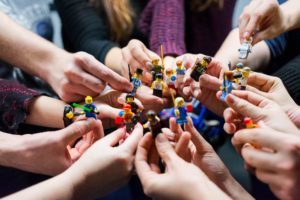
Photo by Johannes Plenio from Pexels

Category: TIEgrad (Page 1 of 7)

More than just a brick in the wall


“We don’t need no education
We don’t need no thought control
No dark sarcasm in the classroom
Teachers leave them kids alone
Hey! Teachers! Leave them kids alone!
All in all it’s just another brick in the wall.
All in all you’re just another brick in the wall.”

This 1979, song featuring a children’s choir and lines of masked children marching in an orderly fashion, was written as a satire, although the writer, Roger Waters, said that while he supports education, his personal experiences in school were negative (Songfacts). I wonder how many people could relate to this. School is great, it just wasn’t for me.  School is important, I just wasn’t the book type etc.  Enough wonderings let me get back on track.

This song began playing in my mind while reading one of the final readings for the course, “Toward a Posthuman Education“.  To back up even further, this all occurred while reflecting back on the course discussions and readings as I contemplated the metaphor I chose for curriculum at the beginning of the course.  The lego metaphor I chose to represent curriculum did a good job of explaining many components of curriculum, but was also lacking in many areas, particularly with regards to the complexity, the multifaceted face of the curriculum.

So, back to the article in question. This article caught my attention due to its dystopian and philosophical nature (Yes, I have a love for both dystopia and philosophy, perhaps due to reading an excess of stories with happy endings as a child…) and its radically different perspective on curriculum. Snaza et al. (2014) begins by discussing what post humanism can bring to the curriculum and then quickly leads into the following dystopian, yet truth containing, description:

“Young people enter primary schools and become instantly a part of the school as anthropological machine (Agamben, 2004; Lewis & Kahn, 2010; as cited in Snaza et al.,2014). They learn quickly to be quiet, stand in line, and place their finger over their mouths when in a hallway—or they will be punished by having privileges taken away, which also means no opportunities for experimentation through play. This machine demands a price from all young people. They become machines for the Educational Testing Services, future workers ready to play their part as money makers, and consumers patriotically saving the economy from recession, buying up anything just to rev up the engine we call an economy. If you are unable to fulfill your mechanical duties, the pharmaceutical machine will come to your rescue. Pills will allow you to do more than you thought possible. This machinic plugging in may cause a loss of appetite, listlessness, even thoughts of suicide but do not worry: the machine has many pills for you; one type is rarely enough. (p. 42)

If you haven’t seen the music video, I have included it here; you will soon see the connection.     (The marching starts at 2.22)

The purpose of all of this is to create what we call civilized citizens (Snaza et al.,2014).

Snaza et al., (2014) provides some good reasoning for rethinking curriculum from a post-humanist perspective.

  1. Education research, philosophy and curriculum is built and completed from a humanist/anthropocentric framework.
  2. It allows for a rebuilding of education where humans are connected to “animals, machines and things within life in schools at the K-12 and university levels” (p.39).
  3. Finally, it will allow for the explor[ation of] new, post-humanist directions in research, curriculum design, and pedagogical practice” ( p.39).

So, there is a post-humanism curriculum to consider, one that appears to have many benefits, but seems complicated in its execution.

Then there are aspects of the hidden curriculum, also striving to create civilized persons, ones that include “frontier colonial logic” (Donald, 2009. p.23).  The discussions by Donald, (2009) connect to Snaza et al’s (2014) discussions in that they both talk about how animality (which we are as humans; we are animals) is something to be overcome by creating civilized humans, through schooling. Snaza et al (2014) questions if this is better, these civilized humans, and notes the divisions this causes. They extend this even further to talk about how the ‘us and them’ mentality has also led to the destruction of the environment. Donald, (2009) echo’s the ‘us and them’ concept, stating that it creates a “condition to be overcome” (p.24). These ideas hurt people and support the continued colonization that goes beyond the teacher in the classroom and lies at the root of the curriculum.  “What is needed is a decolonizing form of curriculum theorizing that conceptualizes Aboriginal and Canadian perspectives as relational, inter-referential and mutually implicative” (Donald, 2009.,p 24 ).

Then there are Aoki’s many discussions of the lived versus planned curriculum and the tension between them.  Creating further complexity, Aoki (1996/2005) also described the curriculum as rhizomean. 

Is curriculum this complicated, or should it be left as the four simple principals created by Tyler (1949)? Unfortunately, while simpler is always nicer, looking at these four principals now, I can see the many layers of complexity built into each one; the planed, the lived, the hidden, the explicit, the extracurricular, the humanistic principals, colonization; all are layered into these four principles, something I see clearly now. The word curriculum has become something more complicated than a document and a teacher in a classroom; it now extends much further to those who develop curriculum, to those who theorize about curriculum, to the researchers, to those who create textbooks and digital content to support the curriculum and most importantly to the students we teach. We want to support the creation of great humans, ones who care about others, the world around them; ones who question and ones who are prepared to take on and help solve the many challenges our world will continue to face.

So, I began building a new metaphor:

  1. A layered chocolate cake. This one tried to make the cut but was too sweet and lacked the complexity needed.
  2. A “Jack in the Box”. It’s a nice and tidy square box with bight primary colours on the outside. The surprise is what’s inside. Each time you turn the handle you do not know when or what will be exposed. This may connect to the hidden curriculum, the lived and planned curriculum, and one could argue that every time you spin the handle a new component is uncovered. However, it is still missing some key components… and there is the inherent creepy factor….
  3. Perhaps a better metaphor for curriculum is a crystal (Non-living things that grow). I spent some time tossing this one over with knowledge that crystals are not considered to be alive, yet they grow and change (as the curriculum does). They are structured (much like the curriculum. Crystals are created from disorder, much like the messy teaching that takes place, that may not look like teaching and may not seem organized but may produce something beautiful. Crystals need room to grow, much like students do and like crystals, the only limits to growth is space. How much space is there in the curriculum ( in its many aspects) for students to grow? Carbon can grow both graphite and diamonds, both considered to be crystals; it is dependent on the process. Just like the process, curriculum, can create or lead to the outcome, the result depends on the process chosen. The bigger question might be, do we want more pencils or diamonds (What are Crystals?)

Tossing this metaphor away, my mind wandering, I searched further for a more fitting metaphor for curriculum. As I searched, I began to wonder about some of my practices. Do I arrange students according to my intentions? Are the resources I am using excluding students? What hidden and excluded components are included in the curriculum as planned and the curriculum as lived, in my biases, in the biases of my students?  As I do this, a house begins to unfold in front of me. This house looks perfect on the outside; orderly, clean with a well-manicured lawn and garden. As you wander through the front door, your eyes first catch a few things that seem out of place, some dust, a book askew on the shelf, but it still seems orderly.  Opening a door, you find a room full of old books, old toys; some broken, all dusty. Nearby is a closet, you open it and are almost knocked to the ground as garbage, bags and bags of it tumble down on you, and around you. Wandering further, you glance out smudged windows to see vines, climbing and trying to make their way through the cleanly manicured garden. A sudden movement catches your eye and you turn to see a winding staircase, you blink, and it has disappeared. Closing your eyes, you breathe in, quickly opening then, and you see it again. It’s continuing to move in an irregular pattern, and you notice that some steps are missing, others look half rotten. After a number of attempts, you manage to grab the rail and pull yourself up, almost falling off as one step cracks under your weight. Making your way to the top you find a room, a room with no ceiling.  Struck by the beauty, you gaze at the stars above and begin reflecting on how hard it was to get to this space, and how it would be even more challenging for others.  The initial first impression of the perfect house now gone, you begin to look around and observe. You observe the vines that have been cut back that are still trying to grow, and you decide to let them grow. You go back to the closet full of garbage and begin to throw these things out, things that are not needed any more; colonial ways of knowing (Donald, 2009) and teacher ego (Aoki, 1993). You go back into the room with the old and broken books and toys and begin dusting them off, some you throw out and some are kept; as they still have value. Perhaps some of these toys connect to students lived experiences, these are placed on a shelf, a reminder of the uniqueness of each. As you place each and reflect on each student, you realize some of them won’t be able to make it up those stairs; won’t be able to see the beauty above. The phone rings and the voice on the other end tells you that in order to live here you will need to park in the lines on the driveway and keep the lawn clean, free of clutter and garbage, and make sure the house gets a fresh coat of paint (grade based reporting). Hanging up the phone, you begin to see that the inside, where we live, our lived curriculum can flourish and grow, we can exist between the lived and planned curriculum.

Perhaps the notion of a house is inappropriate in that it may very well be seen as a symbol of colonialism (or maybe this makes it more appropriate) and I wonder again about the song presented at the beginning, the bricks. Perhaps rather than thinking of each student as a brick, perhaps we rethink the house, and what house means; or we crack open the bricks, to see what lies inside. Perhaps we are dismantling the curriculum and rebuilding, to make room for decolonizing, to make room for post-humanism. This may be years in the making and so, for now, I must continue to keep my front lawn manicured and the cars parked perfectly, but I will continue to look in the closets, the empty rooms, I will throw things out and take things back in, I will let the vines grow and I will find ways for each student to climb the stairs. And, I may begin to break some bricks.

We do not need to create students that are faceless renderings of each other, tramping single file in prescriptive lines, we do not want to create this.  Students are more than just another brick in the wall, and it is clear that some of the walls built, specifically those that exclude and those that support colonization need to be dismantled, brick by brick.

References

  • Aoki, T. T., (1993), Legitimating Lived curriculum: towards a curricular landscape of multiplicity. Journal of Curriculum and Supervision8(3). 255-268. https://pdfs.semanticscholar.org/09c0/8e959a4a83c9716e4bafdf233639a8a4c070.pdf
  • Aoki, T. T. (1996/2005). Spinning inspirited images in the midst of planned and live(d)curricula. In W. F. Pinar & R. L. Irwin (Eds.). Curriculum in a new key: The collected works of Ted T. Aoki (pp. 413–423). Mahwah, NJ: Erlbaum.
  • In James Nahachewski & Ingrid Johnston (Eds.), Beyond Presentism: Re-imagining the personal, social and historical places of curriculum (pp. 23–41). Rotterdam: Sense Publishers. Donald, T.D (2009). The Curricular Problem of Indigenousness: Colonial Frontier Logics, Teacher Resistances, and the acknowledgment of ethical space.
  • Snaza, Nathan, Peter Appelbaum, Siân Bayne, Dennis Carlson, Marla Morris, Nikki Rotas, Jennifer Sandlin, Jason Wallin, John A. Weaver. 2014. “Toward a Posthuman Education.” Journal of Curriculum Theorizing, 30 (2): 39-55.
    https://digitalcommons.georgiasouthern.edu/curriculum-facpubs/47
  • Tyler, R. W. (1949). Basic principles of curriculum and instruction. Chicago: University of Chicago Press.  http://blogs.ubc.ca/ewayne/files/2009/02/tyler_001.pdf

Resources for Assessment

a photo of shelves and stacks of books

Resources for Assessment

As part of our project, we created a series of resources that we felt would aid teachers in planning their online assessments.  These resources were created through experience and are supported by academic research. The created resources are current (created July 2020), relevant (addresses assessment learning outcomes), authoritative (co-created by educators who are students in a Master of Education program), accurate and purposeful (instructional demonstration). 

myBlueprint Assessment Strategies:

The myBlueprint video below, is a resource that demonstrates how to utilize myBlueprint as an assessment tool. Students can reflect, explain, justify and demonstrate personal connections through written, video and audio submissions. It is important that teachers choose accessible digital tools for student assessment. Teachers can give valuable and timely feedback on all submissions. This platform allows for continual student-teacher communication, which directly improves student learning. 


Formative and Summative Assessment in an Online Environment: 

The Infographic below outlines various assessment strategies for both formative and summative assessment. It details which digital tools are well suited to assess students in both online learning and classroom environments. It is important that both formative and summative assessment are imbedded in all learning environments where teachers use a variety of assessment strategies to inform their teaching practices and evaluate students’ learning. 


Formative & Summative Assessment Graphic PDF


Moodle Formatting for Timely Feedback:

The instructional videos below demonstrate how to structure a class on the Moodle learning platform in order to achieve timely assessment.  Moodle was selected to demonstrate what the framework can look like under one central learning management system. Other systems such as Blackboard and Canvas, or combination like Google Classroom and Microsoft Teams can use the same formatting framework. 


1) Weekly Schedule

2) Tools

3) Student Activity


Academic Summary: 

We are educators who teach at a distance learning school as well as students of a Master of Education Educational Technology: Technology & Innovation in Education. We focused on assessment as a crucial component of learning used in both K-12 and post-secondary education.  In order to support other educators, we wanted to examine assessment through the lens of an online learning environment. When integrating formative and summative assessment strategies, teachers should consider the quantity, as creating too many assessments to track student progress can have a negative impact (Vaughan, 2014).  Furthermore, formative assessment should include feedback as students need to understand and be able to act on the feedback they receive in order to improve their learning” (Weurlander et al.,2012). Harlen, (2005) highlights how summative assessment are ‘high-stakes’ and can cause anxiety for some students or distracts students from using their critical thinking and problemsolving skills. Therefore, it is important that online summative assessment is perceived as ‘low-stakes’ for students, as teachers are not there to reduce anxiety. Furthermore, Shea and Bidjerano (2010) discovered that teaching presence along with teaching students the technological skills they need to complete and navigate given tasks leads to “successful online learning” (p. 1727). Well planned online learning experiences along with feedback, help and encouragement also improves learning success for at risk learners (Hughes, 2007) 

In conclusion, when considering online or in-person teaching environments, summative and formative assessments are vital.  Formative assessment should be used to continually check in with students about their understanding of content, leading into a summative review of their learning. When assessing students, a variety of tools and strategies should be used in order to reach all learners for both types of assessments. Overall, the focus of this project was to provide teachers with a realistic and comprehensive overview of what assessment in classroom and online environments could entail. 


Co-Authored by Faune Nicholas, Jerry Chien, Leanne Huston, and Rochelle Smith


References:

  • Harlen, W. (2005). Teachers’ summative practices and assessment for learning – tensions and synergies. The Curriculum Journal16(2), 207–223. https://doi.org/10.1080/09585170500136093 
  • Hughes, G. (2007). Using blended learning to increase learner support and improve retention.  Teaching in Higher Education, 12(3), 349-363.  
    https://www.tandfonline.com/doi/abs/10.1080/13562510701278690 
  • Shea, P., & Bidjerano, T. (2010). Learning presence: Towards a theory of self-efficacy, self-regulation, and the development of a communities of inquiry in online and blended learning environments. Computers & Education55(4), 1721–1731.  https://doi.org/10.1016/j.compedu.2010.07.017 
  • Vaughan, N. (2014). Student Engagement and Blended Learning: Making the Assessment Connection. Education Sciences4(4), 247–264. https://doi.org/10.3390/educsci4040247 
  • Weurlander, W., & Soderberg, M., & Scheja, M., & Hakan, H., & Wernerson, A., (2012). Exploring formative assessment as a tool for learning: students’ experiences of different methods of formative assessment. Assessment & Evaluation in Higher Education. 37.(6). 747-760, DOI: 10.1080/02602938.2011.572153


Image by Free-Photos from Pixabay 

Academic Review of Assessment Strategies

Photo of an open book 


As part of our project, we completed research and created an academic review to provide support for the tools and strategies listed within our blog pages. The academic review, posted below, shows the importance of thoughtful and well-planned assessment, particularly within an online environment. To read the condensed, summarized version, please click here

Academic Review  

Assessment is a crucial component of learning used in both K-12 and post-secondary education.  In order to support other educators, we wanted to examine assessment through the lens of an online learning environment.  Assessment is meant to focus on “student involvement and authentic, meaningful assessment, leading to the development of a variety of assessment forms” (Weurlander et al., 2012).  Quality assessment requires knowledge of provincial curriculum frameworks, district vision and goals, as well as teachers’ expertise with traditional and online tools to support it. Furthermore, there is an emphasis on competence-based curriculum focusing on “capability rather than factual knowledge” (Weurlander et al., 2012).  The resources we curated as well as the resources we created are supported by research and support our learning outcomes. 

Formative and summative assessment are vital aspects of all learning environments. Formative assessment informs teachers of students ongoing learning and understanding, whereas summative is a final capturing of students overall learning. According to Weurlander et al. (2012) formative assessment can influence studentslearning in a number of ways. It sends messages about what counts as important knowledge; it has an impact on students’ approach to learning and gives feedback to students about their learning” (p. 749). Additionally, they included research that found formative assessment “positive[ly] impact[s] student learning” (p. 749). When considering or creating assessment, it is important to include a variety of “assessment tasks [as they] have the potential to support student learning in different ways (p.758). Moreover, a multitude of assessment strategies, including collaborative and blended learning approaches, increases student engagement (Vaughan, 2014). 

Summative assessment is meant to be a final snapshot of students learning.  However, it can exclude learners or create anxiety when the stakes are high for a singular assessment for both in-person and online learning environments states that, 

[h]igh– stakes tests are inevitably designed to be as ‘objective’ as possible, since there is a premium on reliable marking in the interests of fairness. This has the effect of reducing what is assessed to what can be readily and reliably marked. Generally, this excludes many worthwhile outcomes of education such as problem-solving and critical thinking” (p. 209).  

Another concern about high-stakes summative assessments is that they may encourage cheating, a pressing concern for teachers, particularly in an online environment (Mellar et at.,2018).  Creating a variety of authentic summative assessments and giving students choice can help to ensure their validity (Mellar et al., 2018). Therefore, it is imperative that students are provided with a variety of summative assessments with low stakes when teaching online. 

When integrating formative and summative assessment strategies, teachers should consider the quantity, as creating too many assessments to track student progress can have a negative impact (Vaughan, 2014).  This also restricts teachers from providing timely feedback to their students, a key component of successful online learning (Gaytan and Mcewen, 2007). Feedback is therefore a key component in formative assessment, and students need to understand and be able to act on the feedback they receive in order to improve their learning (Black and Wiliam 1998; Nicol and Macfarlane-Dick 2006; Sadler 19891998; as cited in Weurlander et al.,2012., p. 748).  Furthermore, Shea and Bidjerano (2010) discovered that teaching presence along with teaching students the technological skills they need to complete and navigate given tasks leads to “successful online learning” (p. 1727).  Thus, well planned online learning experiences along with feedback, help and encouragement also improves learning success for at risk learners (Hughes, 2007). 

In conclusion, when considering online or in-person teaching environments, summative and formative assessments are vital.  Formative assessment should be used to continually check in with students about their understanding of content, leading into a summative review of their learning. When assessing students, a variety of tools and strategies should be used in order to reach all learners for both types of assessments. Overall, the focus of this project was to provide teachers with a realistic and comprehensive overview of what assessment in classroom and online environments could entail.  


References 

 Gaytan, J., & Mcewen, B. C. (2007). Effective Online Instructional and Assessment Strategies. American  Journal of Distance Education, 21(3), 117–132. https://doi.org/10.1080/08923640701341653 

Harlen, W. (2005). Teachers’ summative practices and assessment for learning – tensions and synergies. The Curriculum Journal, 16(2), 207–223. https://doi.org/10.1080/09585170500136093 

Hughes, G. (2007). Using blended learning to increase learner support and improve retention.  Teaching in Higher Education, 12(3), 349-363. https://www.tandfonline.com/doi/abs/10.1080/13562510701278690 

Mellar, H., Peytcheva-Forsyth, R., Kocdar, S., Karadeniz, A., & Yovkova, B. (2018). Addressing cheating in e-assessment using student authentication and authorship checking systems: teachers’ perspectives. International Journal for Educational Integrity, 14(1). https://doi.org/10.1007/s40979-018-0025-x 

 Shea, P., & Bidjerano, T. (2010). Learning presence: Towards a theory of self-efficacy, self-regulation,  and the development of a communities of inquiry in online and blended learning environments. Computers & Education, 55(4), 1721–1731. https://doi.org/10.1016/j.compedu.2010.07.017 

Vaughan, N. (2014). Student Engagement and Blended Learning: Making the Assessment Connection. Education Sciences, 4(4), 247–264. https://doi.org/10.3390/educsci4040247 

Weurlander, W., & Soderberg, M., & Scheja, M., & Hakan, H., & Wernerson, A., (2012). Exploring formative assessment as a tool for learning: students’ experiences of different methods of formative assessment. Assessment & Evaluation in Higher Education. 37.(6). 747-760, DOI: 10.1080/02602938.2011.572153
 

Co-Authored by Faune Nicholas, Jerry Chien, Leanne Huston, and Rochelle Smith 

Image by MorningbirdPhoto from Pixabay

Curriculum and Collaboration

Photo of many hands holding lego figures together in a circle

Curriculum and Collaboration

“We human beings are social beings. We come into the world as the result of others’ actions. We survive here in dependence on others. Whether we like it or not, there is hardly a moment of our lives when we do not benefit from others’ activities. For this reason, it is hardly surprising that most of our happiness arises in the context of our relationships with others” (A quote by Dalai Lama XIV )

This quote resonates with me as this is a large part of how I view my role as an educator. I and those who form my school community are social beings.  I collaborate with other teachers, with students and I create opportunities for students to work with each other, to collaborate with their peers as well as with me as their teacher.  One clear illustration of this student-teacher/ teacher-teacher/student-student collaboration is the project we took on as a musical theater class.  My co-teacher and I worked with a variety of students to create and perform our very own musical creation of “Pride and Prejudice”.  The learning that took place for the students as well as for us as teachers, far exceeded any expectations we had.  In my other classes, as the students I teach are part of a blended program and only attend two days a week, I build collaborative activities into most classes.  I have seen the benefits of collaboration both in connection to learning content/skills as well as essential communication strategy’s/ problem-solving.  From a social point of view, these activities also help to foster class community and build relationships.  Collaboration is part of my class curriculum and part of BC’s New Curriculum (Building Student Success-BC’s New Curriculum). 

Curriculum and Theories of Collaboration

Snaza et al. (2014) wrote that “consciously or not, we educators and educational researchers are used to looking at schools as places where humans dwell together to learn what it means to be human and to accumulate the kinds of skills and habits required to participate in human societies as adults” (p. 39).  We can presume that this would have been considered either “consciously or not” when developing B.C’s New Curriculum; likely in partnership with the following four “Basic Principals of Curriculum and Instruction” created by Tyler (1949).

  1. What educational purposes should the school seek to attain?
  2. What educational experiences can be provided that are likely to attain these purposes?
  3. How can these educational experiences be effectively organized?
  4. How can we determine whether these purposes are being attained? (p. 51)

BC’s New Curriculum, as part of their considerations, determined that collaboration was to be an essential part of classroom learning experiences.  I propose this to be a result of the researched benefits (building of 21st century skills), and the shift to personalized learning (Building Student Success-BC’s New Curriculum); likely also linked to the unconscious agenda proposed by Snaza et al. (2014).

Theories created by Vygotsky, Dewey, Bloom, Bruner and various others affirm the benefits of collaborative learning.  Vygotsky, who developed current theories around social development believed that we learn through interacting and communicating with others (McLeod, 2018).  Dewey also believed that we learn through interactions and theorized the teacher’s role as that of a guide; the student’s natural curiosity and interests should drive the learning (Lammert, 2020).  Bloom, who created what is widely known as Bloom’s taxonomy of learning, “derived much of its theoretical foundation from the work of Dewey (Salmon, 2019., p. 10).  Bruner, who according to Takaya (2008), initially discussed learning as individual in his early works, came to similar conclusions as Dewey and Vygotsky, stating in 1996 “that education tends to work well when learning is, first, participatory, provocative, communal, and collaborative; and second, when learning is a process of constructing meaning rather than receiving” (p. 84; as cited by Takaya, 2008., p. 15).

McLeod (2018) discusses some specific aspects of Vygotsky’s theories: reciprocal teaching, scaffolding, apprenticeship, the more knowledgeable other (MKO) and the benefits of working in what is known as the zone of proximal development (ZDP).  The MKO is connected to the ZDP which “is an important concept that relates to the difference between what a child can achieve independently and what a child can achieve with guidance and encouragement from a skilled partner (McLeod, S.A., 2018 sec. 5).  Dewey’s theories are commonly associated with a mode of learning called “Inquiry”, a theory soon followed by a more structured approach in the work of Kilpatrick’s Project Based Learning (PBL) (Lammert, 2020).  While there may be slight differences in the exact details of each individual theory, and the specific application of it, all of these theorists have one thing in common, the belief that we learn with and from others.

Although this concept and these theories are clear, supported by research, have been trending topics in the 21st century ( in my experience) and are included in the curriculum, I am curious about whether teachers as a whole are equipped to implement collaborative activities or if the concepts are merely included in the curriculum as an ode to the latest trend without clear objectives and without the training required to implement them effectively.   I see collaborative learning taking place within the classrooms in my school; however, conversations with others, as well as research, indicates that this is most often not the case.  In a recently transcribed interview with Norris and Solway (both ed-tech researchers), Norris stated that direct instruction is still the most common teaching strategy used in classrooms (Gewertz, 2020).


Aoki, (1993) would likely claim that this is a result of the “planned” versus the “lived” curriculum.  In this case the planned curriculum of collaboration may be different than the lived curriculum.  Teachers may not have the training, nor the time to train.  Teachers may have a classroom of students who lack the skills needed for collaboration due to their lived experiences; teachers may not have the skills/knowledge needed to build collaboration within this environment.  I wonder then, as we shift from face-to face learning to learning that may be blended or all online, how will the lived curriculum affect this already weak integration of the planned curriculum of collaboration?  If we are in tension, and should live in between these two, as Aoki (1993) said, how do we as educators best do this?  How can we use technology to create opportunities for students to collaborate?  What are our lived realities when it comes to using technology and digitizing the practice of collaboration?

Working definitions of Collaboration

Crucially, it would be prudent to spend a few lines to explain and further define the practice of collaboration.  Smith and MacGregor (1993) define collaborative learning as:

an umbrella term for a variety of educational approaches involving joint intellectual effort by students, or students and teachers together.  Usually, students are working in groups of two or more, mutually searching for understanding, solutions, or meanings, or creating a product. Collaborative learning activities vary widely, but most center on students’ exploration or application of the course material, not simply the teacher’s presentation or explication of it” (p. 1).

Collaborative learning benefits learners and teachers as it engages students in active learning, builds relationships, teaches tolerance, caring, conflict resolution, caring, how to create an active voice, how to listen as well as how to express ideas clearly (Smith & Macgregor, 1993).  It could be argued that collaboration as a social endeavor, inadvertently or otherwise has the added benefits of building community and creating a culture of respect, it may even create natural opportunities to work towards decolonizing the curriculum.  Collaborative learning in a face-to face classroom may be evident in a physical way, as students would be grouped together; a classroom may even be set up to encourage collaboration (e.g. pods rather than singular desks).

In addition to my experiences with collaboration in Musical Theatre, I have set up collaborative activities in Foods classes (e.g. group baking), as well as English classes (e.g. group writing).  With the move to learning fully online, these types of collaborative experiences changed and evolved; activities that were easy to create in class, became much more complex in an online world.  Although students had experience with the use of some online collaborative tools (e.g. forums/ shared docs/video conferencing), removal of the face-to face aspect created new challenges and changed many students’ collaborative experiences.  From Aoki’s (1993) perspective this would have been my lived curriculum; as a lived experience, my knowledge, perceptions and skills connected to creating collaboration online along with the students (their experience’s, skills etc.), created the curriculum in that moment in time.

Aoki’s (1993) contemplations with regards to the tensions that exist between the lived and planned curriculum may aid in the development of activities that will help to implement collaboration, regardless of the version of schooling that will emerge in the fall, as we can make a variety of predictions concerning what our lived curriculum as opposed to planned may be.  I expect that the return to the classroom in any form will create the need for the physical distancing and spacing of students.  This may inadvertently discourage collaboration and thus traditional face-to face collaborative activities may need to be revised to take this into consideration. There is also the possibility that even with the return to school, COVID cases could suddenly swing the other direction and we could find ourselves only teaching online again.

Opportunities, Barriers and Final thoughts

Students, as digital natives, have the skills to communicate online.  Salmons (2019) observes that this is “a[n] era where text messaging, social media, e-mailing and blogging are common ways that students interact socially, [the next step is to consider how we can create] collaborative learning [that] encourages students to apply these practices to meaningful tasks” (p.76).   Simple as this may seem, it can be challenging to create meaningful collaboration; collaboration that involves all/or as many students as possible.  While I experienced some success with this in the spring, there were many failed attempts and areas that could be further improved.  Salmons (2019) notes a couple of essential considerations when it comes to creating collaborative learning experiences.  The first and foremost of these is trust, as students need to trust both the teacher and their classmates.  The second consideration would be the skill level of the students when it comes to collaborating; this will determine the type of collaboration that would be most successful as well as the amount of time that would need to be spent on teaching students the necessary skills ( Salmons, 2019).  Like Bloom’s taxonomy, there are varying degrees of collaboration included as part of the taxonomy of collaboration (reflection, dialogue, review, parallel collaboration sequential collaboration, synergistic collaboration ) that move from one level to the next, and that could be used to create collaborative experiences that reflect student needs (Salmons, 2019).  In line with many of the theorist’s work mentioned earlier as well as the personalization of the curriculum, Salmons (2019) notes the importance of considering the needs and experiences of the students. Thought should also be given to the tools that students have access to as well tools that comply with district policies.  In my experience, this can be challenging at times; roadblocks may interfere with experiences we would like to provide for our students.

While no one can know for certain what the future will look like I, like many other teachers I know, am a planner.  So, I will plan, and I anticipate that much like the planned curriculum we use to guide us, my planned activities and my planned online/ blended classrooms will be different from the lived one I will experience in the fall.  Technology may fail, and new strategies may go up in flames, however, I will continue to work towards what may be the most important part of schooling; building collaboration, building community, as this, these relationships, are where “most of our happiness arises” (A quote by Dalai Lama XIV ).


References

“A Quote by Dalai Lama XIV.” Goodreads, Goodreads.  www.goodreads.com/quotes/31335-we-human-beings-are-social-beings-we-come-into-the.

Aoki, T. T., (1993), Journal of Curriculum and Supervision8(3). 255-268. Rhttps://pdfs.semanticscholar.org/09c0/8e959a4a83c9716e4bafdf233639a8a4c070.pdf

Building Student Success – BC’s New Curriculum.  https://curriculum.gov.bc.ca/

Gewertz, C. (2020, June 3). How Technology, Coronavirus Will Change Teaching by 2025. Education Week.  https://www.edweek.org/ew/articles/2020/06/03/how-technology-coronavirus-will-change-teaching-by.html.

Lammert, C. (2020). Becoming Inquirers: A Review of Research on Inquiry Methods in Literacy Preservice Teacher Preparation. Literacy Research and Instruction59(3), 191–217. https://doi.org/10.1080/19388071.2020.1730529

McLeod, S. A. (2018, August 05). Lev Vygotsky. Simply Psychology. https://www.simplypsychology.org/vygotsky.html

Salmons, J. (2019). Learning to collaborate, collaborating to learn: engaging students in the classroom and online. Stylus Publishing, LLC. https://ebookcentral-proquest. com.ezproxy.library.uvic.ca/lib/uvic/detail.action?docID=5748777

Smith, Barbara & MacGregor, Jean. (1993). What is Collaborative Learning? Wash Cent News.7. https://www.researchgate.net/publication/242282475_What_is_Collaborative_Learning

Snaza, Nathan, Peter Appelbaum, Siân Bayne, Dennis Carlson, Marla Morris, Nikki Rotas, Jennifer Sandlin, Jason Wallin, John A. Weaver. 2014. “Toward a Posthuman Education.” Journal of Curriculum Theorizing, 30 (2): 39-55.   https://digitalcommons.georgiasouthern.edu/curriculum-facpubs/47

Takaya, K. (2008). Jerome Bruner’s Theory of Education: From Early Bruner to Later Bruner. Interchange39(1), 1–19. https://doi.org/10.1007/s10780-008-9039-2

Tyler, R. W. (1949). Basic principles of curriculum and instruction. Chicago: University of Chicago Press.  http://blogs.ubc.ca/ewayne/files/2009/02/tyler_001.pdf


Photo by Vlad Hilitanu on Unsplash

Unlocking Assessment: the rationale 

Photo of a keyboard with a key placed on top


As educators, assessment is a large part of our job and there are a vast number of tools and pedagogies available. Therefore, as a group we chose to look at the specific aspects of assessment and online assessment tools for the current time we are in, during the COVID-19 pandemic. We first created a set of learning outcomes for assessment (see below), then our curated list and finally we collaborated on a blog post. The Key to Unlocking Assessment seeks to provide educators with ideas of how to transition into the blended and online learning environment that will likely be our reality in the fall. These sources, strategies, and tools were chosen with a critical lens in order to provide practical resources for the everyday educator. The remainder of this post provides our rationale behind this curation. We focused on a range of resources from connections to ministry curriculum, different types and formats of assessments, tools to conduct them, and opportunities for professional development. To achieve this, we examined government and university articlescommercial enterprises, as well as public/private blogs. The CRAAP test was applied to each entry, to evaluate whether they were: Current, Relevant, Accredited, Accurate, and Purposeful. There were only a few resources in our curated list that did not meet every aspect of the test, however they were included for the following reasons.  

  1. Old ministry document: This document is not considered current as it was created in 1994. However, the PDFs are still useful as a starting point for educators; although some adjustments will need to be made in order to address updated curriculum. Included in the list are the updated curriculum resources. 
  2. Raising Standards Through Classroom Assessment: A 2001 summary of a 1998 literature review that provides a detailed outline of the important building blocks of assessment by answering the questions of why assessment is important and how it aids learners. It focuses specifically on formative assessment for learning. Although the literature review was written over 20 years ago the information provided is still applicable to today’s learners and educators. 
  3. Assessing the Online Learner: Does not contain a specific date but does contain referenced work from 2007, therefore we can reasonably conclude that it was written sometime after this. The information shared is applicable, purposeful, reliableaccurate and could be a very useful resource for teachers.  

 Learning Outcomes for Assessment: 

1.Identify self-assessment tools that allow students to engage with content through:  

  • Explanation 
  • Justification
  • Office Hours  
  • Personal connection  

2. Identify self-assessment tools that allow students to engage with content through:  Build and apply rubrics and scales to assess curricular competencies.  

3.Investigate and utilize various forms of formative and summative assessment for online learning environments.  

4.Develop a variety of assessment methods to engage students in a subject area using technology.

  • Personalized to consider student needs.  
  • Voice and choice 
  • Use assessment to inform instruction 
  • Consider teaching/learning environment (online vs blended) 

5.Construct timely assessment or appropriate support to ensure student success.  

  • Check-ins 
  • Support Blocks 
  • Office Hours  
  • Communication Home 


What’s Next? 

Our next step is to create resources and evidence informed content that will authentically assess student understanding, in our new learning context. Additionally, we aim to aid educators in developing their own assessment skills, strategies, and tools, that will fit both in-class, blended and online environments.  


Co-Authors: Faune, Jerry, Leanne, Rhyanon and Rochelle 

Image retrieved from: Pixabay

Accessibility


Sign that says “no entry”


Accessibility. How accessible is it? Questions and thoughts bubbled up while listening to Kim Ashbourne, one of the presenters this week.  Kim talked to us about web accessibility and it was very informative, covering some accessibility considerations that I had not thought of before.  Sure, I ensure that students have voice to text options, audio books for novel studies, that I provide clear instructions, both orally and in written format and… I may once in a while act things out in an attempt to get my point across/or drone on with, “anyone, anyone” ( a reference to Ferris Bueller’s Day Off that maybe one student in the class understands) in order to gain everyone’s attention.   In addition to this, the Learning Management System (LMS) we use (Moodle) has some accessibility features built right into it (colors/font sizes, text-to speech, transcriptions of video ( although not all have this feature) to name a few. However, I do not often think about accessibility or about how accessible any content I create online is. The awesome thing about this presentation was that it now has me thinking about accessibility both within my teaching face-to face, online as well as within the Learning Management System (LMS) I use in my teaching.

As an English teacher, the points Kim made connected to the clarity of the written word also resonated with me. When students are not face to face with you, this clarity becomes even more important as we are unable to see the looks of confusion, disengagement or the path they have taken.  The other piece I took away from this is that these are skills that students also need to be taught. Sure, I teach them how to create organized essays, how to include headings and images, but many of these accessibility considerations I have not specifically taught them. It would be interesting to have students look at some sites online to determine the accessibility of them and to consider how the layout of the site impacts them, and how it might impact someone with a physical or cognitive disability. I would also like them to consider how some individuals may lack access to certain cites or many lack access to any technology/have limited technology.

While doing some research this week, I stumbled upon a quote from Writing on Social Media: a Review of Research in the High School Classroom  .  This quote really resonated with me as I have begun working on and considering content in advance of  co-designing a Moodle course for the fall and, more recently have been searching for resources connected to assessment.

“These assessments should consider students’ writing in light of traditional academic literacies (e.g., clarity, coherence, use of writing conventions), as well as in light of non-traditional or new literacies (e.g., use of images, hyperlinks, multimedia) and consider whether and how the writing effectively communicates in the social context (67).”

This quote also connects to concepts shared within the accessibility presentation as understanding and teaching students how to use these new literacies will also allow for further instruction and learning connected to accessibility.

Check out Ashbourne’s blog page for more information connected to accessibility including: creating accessible word files, making your website accessible, text to speech resources and how to make your LMS courses accessible.

Also, check out this blog page on How to Create Accessible Content.

Photo by Matt Seymour on Unsplash

References

Galvin, S., & Greenhow, C. (2020) Writing on Social Media: a Review of Research in the High School Classroom. TechTrends 64, 57–69. https://doi.org/10.1007/s11528-019-00428-9

« Older posts