Teacher Talking Technology

Photo by Johannes Plenio from Pexels

Page 7 of 7

Research Methods 515: Assignment#2

Description of Action Research, A Qualitative study and An Examination of both with Respect to the Researcher, the Research, the Researched and the Reader.

“Shenandoah River State Park”by vastateparksstaff is licensed under CC BY 2.0

“Two roads diverged in a yellow wood,

And sorry I could not travel both …” (R, Frost , Foundation, 2019)

Robert Frost captures the idea of choosing between two equally appealing paths in his infamous poem, “The Road not Taken”. Much like the decision before the reader as to which path to take, the researcher also has a choice as to which method to choose to conduct their research: quantitative or qualitative. The variety of research methods within these two categories that are available to a researcher can be overwhelming. One should determine what they are interested in, what their questions is, what resources they have available and then which research method would best fit the proposed question. The difficulty lays in the fact that sometimes there may be more than one “right” way to conduct the research.

One type of Qualitative Research a researcher may decide to use is that of “Action Research”. Action Research (AR) is described in detail by Mary McAteer  as “ a methodology, a way of understanding and generating knowledge about the complexities of practice.” (McAteer, 2013, p.2) What does this mean? What does this look like? According to McAteer (2013), this type of research is moral, philosophical, messy, the merging of theory and practice and is also rigorous and grounded in research. McAteer (2013) illustrates the concept with images that show the cyclical nature of this type of research: Begin with a question, plan, act, observe and reflect back to the original question. The question may then be revised as needed, and the process begins again. In this way the research does not have a set end; it may carry on for a few cycles or for many. The research gathered from this process is authentic and intellectual (McAteer, 2013). The perceived weakness of AR by both the reader and researchers is the illusion of an unstructured method and concerns/critiques about the subjectivity of it (McAteer, 2013). McAteer, (2013) argues that this type of research, like all good research, is founded in theory and is systematic and rigorous. The underlying characteristics of AR and justification for the validity of it is clearly illustrated when McAteer (2013) states,

Having an appropriate mindset is as important as having a road map. A willingness to listen to the data with an open mind, to uncover, articulate and challenge assumption, to consistently question ‘the way it is’, and a preparedness for uncertainty, will be of more use than having a clear set of rules and procedures which could be applied with little understanding.                                                                                                                                                    (p.19)

In addition, McAteer (2013) makes a strong case for the validity of the subjectivity within this type of research when she mentions that,

It would be difficult to imagine them describing knowledge of and in the classroom as objective, value free and not strongly bound up in the individuals involved. How should we begin to understand our role as educators were we to dehumanize it.

                                                                                  (p.16)

These two quotes leave no doubt that this research can be valid and reliable, and therefore may be a good option for the researcher who likes to get a little “messy”.

Using the framework of one type of research, like AR to do a side by side comparison of other types of research may be helpful when critically analyzing the four R’s within research; The Research, The Researcher, The Researched and The Reader. The following study, a quantitative research project will be overviewed and then analyzed through this lens.

The Study

The research,  “The Impact of Teaching Presence on Online Engagement Behaviors” (Zhang, Lin, Zhan, & Ren, 2016) , identified a gap in published literature with regards to online learners and engagement; this study was conducted as a means to shed some light on this phenomena and is particularly important given the increasing number of online students worldwide (Zhang et al., 2016). “The purpose of the study was to investigate whether teaching presence would impact online learners’ passive, active, constructive, and interactive engagement behaviors”(Zhang et al., 2016, p.887 ). The researchers asked the following research questions:

Research questions:

(All questions were controlled for the potential effects of the demographic variables)

  • 1. Does teaching presence impact online learners’ passive engagement behaviors,?
  • 2. Does teaching presence impact online learners’ active engagement behaviors,
  • 3. Does teaching presence impact online learners’ constructive engagement?
  • 4. Does teaching presence impact online learners’ interactive engagement behaviors?

(Zhang et al., 2016)

218 middle school English teachers volunteered to participate in the study (Zhang et al., 2016). Of those 17 were males, 201 were females, 89% were married and 87% had participated in a online professional development course before (Zhang et al., 2016). Participants were not rewarded or penalized for their participation or lack thereof (Zhang et al., 2016). The online facilitators designed the courses that included lesson plans, videos, slides and scholarly publications (Zhang et al., 2016). Participants were asked to participate in a variety of different tasks: “studying learning resources, completing assignments, contributing to blog postings, contributing to voting activities, and participating in online discussions”(Zhang et al., 2016 p.891). Students had from March until December of one calendar year to complete the course (Zhang et al., 2016).

Data was collected from online surveys (personal demographics questionnaire/teaching presence questionnaire) and from log files (Zhang et al., 2016). Log files were categorized as passive, active, constructive, and interactive; teaching presence was measured by 13 self-reported items, and the   website tracked user-interface behaviors (Zhang et al., 2016). “Online students were asked to participate in a series of tasks: studying learning resources, completing assignments, contributing to blog posts, voting activities and participating in online discussions” (Zhang et al., 2016, p.891). Participants were given a personal website and access to a class website (Zhang et al., 2016). The online facilitators interacted with the students through moderating, posting content, comments, messages, encouraging participation and responding to questions(Zhang et al., 2016). Table one and two below show the “Teaching Presence Measures” and “Categories of Engagement Behaviors” (Zhang et al., 2016).
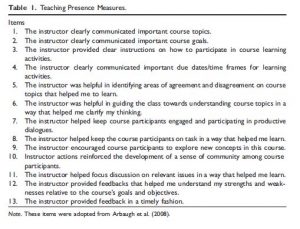
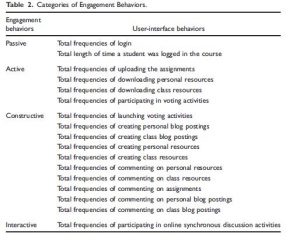
To determine the results, “regression analysis was used to assess the impact of teaching presence on active engagement behaviors” (Zhang et al., 2016 p 895). The findings showed that for behaviors classified as Passive (totals for login frequency/time) and Active (total frequencies uploading/downloading assignments and participation in voting activities), the impact of teaching presence on these engagement behaviors was not significant. For behavior’s classified as Constructive (launching voting activities, creating: blog posts, personal and class resources, and commenting in all areas) and Interactive (“participation in online synchronous discussion activities” (Zhang et al., 2016, p. 894)), “the positive impact of teaching presence on the interactive engagement behaviors was significant”(Zhang et al., 2016. p. 896).

The authors conclude that the results indicate, “that significant teaching presence can lead online adult learners to enhance communications in the learning environment and to generate a substantial number of outputs that are beyond the learning materials.”(Zhang et al., 2016, p.897 ) More specifically the results showed “that teaching presence had a positive impact on learners’ constructive and interactive engagement behaviors” (Zhang et al., 2016, p.887 ).  While this study focused on adult learners who would likely be more motivated and self-disciplined than high school learners, it could be argued that, given the results, further teacher presence in high school online classes through increased communication with students, blogs and other forms of communication (eg forums) might also lead to an increase in engagement. What this study does not test is whether the increased engagement also results in an increase in learning. However, in the pertinent literature shared by Zhang et al., (2016) it was noted that,

 “when students are interactively engaged in learning, they receive information, activate prior knowledge, integrate new information, and make inferences by having a mutual dialog with others. Therefore, learning outcomes associated with interaction is believed to be better than learning outcomes associated with construction, which is better than activeness, which is superior to passiveness”

                                                                                                                                                                                                     ( p.888).

Given this information, it may be beneficial for students to spend more time involved in interactive and constructive tasks. The results of this study show that teacher presence is instrumental in the attainment of this and that this may lead to resulting successes for students.

The 4 R’s

 The Research

 “The Impact of Teaching Presence on Online Engagement Behaviors” (Zhang et al., 2016) is designed as a quantitative study that is rigorous, controlled, data driven and based in theory. Relevant literature was reviewed, justification for the research was given, a research question and hypothesis were formed and data in the form of questionnaires and server files were collected. The nature of this study was artificial and controlled; however, the researchers did attempt an authentic task; that of an online professional development course. The research has a defined beginning and end and produces clear results.  Discussion of this research alongside the framework of the AR method is one way to provide clarity to both forms with the potential to create further insights and ways of knowing. Within an AR framework, a researcher teaching online could create a study of this topic that would also be rigorous and set in theory; the difference would be in the execution. An AR researcher dealing with these same phenomena may attempt to respond to this observed phenomenon in their classroom or teaching with a question like: Will an increase in teacher presence improve student engagement in online courses? After developing a plan that may include the implementation of a blog or other forms of online media/tools that would increase teacher presence, the researcher would then observe, reflect and then the original question would be re-evaluated. This may lead to one or many more cycles as the researcher attempts to gain understanding and improve their practice. The final results for the AR research would be based on observation regarding student interaction in opposition to the numerical data obtained in the Zhang et al study (2016). It is possible within the context of this specific question that the theories developed through both types of research would be similar; however, the methodology to get there would be drastically different.

The Researcher

According to the author biography, the researchers involved in “The Impact of Teaching Presence on Online Engagement Behaviors” Huaihao Zhang, Lijia Lin, Yi Zhan  and Youqun Ren, are all employed in the faculty of Education at East China Normal University. All show involvement with technology and teaching; all have direct interest in and knowledge of the design and facilitation of online courses (Zhang et al., 2016). Likely, as all have experiences within these environments, this led them to their research and ultimately to the research question. In this manner, this initial process may vary little from an AR researcher who has identified a similar need in his/her practice.  The experiences, however, of conducting this research would be drastically different. On one side we have the AR researcher who is working closely with students and is continually reevaluating the original question and revising as needed. This researcher is connected emotionally, intellectually and is looking for ways to improve their practice. On the other side are researchers who are connected with the question and with the theory but are distanced from it through their research. These researchers, due to the nature of the research would also require funding and a specific skill set to run and analyze data.  These researchers may be detached from the process they designed; they collect, define, quantify and describe the data.  Many researchers may prefer one process over another based on these effects; some researchers enjoy the “messy” aspect of AR and the emotion of it, other researchers enjoy the distance, and, possibly the preciseness of Quantitative research studies.


The Researched

 Those researched play a vital role as researchers often need participants in order to answer their research questions. All research participants are impacted in some respects, the effect may be almost negligible, but argument can be made that this is still an impact. In the (Zhang et al., 2016) research, the participants, at a glance, appear to be unaffected by the research. On closer examination regarding the nature of the study and the expectations for the participants, they may have been affected in the following ways: the loss of time to do other things due to their participation, the potential to gain new skills as part of the class and the potential to create a new community and connections due to the nature of the tasks and the runtime of the course. Did participants continue to communicate after course completion? What effect might this have? All of these impacts may be deemed neutral or positive impacts, but without questioning the participants, it would be hard to determine with certainty.  If this study was created as an AR study, the students would be impacted, as they would be directly involved as part of the research. Students involved in AR research may be impacted by requests to try new things as the teacher explores ideas; students may feel obligated to participate or to complete tasks as a result of the teacher/student relationship or because peers are participating.  Considerations of participation involvement in either case should be thoughtful and ethical.


The Reader

The reader may be another researcher, a student or someone interested in the topic presented. As a reader, personal bias and beliefs may impact thoughts and ideas throughout. Some readers may dismiss the Zhang et al, (2016)  study as it is not “authentic”. Some may embrace the objectiveness of it. Some readers may dismiss AR research as it is biased, subjective and is lacking in practical application. Some may embrace the authenticity and insights it provides. As a reader all research should be viewed carefully for critical issues that arise within each methodology: eg.  all research is subject to bias and error/ participants need careful consideration, reliable isn’t always reliable. Readers should disseminate research with this in mind.  That being said, as a reader, both types of research presented can develop new meaning, new ideas, new questions and new application. The reader may see the benefits and learning that is created through both types of research and may apply knowledge from both to create new understandings.

The benefits and learning that come from different methodologies has led to the creation of mixed methodologies where both quantitative and qualitative methods are used to create a more complete understanding. This merging of methodologies, while challenging in nature, may ultimately be the most effective way to approach a problem. Perhaps Robert Frost was wrong; one can travel both paths.


References

Foundation, P. (2019, July 14). The Road Not Taken by Robert Frost [Text/html]. Retrieved July 14, 2019, from Poetry Foundation website: https://www.poetryfoundation.org/poems/44272/the-road-not-taken

McAteer, M. (2013). Action Research in Education. https://doi.org/10.4135/9781473913967

Zhang, H., Lin, L., Zhan, Y., & Ren, Y. (2016). The Impact of Teaching Presence on Online Engagement Behaviors. Journal of Educational Computing Research, 54(7), 887–900. https://doi.org/10.1177/0735633116648171




Knowledge is Power: “Scientia Est Potentia (1A:Week 2)

Reflection on the use of social media, video, animation, research methods and literature reviews through a discussion and analysis of, Public comment sentiment on educational videos: Understanding the effects of presenter gender, video format, threading, and moderation on YouTube TED talk comments”. Veletsianos, G., Kimmons, R., Larsen, R., Dousay, T. A., & Lowenthal, P. R. (2018). 

The topics and research reviewed this week led me to a discussion of this paper as I made connections with the ideas presented and discovered applications that would be useful in guiding my future research as well as current teaching practices. In addition to this, this paper reflected specific topics presented and discussed throughout course discourse this week, leading me to the belief that it would be particularly useful and relevant to discuss multiple aspects of this research.

We were able to have a face to face visit with one of the authors of this paper, George Veletsianos. The visit was beneficial in many ways as we were given the opportunity to engage with him regarding his research through questions and discussions. When discussing the 4 R’s this is directly relevant as it gave insight into who George is a researcher and what has led him to become involved in the work he does. According to his “About Me” page on his blog, one of the larger influences for his work was his parents’ direct experiences with war and their beliefs in education. Veletsianos shared as part of class discourse how within his research he wants to know people and hear their stories. “My research aims to understand and improve teaching, learning, and participation in digital environments” (Veletsianos.com/About Me).  This study does exactly that.

In the introduction, Veletsianos et al (2018) reviewed current literature to provide background research justifying why this study was important and needed.  The discussion of relevant literature led to the conclusion that there was a gap in the research and this experiment was justified in that manner. As a reader, I found this literature review to be interesting in a new way as I was now reading through it with a deepened understanding of what a literature review was. 

After exposing this gap, their research object was stated as follows.

“To investigate these issues, we examined the strength of positive and negative sentiment expressed in response to TEDx and TED-Ed talks posted on YouTube (n = 655), the effect of several variables on comment and reply sentiment (n = 774,939), and the projected effects that sentiment-based moderation would have had on posted content.” (Veletsianos et al,.2018)

The importance of this research is discussed in a practical manner as more and more students, teachers and others are encouraged to go online and to build online digital identities. Further research that outlines these ideas as well as a discussion around the practical implications and application of the findings of this study are discussed. Based on discussions and topics covered this week in class regarding Twitter, Blogging, using social media in the classroom and creating professional online digital identities; I agree, this research and future connected research is needed.  

Sentiment is the topic [term] primarily under investigation for this study and as such Veletsianos et al (2018) spend time discussing the term so the reader is familiar with it. In addition to the discussion of sentiment,  Veletsianos et al, (2018) go on to explore the concept of moderation in depth. Again, as a reader, I am connecting to the literature that is reviewed through these sections.

……I wonder why people choose to post negative comments, I wonder why these begat further negative comments, I wonder about the ease with which one person can post a comment that can make or break another human, I wonder about the disassociation with humanity, the lack of kindness/of thoughtfulness, and then I wonder about the rich and deep connections people build…..

This literature review gives an overview of some of the current and past research associated with both sentiment and moderation as well as some of the general findings resulting from this research further establishing the necessity of the research they are conducting. This is important because it not only gives the reader (myself, and other educators, researchers) a broader understanding of the terms, it also addresses connected and relevant research.

The research investigated Ted-X and Ted-ed talks and resulting comments to answer their research questions. Those researched were not directly impacted in anyway; only data they had posted or responded to was included; personal interviews, questionnaires or any other form of communications with those involved was not a part of this study.  Interestingly, this contrasts with another Veletsianos study we investigated this week: Women scholars’ experiences with online harassment and abuse: Self-protection, resistance, acceptance, and self-blame by George Veletsianos, Shandell Houlden, Jaigris Hodson and Chandell Gosse. This study focused on a small group of participants who were interviewed individually.  In this study, both the researcher and the researched would have been impacted through their participation in these interviews. For the researchers, conducting this research may have provided a sense of connection with these women and a deeper understanding of the issues they had faced/were facing. It may have impacted them on an emotional/personal level. For those researched, the interviews may have become a coping skill itself as their voices are heard (their stories are important) or it may have been therapeutic or may have created further anxiety. Given Veletsianos’s background information as well as insights gained in class, I am curious about his experiences with both studies as the research methodology differed.  I am also curious about whether the unknowing participants of the Ted-X and Ted-ed study would have been affected had the result of this study been shared with them. What, if anything would they change going forward? This would be interesting to explore further.

 Within this study, justification is given for using only Ted-x and Ted- ed talks; however, I do find it to be a limiting factor as they look at only one type of video and arguably, one type of audience. The three research questions for this study were then given:

RQ1. What is the strength of positive and negative sentiment in response to TEDx and TED-Ed Talks posted on YouTube?

RQ2. How does the gender of the video presenter, the delivery format (presentation vs. animation),

and comment threading influence the sentiment of comments and subsequent replies?

RQ3. What would be the likely impact of moderating negative comments upon community participation?

One thing I wondered about these questions is: Are three questions too many to address within a piece of research? Does it make more sense or is it more appropriate to delve deeply into one question? It makes some sagacity to include the first two questions are they are explicitly connected. I do wonder about the reasoning and validity of including the third question as this seems to begat its own study.

My other question, as mentioned previously, was the limiting factor of only using one type of video for the study. I questioned whether it had to do with the amount of data being analyzed but upon further examination of the methods of analyzing the data I noticed that they used a piece of statistical software called “SentiStrength”. “We then generated sentiment scores for all comments and replies in the dataset, by using the open source sentiment analysis tool SentiStrength” (Veletsianos et al., 2018). According to http://sentistrength.wlv.ac.uk/, SentiStrength is capable of analyzingup to 16,000 social web texts per second with up to human level accuracy for English”. In this case, why not analyze a larger data set that includes multiple types of educational videos? Perhaps this had to do with the manual coding that also took place as well as the fact that they were examining both quantitative and qualitative data. This limitation was addressed within their study leading me to the belief that the researchers felt, that despite this limitation, the study would still provide valuable information. Upon reading through their results, I would agree.

 The results of their study are listed below:

1.      Overall, comments and replies were categorized as neutral.

2.      Some video topics were more likely to lead to positive comments and replies (beauty, passion, career) and some were more likely to lead to negative comments and replies (cancer, college, pain).

3.      Male presenters were more likely to receive neutral comments and replies.

4.      Female presenters were more likely to receive positive and negative replies.

5.      “Animations neutralized both the negativity and positivity of replies at a very high rate” 

6.      Positive responses were more likely to lead to further positive responses. The same was true for negative responses.

7.      Comment moderation did not significantly reduce negative responses.

The conclusions went on to discuss each found phenomena in further detail along with potential applications and a call for more research in some of these areas. These results, as the reader and an educator impacted me in multiple ways.  I was surprised, especially given pre-existing research, that the results found for comments overall were categorized as neutral overall. I wonder if the researchers had chosen to view multiple types of educational videos, if these results would be the same. I also wonder, if other educational videos were examined, perhaps the same results would be found as it may be that all educational videos would have the same specific type of viewer. I found the results regarding topics interesting. This could lead to a greater understanding of what topics may cause negative or positive responses within the classroom OR when educational videos are viewed. The information regarding gender is applicable in many ways, both as a female venturing into the online world …..this can feel scary at times…. and as a teacher with both male and female students. It is important to understand that online experiences for males and females is not the same. It is also important to remember that social media as a tool can be both a positive and a negative experience. This reminds me of a recent twitter feed post:

Relevant read from this week’s classes. #tiegrad @veletsianos @ChristineYH
This is important. When I teach about academic blogging now, I highlight the benefits of social media but also mention the drawbacks and make it clear that no one should feel obliged to engage with social media. #femedtech twitter.com/KAMWright/stat…


I think this post contains vital information. It is so very important to remember that no one should feel obliged to engage with social media.  I view this idea with a new lens now as recently, as a result of discussions and readings in class, I had begun thinking of the ways I could incorporate social media in my blended and online classes as a means to engage, promote discussion and community within the online learning environment.  Keeping this idea close as I begin to explore the use of social media in my classes is very important. This also connects to concepts and ideas presented this week in class through both the readings on privacy and through the information shared by the guest speaker Jesse Miller from Mediated Reality

One idea for application that arose as part of this study is student use of animations to share information rather than a video or live presentation of themselves. This eliminates the male/female phenomena and, according to research presented as part of this study, also creates anonymity which can increase overall participation. This would benefit the student as they would be given a voice. This would benefit other students in the class as they would have new ideas to listen to.  And with that I circle back to my thoughts at the beginning and my purpose for writing; that of knowledge.

Knowledge is power. Education is power.  

Media, Social Media, Apps, Social Network, Facebook

Image from Pixabay

Social Media as a Professional Learning Tool

Today we had the pleasure of two guest speakers who shared their experiences with using social media as a professional learning tool and as a way to connect with other educators. An avoider of many forms of social media, I recently resurrected my Twitter account and have decided to to do some of my own experimentation with using Twitter.

I am posting this as a means to create some accountability to myself as well as to reflect on my experiences using social media.

Week #1

I tackled the first hurdle, publishing my first tweet as an educator; my finger hovering over the tweet button, eyes closed as I stabbed blindly at the small blue bird icon. And just like that, I had entered into another realm. I was officially a tweeterer… Is that even a term?

Next step: Adding to my lists

First: hashtags

  1. #blendedlearning
  1. #engchat
  1. #onlinelearning
  1. #distributedlearning
  1. #edtech

Second: Twitter handles

  1. @blendedlearningnetwork
  2. @nelliemuller
  3. @insdpire
  4. @thinklangley
  5. @uconnect35

Third: Blog addresses

1. lornacampbell.org

2. Veletsianos.com

3. Couros.ca/blog

These were a lot harder to find, but I’ll be keeping my eye on my feed in hopes of finding more to follow…

Now to see how well this app works …

#postingfrommyphoneforthefirsttime

Putting an End to the Never-Ending Debate

Two articles read this week in class appear to show opposing points of view; two different styles of teaching.  Both are correct and both are incorrect as neither article gives the reader a clear understanding of the whole.  The meaning I pulled from the articles was that both styles of teaching are valid and necessary.  Students need skills taught through direct instruction and they need freedom to explore and grow and build their “soft skills” without direct instruction. In a way, the ideas presented, while drastically different on the surface, have some common ground.

The first reading, a book excerpt, Teaching for Meaningful Learning: A review of research on Inquiry-Based and Cooperative learning, by Dr. Brigid Baron and Dr Linda-Darling Hammond, argues for the benefits of Inquiry based and Cooperative learning.  A strong emphasis is placed on preparing students for jobs that do not exist yet and arguments are made against what is referred to as traditional methods of “memorization and application of simple algorithms” (p.1). Baron and Hammond state that these skills will not “develop students who are critical thinkers or students who can write and speak effectively” (as cited in Bransford, Brown, & Cocking, 1999; Bransford & Donovan, 2005, p.1).  A strong argument, for who could argue that pure memorization would lead to any of the skills mentioned. Baron and Hammond also discuss the benefits of authentic learning. This is another point that would be challenging to argue, as any teacher who has experienced this with their students will argue that authentic learning is engaging and purposeful in a way that memorization is not.  

The article in opposition, Why Minimal Guidance during Instruction does not work: An analysis of the failure of constructivist, discover. Problem based, experiential and inquiry-based learning, by Paul A. Kirschner , John Sweller & Richard E. Clark (2010) argues the converse. Kirschner et al (2010) argue that students need direct instruction to learn effectively and that Inquiry based learning is not only ineffective but may be detrimental. One interesting point I took away from this article is that the learners they appear to be referring to are novice or intermediate; without a clear definition for either term, the exact nature of each is unknown. It is then made clear that a student who was considered to be an “expert” was not included as part of this report. Kirschner et al (2010) also delve into some discussion around learning a discipline versus practicing a discipline; both of which would require differing teaching strategies.  It therefore could be argued that the research they shared as a basis for their claims, deals with novice/intermediate learners who have not yet learned the skills necessary for the discipline.

It would be hard to argue against traditional teacher-led activity as an effective mean of building skills in novice and perhaps intermediate learners. One may also say that given the research on inquiry based learning and personal experience, that it may be hard to argue against inquiry-based or collaborative learning for students who have a base set of skills (they may be classified as experts) that they can take and extend further. 

Contrary to the claims of the use of minimal instruction in Inquiry based learning discussed by Kirscher et al., the excerpt by Baron and Hammond states that, “Teachers also offer instruction in more traditional ways, such as lectures and explanations that are crafted and timed to support inquiry” (p.3).  Interestingly, this supports the idea that minimal instruction is not always appropriate nor the best for student learning even within an Inquiry based method, leading to the conclusion that while outwardly appearing in opposition to each other, these two readings perhaps share more in common than it may initially seem. 

 Personal experiences and connections

My personal experiences with inquiry-based learning supports the idea that students in an open inquiry require guidance and scaffolding. Students involved in Problem Based Learning or a subject focused inquiry require basic skills before they can move on to the more authentic, self-directed tasks. Having a solid understanding of the basics allows for students to use them/ discredit them or pick them apart and create new understanding that may be more relevant and authentic. Having a solid understanding of basic skills builds confidence in students thereby giving them the ability to tackle more challenging tasks where they can apply the skills and build on them in new and different ways.

For example, musical theatre students within our class this year had the opportunity to be involved in the creation of this year’s musical. Students were involved in promoting, directing and the creation of script, music and lyrics. The students involved were actively engaged in an authentic task, they were given opportunities to lead and to make decisions. We, the teachers, were the facilitators and guides of this learning; not the instructors. These students; however, had they not had the background knowledge of music, script and directing would have been unable to successfully complete these projects. These students, without the guidance of the teachers would also have struggled to successfully complete these projects.  Years of building a base of knowledge and understanding along with teacher guidance allowed them to be successful with this. The benefits the students gained as part of this project are immeasurable.

Will I continue to implement both? Absolutely! 


“DSC_0074”by sicheiiyazhi is licensed under CC BY-NC-SA 2.0

Writing to Extend Thinking

My past experiences with research methods focused primarily on one of two types: qualitative and quantitative. Curious to explore new ideas, it was with much interest that I read through two research articles that introduced me to a specific type of qualitative research (autoethnography) and to a research tool (the research diary). Both articles presented me with new information.

The first article, taken from the “International Journal of Qualitative Methods”, “Research Diary: A tool for Scaffolding”  by Marion Engin (2011) discussed the benefits of journaling while researching. According to Engin (2011), the act of journaling experiences, connections, thoughts and questions while researching leads to deeper understanding and allows for greater reflection. Engin, (2011) discusses how the mind will forget what it was feeling or thinking at a particular time and aptly uses a quote by Durkheim (2006)  where it is “suggest[ed] that we can only think about a topic when we have named it, and this can only be done verbally: …without language, we would not have, so to speak, general ideas; for it is the word which, in fixing them, gives to concepts a consistency sufficient for them to be able to be handled conveniently by the mind” (Engin, 2011 p). It would be fair to assume, given the context, that “verbally” would also include the written word. The benefit of writing ideas down is that you can go back to them multiple times; they are not lost. The spoken word, unless it is recorded, is lost the moment it ends.  My personal experience with journaling while reading research papers it that the act of recording my thoughts and understandings as I view that article gives me a deeper and more thorough understanding of the article.  As part of my journey through this grad program, I will have many opportunities to continue to experiment with research journaling and to discover the benefits for myself. This will be an ongoing discussion throughout my time in the program.

The second article, from the, “Forum: Qualitative Research”, Autoethnography: An Overview by Ellis, Adams and Bochner (2011), defines and discusses Autoethnography. According to Ellis et al. (2011), “this approach challenges canonical ways of doing research and representing others and treats research as a politically, socially-just and socially conscious act” (abstract). This article got me thinking about my past experiences with research; in all my experiences it was drilled into me that research, in order to be good, it must be unbiased.  Words like “double blind”, “control group”, “experimental group” and the negative connotations associated with researcher bias come to mind. Past encounters with research have trained me to believe that this type of research is superior.  So, it was with great interest that I viewed and journaled my way through this article. Ellis et al. (2011) discuss the authenticity of this type of research and how it, rather than ignoring bias, accepts that this is a part of the research and uses it and attempts to understand it. However, they also argue that this doesn’t mean that the research is unsubstantial and state that it is still: “rigorous, theoretical and analytical” (Ellis et al. 2011. p.11). The discussion also includes a well-reasoned and thoughtful exploration of how culture, bias, age, location, experiences and many other aspects do affect both the researcher and the researched. Interestingly, this research connects directly to the previous article by Engin, (2011) on journaling.  When Ellis et al. (2011. p.7) cites Richardson’s (2000) statement that, “writing is a way of knowing, a method of inquiry” and Kiesinger (2002) and Poulous‘s, (2008) statement that “ we write to make sense of ourselves and others”, one can see that discussion(s) around the benefits of writing is expressed by the authors in both articles.

Both autoethnography and research journaling discuss the importance of writing and the benefits that come from engaging with writing. In both readings the act of writing is shown to divulge truths, create meaning and extend thinking. This reinforces my thoughts around the practice of journaling and it’s potential benefits. This also lends itself to classroom practice as if journaling is a benefit to researchers, it seems plausible that it would also benefit students. Future ideas for research and classroom implementation may include using journaling to extend students understanding of what they are reading and as self-assessment.

Clearly the benefits of journaling are well documented. But I wanted to see what other connected information I could find on journaling. A quick google search led me to some information on bullet journaling and the benefits of this style of journaling.  I have used this with my English students but could use it in a more focused, authentic and ongoing manner throughout the year. 

Link to TEDx video on bullet journaling

Another type of journaling I found some information on was video journaling. This could be an alternative to writing thoughts down. Students could include these in a blog to showcase their learning and progress or could record and keep them for personal use, perhaps reflecting upon them at certain points during the year/semester/project.  One of the reoccurring themes that came up is that journaling in any form fosters creativity; creativity has been acclaimed as a 21st century “soft skill” that will help prepare students for the future.

Change in Your Pocket: How a Video Journal Can Help You Grow


Newer posts »