I chose this image because it connects to how I imagine my research in a number of ways. The first connection is fairly obvious, and that is the lens. To start with the lens illustrates my new understanding of research as I, like many of you, came from a place of understanding “good research “to be clinical and quantitative; if you look closely you will see that the image within the lens is flipped. This connects to my flipped (new) understanding of what research can be. I now know that good research comes in many forms. This lens also allows me to look closer at something, to look deeply into something to gain a new insight or understanding. It allows me to see things in a new light, from a new angle; a new viewpoint. It also gives me the ability to put it down, to look around, walk around, turn around, breathe in the air, feel the air, and then zoom in on something.
“This looks interesting, let’s take a closer look at it.
I also think the lens allows for examination without judgement. This in turn opens up the possibilities and allows for new knowledge and understandings. This naturally connects to the idea that this lens can be used to explore research from each of the 4R’s (the research, the researcher, the researched and the reader); these would be different filters/ lenses.
I made two other connections to this image. The first connection is to the road; to the journey. The feeling I had when I first looked at this image was that this was the beginning, the beginning of a journey. This is where I am; at the beginning of my new research/teaching journey, at the beginning of my journey through this program, and its exciting. The second connection I made with this image was with the trees. In fact, when I first started looking at images, I was looking at trees; trees with roots that were deep and intertwined. This to me illustrates the intertwining and connectedness of ideas, the messiness that can come with research and teaching, the intertwining of different methods, of relationships, and the beauty of all of these, and perhaps if you were to close your eyes, you could imagine me moving the lens in that direction and zooming in to see this beauty.
The persistent idea I will carry forward, is that of the lens, both within my teaching practice and within my research journey in this program over the next two years. This idea of looking from many angles, zooming in and then out, trying on different filters, different viewpoints and then putting the lens down, looking around, seeing, touching, listening and then pulling it up again. Within my practice I may be thinking…is that what the student needs or is that what I think they need? I may be thinking… It’s always been done this way; but maybe there’s a new way, a different way or a way to blend ideas together. I may be thinking this can’t be done…but maybe it can, what else can I look at, who else can I talk to? So ultimately, I want to use these ideas and new understandings to continue my journey and further build my practice by exploring the use of further technology within my classroom, cross-curricular teaching, inquiry, and problem-based learning. I want to use this lens as a tool to guide me as I work towards reaching my goal of preparing students for the future. As Tom Whitby said, “We as educators need to shift the education dynamic of teaching kids what to learn to teaching kids how to learn. This is the best way we can provide for them a way to live in their world and not ours.”
In the study, “Pervasive Learning and Technology Usage for Creativity Development in Education”, Shubina and Kulakli (2019), looked at pervasive learning, the benefits of creativity and the use of technology to foster and develop creativity in students by reviewing and analyzing relevant literature. Their focus question was: “How [a] technology-pervasive learning environment can enhance stimulation and development of creativity among students” ( p.95).
Research Questions
Shubina and Kulakli (2019), specifically asked three research questions connected to this larger focus question.
1.“How creativity is related to students academic and career achievements?”
2.“Does external and internal factors enhance or lessen creativity?”
3.“How technology and pervasive learning environment can enhance stimulation and development of creativity among students?”
( p. 95)
Literature Review
In the Literature Review, Shubina and Kulakli (2019) first discuss the literature connected to creativity and education. They note that the analysis of creativity can grouped into process-oriented models, product-oriented models, and what is referred to as the 5 C model. After discussing each in detail, Shubina and Kulakli (2019) conclude that, creativity is “important [for] developing the following skills”:
1.The ability to judge the usefulness of a new idea or solution
2.The ability to generate new ideas, skills or to improve or modify ideas to make them more useful.
3.The ability to solve problems in combination with critical thinking, communication and negotiation skills as well as evaluation skills and analytical thinking.
( p.97)
In addition, the authors conclude that “creativity at the little “c” is a good starting point for implementing creativity in education” ( p.97). They define little “c” as; “creativity, which occurs at [a] personal level as a unique, novel and meaningful interpretation of experiences, actions, and events by an individual” (p.96). Following the discussion of creativity in education, Shubina and Kulakli (2019), go on to discuss again the purpose of the study, the research questions, and then the methodology of their study (conducted by relevant literature review).
1st Focus: “Factors that Enhance Creativity Development”
Shubina and Kulakli (2019), discuss research connected to “motivation, self-determination, teaching approach and individual differences” (p.98). They first concluded that “educational institutions can enhance creativity development” by “applying policies, developing assessments and preparing teachers” ( p.98). Within this, they discuss the promotion of non-traditional teaching methods, collaboration, supports for teachers, etc. The second conclusion they make is that when teachers provide feedback to students that is “perceived as informative, constructive or useful” this “may have a positive impact on their intrinsic motivation to be creative”(p.99). The third and final conclusion they make is that, “positive mood, openness to experience, positive self-image and high self-efficacy are all related to greater creativity” (p.99)
2nd Focus: “Barriers to developing Creativity in the Classroom”
This focus is “divided into three groups: teacher’s attitude and practice, types and structure of assessments, and students’ beliefs regarding creativity.” (Shubina & Kulakli, 2019, p.99). What Shubina & Kulakli (2019) conclude is the following:
1.Traditional teaching methods provide few “opportunitie[s] for students to share “unusual ideas” and to discover insights.
2.The social role of the teacher and biases the teacher may have about creativity may suppress creativity (Teachers may think of only big C -creativity; connections to creative geniuses; they may be result focused and may miss/ignore the process)
3.External motivators primarily connected to social factors may suppress creativity e.g. social comparisons, competitions.
4. Students who doubt themselves and their abilities are less likely to exhibit creativity.
“Pervasive learning and technology usage for creative development”
Shubina and Kulakli (2019) discuss pervasive learning as defined by Pontefract. They state that this type of learning is characterized as “collaborative, inter-connected, continuous, communicative and social community-based” (p.100) . Shubina and Kulakli go on to discuss multiple types of technology available now that supports pervasive learning. Current and future technology supports pervasive learning as it, more than ever, allows for continuous, collaborative and social learning that extends beyond classroom walls.
“Studies on the relationship between pervasive learning, technology usage and creativity”
Shubina and Kulakli (2019) discuss the following key findings:
1.“Technology use may help to develop creative and critical thinking skills, problem-solving skills, and study skills as [an] additional benefit of its usage” ( p.102).
2.The combination of digital and non-digital sources may “enhance the learning process as students have to search, select, retrieve and share opinions or discoveries based on analysis of information from multiple sources” ( p.102).
3.Pervasive learning may lead to an increase in engagement and may increase intrinsic motivation.
4.“Intrinsic motivation is measured based on such constructs as interest, curiosity, attention, and creativity” ( p.103).
5.“Triggered curiosity” which can be brought about through the use of technology, “is supposed to enhance creativity development as well as to maintain interest and cognitive engagement” ( p.103).
6.Technology may help to increase the “intrinsic motivation of [the] learner through increasing student’s interest, attention and cognitive engagement” ( p.103). Based on the research provided, the use of technology may lead to further student successes.
They concluded this section with an overall comment regarding the benefits of technology, but also mentioned that it has the potential to become a distraction.
Conclusion
Shubina and Kulakli (2019), concluded that the research examined showed that there was a “strong relationship between technology use and creativity enhancement through reinforcing students’ intrinsic motivation, self- regulation, curiosity, self-efficacy and knowledge exchange” (p.104). In addition, technology further allows for pervasive learning. Based on the research findings the authors also note the importance of creativity and state that “creativity [should be moved] to one of the center points in educational programs” ( p.105).
References
Shubina, I., & Kulakli, A. (2019). Pervasive Learning and Technology Usage for Creativity Development in Education. International Journal of Emerging Technologies in Learning (IJET), 14 (01), 95–108. DOI: 10.3991/ijet.v14i01.90679.
My Story
I currently work in a blended program ( U-Connect) teaching grade 8-12 students ( English, Foods, Musical Theatre). Within my practice, I often think about the importance of preparing students for the future and, I believe that I have met this agenda in some areas. To further my practice, I would like to work on building more opportunities for students to develop “soft skills;” and, I would like to further incorporate technologies and create more authentic tasks. When teaching with Moodle created courses, I find that they have some strengths; however, they are still primarily based on the system of stand and deliver to; now produce a product. These courses also contain an incredible number of assignments, leading to what I believe is a surface skimming of many things and little time spent in deep understanding. It is my belief that creativity, an important 21st century skill, may be destroyed through the vast quantity of work students have to “get through” in some of these courses; and, it is highly unlikely to be fostered. One course that I teach that I have spent some time reflecting on over the past month is Foods and Nutrition 11/12 (FDN). This course has an effective practical component connected to learning how to cook but is lacking when it come to the exploration of emergent and important topics (food availability, food justice, GMO’S, nutrition, technology and food); these topics are being covered in a traditional teaching method. And so, I set out to find the perfect paper on integrating technology into Foods classes as a means to deepen engagement and build 21st century skills.
To find a paper that met my needs that was connected to (FDN), technology and 21st century learning was like looking for a needle in a hay stack. At that point, I chose to look for a paper that contained general ideas around technology, and 21st century skills. While searching, I continued to run across the word “creativity” and the need/importance of creativity. This paper resonated with me as it addressed creativity as well as my initial search for the benefits and uses of technology and 21st century leaning. I was intrigued by the concept of pervasive learning as it fits nicely with 21st century learning and with the blended program I work in. This paper included relevant details that support the benefits of including technology as well as the process of creativity and the link between technology and creativity. The discussions around fostering creativity and barriers to creativity gave me some clarity around steps I would need to take with my students and myself in order to build creativity through the use of technology. These are skills that will help to better prepare my student for the future. My hope is that including these components within my FDN class will give students the opportunity to collaborate, communicate, analyze, create, take risks and to problem-solve; these are vital 21st century skills.
Further specific details regarding the research problem(s)
1.The Teaching Platform: Moodle. Although it has some positive aspects to it; videos, forums, messaging, and options for some assignments, there are also negatives: a stand and deliver style of teaching (the online component), a lot of text and material for students to sift through, little choice (unless students take the initiative to talk to the teacher about other options), too many small assignments, and structures in place that make it challenging to engage with online learners. As such, the fully online learners are often disconnected and are less likely to successfully complete classes. Based on the paper discussed and the importance of technology and creativity, I wonder what changes could be made to provide a learning experience that is meeting the needs of the students and preparing them for the future. I wonder about the use of social media, blogs, podcasts and other tech tools that are connected to pervasive learning and to building skills like creativity.
2.In-class: Face To face Teaching. Although this teaching portion has a lot more positives than negatives; there are still aspects to it that I feel are not meeting the needs of the students. One that I spoke of earlier was again connected to Moodle as we deliver our course material this way. Although the concepts are connected to important and emerging topics (FDN11/12), they are taught in a manner reminiscent of traditional teaching. The practical part of the course is, well, practical and works well as students learn to work as a group to complete Foods labs. This portion builds skills like: collaboration, problem solving, creativity and practical life skills. Again, for the concept portion, I wonder what technology I could begin to include to further engage students and to provide the opportunity to further build soft skills like creativity. I wonder what skills/scaffolding students need to further develop their self-confidence so that they can engage in the creative process.
3.The Compartmentalization of Subject(s), particularly again in FDN. As mentioned earlier, I believe that the skills that we want students to learn should be taught across all subject areas. With regards to Foods, STEM (Science, Technology, Engineering, Mathematics), would be a natural fit for the emergent topics in Foods class.
The list below is of research questions I have been adding to over the last few weeks. I was surprised and pleased to see that many of them fall into the larger research question I have asked here. I have noted the connections/ideas for each below.
Blog List of Research Questions.
How do I create meaningful learning in an online (Moodle) environment?Based on the research I looked at the use of social media or other social constructs may be one way. I wonder how I might build these structures within the courses. I wonder about building community within these courses?
Can the use of animations create higher levels of student participation? Again, this could be connected to the use of social media and may even be used as a scaffolding tool. Students could start with animation and them once they have built skills and confidence, could move away from the animation.
Can the use of social media increase student participation and engagement in online and blended classes?This may be possible as the research demonstrated an increase in engagement with the use of technology. This use of social media, as pervasive technology, may also increase engagement. This engagement may lead to higher levels of participation and may lead to higher level of creativity.
Can teacher presence increase student engagement in online classes?Again, this could connect to the use of social media or other tools like pod casts or vodcasts.
How can I create a community with my online learners?Again, this is connected to social media and other tools that create opportunities to collaborate with others. I wonder what this might look like…
What is the best way to implement cross-curricular/inquiry projects/project based learning?
Technology is not incorporated as often into electives like music despite the benefits it may provide to students. This journal article does a good job of discussing, providing examples and detailing specifics around how to include podcast projects in music classes.
My Thoughts:
This article is very specifically geared towards one type of project. Teachers could find this useful if they were wanting to add tech to their music program as it contains specific implementation instructions. Practically, this project could be used across a multitude of electives and academics as another way for students to engage with and show their learning. This project may also be used in courses like ADST as it would be easily adapted and could be created by all students regardless of their musical background or aptitude.
Overview: The article discusses the lack of food technology components covered in class with concerns that foods is falling behind as far as evolving and that students are not developing 21st century skills.
My Thoughts: Is not a very useful resource as far as looking at ideas to incorporate technology. Rather it talks more about different aspects of food technology such as food science, food sustainability, food industry and food availability, GMO’s, nutrition- these are components where technology could be used to engage students with some of these ideas. This may lead to the development of critical thinkers prepared for food challenges that the world/ country /community may face. It may be useful for teachers to review in order to evaluate their own program of teaching to ensure that these important topics are being covered. It could also be used to create guiding questions for students based around inquiry: create a question around sustainable food sources, create a question around food availability or GMO’s or Local Food Sources.
Overview: Discusses using technology to engage students with Shakespeare. Discusses remix: combining the traditional Shakespeare with current ideas (could be connected to music, video games, movies etc.). Discusses the benefits and outlines some sample projects. Discusses the idea of a participatory culture with reference to social media. The big idea is that if kids participate, they engage.
My Thoughts: This is a great resource for Music, English, Drama, Art and ADST teachers especially as teachers can address one area specifically or can pull in multiple components.
Overview: Discusses the use of podcasts as a means to introduce students to new recipes/ ingredients etc. so that they are prepared when they come to class and are able to build more skills.
My Thoughts: This reminds me of a flipped classroom idea. This could be used in conjunction with the idea of creating podcasts as it could be a combination of both. Providing students with the ideas and the know-how for specific cooking assignments ahead of time would allow for students to come to class better prepared thereby furthering their skills. It may also allow them to showcase certain skills. I think the ideas of using this as a flipped classroom for labs would be successful. I also think that using the idea of podcasts, vodcasts etc. would be a good way to examine some of the other aspects of the FDN curriculum.
“Left hand driving is much safer than right hand. That’s scientifically proven”
This excerpt from “Kitchen Stories”, written and produced by Bent Hamer and Jorgen Bergmak, and directed by Bent Hamer shares a tale of a research project that had kitchen optimization for Norwegian men living alone as its goal. The research plan was to situate a male observer in the corner of the kitchen in a towering chair to observe the single Norwegian man as he moved around the kitchen. The researched (Isak) is lured in to participate through the offer of a horse; sadly, the horse given to him is not that of a living breathing horse but rather a small artifact that may be housed on a shelf somewhere. This initial incident, what would now be considered an ethics violation, leads to a multitude of further research/ethics violations, according to the way the research was structured, and also leads the researched (Isak) to also become a researcher as he stops using his kitchen and observes the researcher (Folke) at his high station through a hole he has made in the ceiling. These violations, while set in a humorous context, illustrate a deep disfunction and one cannot help but feel sadness for both the researched (who ultimately dies) and the researcher who develops a strong friendship with the researched. This movie does not specifically shed light on the experience the reader might have had of this particular study, although one may imagine that if the study was not deemed invalid due to many critical errors, the readers may have a perspective on the situation that could potentially be full of inaccuracies. Or perhaps the ‘reader’ in this case could be applied in multiple ways; as the viewer of the film, as the researcher who comments at the end of the movie, ” I have some observations here that should interest you. He’s hit on something essential here.”, and, as the reader previously discussed. The movie brilliantly addresses themes connected to friendship and human nature while simultaneously addressing the inherent flaws of research in a satirical manner.
Although today there are ethics boards and research committees, policies and procedures to prevent these types of violations from occurring; research may still be fallible. According to Brown, Kaiser, & Allison, (2018) in, “Issues with data and analyses: Errors, underlying themes, and potential solutions”, there are a variety of errors that may occur within a study.
“We have noted errors related to measurement, study design, replication, statistical analysis, analytical choices, citation bias, publication bias, interpretation, and the misuse or neglect of simple mathematics, reporting, collaboration, data collection, and study design”.
(Brown, Kaiser, & Allison, 2018., 2564)
This quote reinforces the idea that just because something is “scientifically proven” does not mean it is true or true forever or in all circumstances. It may be true, or it may be true at that time and place; or may be true for a particular person or group but may not be a universal truth. Some of the reasons for these errors are simple to explain. For example, a calculation error may be as simple as one incorrect number. Whereas other reasons for errors can be a lot more complex. A more complex error that may occur is researcher bias. Interestingly, a few articles I read this week, connected to social media, provided some interesting discourse around this phenomenon.
The first article, titled, “How to Convince Someone When Facts Fail” by Michael Shermer (2017), discusses belief systems and how people will hold on to beliefs despite evidence to the contrary. This could directly impact the work of a researcher because their overriding beliefs (particularly those who are very passionate about their beliefs) about what the outcome should be or how the participants should respond may be realized through intended or unintended actions. This may also impact the reader as despite what they read and despite how much evidence there is to support an idea, the mere fact that they hold another truth in their mind, may not allow for belief in anything that opposes this. In fact, according to Shermer, the more an individual reads opposing views, the more they listen to opposing views, the more they see opposing views, the stronger they will grasp and hold on to their previously set beliefs. Given this it would be fair to say that a researcher may be blinded by their beliefs.
Mike Caulfield addresses this same idea in his article, “Network Heuristics” (2019), as he shares a personal experience he had with colleagues/students. He would show them a site and then ask them to identify all the components that made it fake. After they had come up with several items proving the site was fake, he would reveal that, in fact, the site was real. What he discovered was that once people had made up their mind about something it could be very hard to change it, despite all the evidence he provided. In fact, he found that a certain number could not be convinced that the site was real and would become argumentative. Caulfield referred to this as cognitive dissonance.
When thinking back on the speaker we had in class this week, Dr. Shauneen Pete, the term cognitive dissonance could also be used explain the long-held biases some Canadians have and why they may refuse to let these go despite evidence to the contrary. It may also be why, when stories of injustice regarding indigenous people arise, and when stories about their history are told, that some people still hold to these beliefs/biases about indigenous people and may in fact become argumentative. I recall a comment that arose in a discussion about indigenous people that shocked me but could perhaps be explained by this phenomenon. The argument made in response to a discussion about residential schools was that, “their children were taken away from them because they couldn’t take care of them; they are/were drunks.” Long held biases like these need to change, but as previously mentioned are very hard to change. These biases, again may affect all aspects of research.
At this point I stop and reflect wondering what biases I may hold. Wondering how these impact me as the reader, the research, the researcher and the researched. I search my mind for arguments I have had with others about beliefs I hold and I being to look at them as I think about bias and I think about cognitive dissonance.
And again, this idea of bias appears an article by Bowers. C .A (2018), “The Digital Revolution and the Unrecognized Problem of Linguistic Colonization” when Bowers discusses in great detail the concept of print and the value we place on a method of documentation that is: “ abstract” [and] “ is inadequate in communicating ongoing relationships, and reduces the importance of learning from all the senses and giv[es] special attention to local contexts” (Bowers, 2018., p.193). Bowers believes this reliance on print (he also connects this to digital systems as they are all print based as well) and this belief about the written word as a “high-status knowledge” system leads to “abstract and surface thinkers”(Bowers, 2018., p.194). He also discusses the, “importance of oral communication” stating that lived experience results in more complex and context-based knowledge (Bowers, 2018., p.193). Bower notes that this intricate and complex form of communication is represented as inferior to data as it is not objective. Bower explicitly discusses bias within this context when he says,
“The long-standing bias against oral traditions can be seen in how the word “illiterate” carries the connotation of backwardness and ignorance.”
(Bowers, 2018., p.196)
Again, those who hold this bias, may be influenced by it and may struggle with accepting this alternate viewpoint. The bias Bowers discuses directly relates to another paper viewed this week by Onwu,G & Mosimege, M (2004), “Indigenous knowledge systems and science and technology education: A dialogue”. The dialogue between the two speakers is a discussion regarding Indigenous knowledge systems and education. There is discussion around the lack of documentation of belief systems and practices with an agreement that this is a step that needs to be taken. This connects to Bowers paper and I would be curious to know what he would think about the documentation of these ideas. After reading Bowers paper I suspect he might have some concerns about transferring what would be, “complex and context-based knowledge” to the abstract and disconnected print form (Bowers, 2018., p.194). I also think, based on the ideas included, that transferring this knowledge to print form could be impossible as some aspects of this knowledge would be lost. I think Bower may appreciate the following comment by Mosimege, M when he says,
“I am suggesting that the two systems are different and therefore require different forms of verification. These verification methods and processes can actually be equated and be made to be of similar standards, however they have to be appropriate for each system, otherwise we would compromise one system at the expense of another and in the process lose the beauty of what the two systems could provide alongside each other.”
(Onwu,G & Mosimege, M, 2004., p. 6)
This comment resonates with me, in particular, the ending where it discusses the beauty that could be lost by trying to have the same verification process for two different systems. To hear it expressed in this manner, creates clarity; it seems reasonable and logical. I have found in discussions over the last few weeks that there may be many right ways rather that just one right way. This idea is reiterated within the Onwu & Mosimege dialogue as one of the questions that arises is; Why is Western science is considered to be the “only true science”; and, why it is considered to be the superior science? (Onwu,G & Mosimege, M 2004., p.11. This again connects to the idea of bias, as a researcher who holds these biases; that of the printed word and of western science may occlude items as a result and may create research that reflects and perpetuates this bias. It may be true that all aspects of research: the research itself ( methodology chosen or research question), the researcher, the reader ( preconceived bias that affects the meaning they may make) and the researched ( selection of participants, derived meaning/translation of oral to print language) are subject to bias.
And, I pause again as I think about my history, my story connected to these ideas and my beliefs around these ideas. And I wonder again about biases, my biases connected to science, connected to the written language, connected to the very word “illiterate”.
While I did not set out to engage in an intense discourse around bias when I began this post, ultimately that is the link that connected each idea to another and thus I was led down this path. As the research, researcher, researched and the reader, the understanding of bias and the effects it may have is important. Perhaps some of our beliefs are purely, “stories”. Perhaps some of our “stories” are purely facts.
“We’ve often convinced ourselves in higher education that there is something called “critical thinking” which is some magical mental ingredient that travels, frictionless, into any domain. There are mental patterns that are generally applicable, true. But so much of what we actually do is read signs, and those signs are domain specific. They need to be taught.”
I bought a new chair recently, it’s a bright baby blue color and it sits in my room. On the chair sits a small plain cushion. Both look a little strange still in the corner of my room; often I wander in and am surprised to see them there. And then I remember, my decision to bring Twitter and my Public blog into my life. I remember my commitment to try it out, to experiment and to be open to seeing what it could become.
And so, my continued journey with social media this week has been…. engaging, educational and surprisingly friendly. My tweet asking for some ideas around teaching was responded to quickly and with unanticipated enthusiasm.
My tweet to a researcher regarding her research; I received not one but a multitude of responses followed by a kind offer to continue dialogue through e-mail.
That’s great! I really appreciate you sharing all of these thoughts with me. I hadn’t picked up a few of the ideas you mentioned so this also helps me to have a better understanding of what AR is all about!
Surprised, shocked and very pleased, my mind begins shifting into a comfortable spot on this brand-new baby blue chair; with my pillow snuggled beside me. While I’m sure this is due to the very small and specific group I follow; nevertheless, it is a nice foray into a new world.
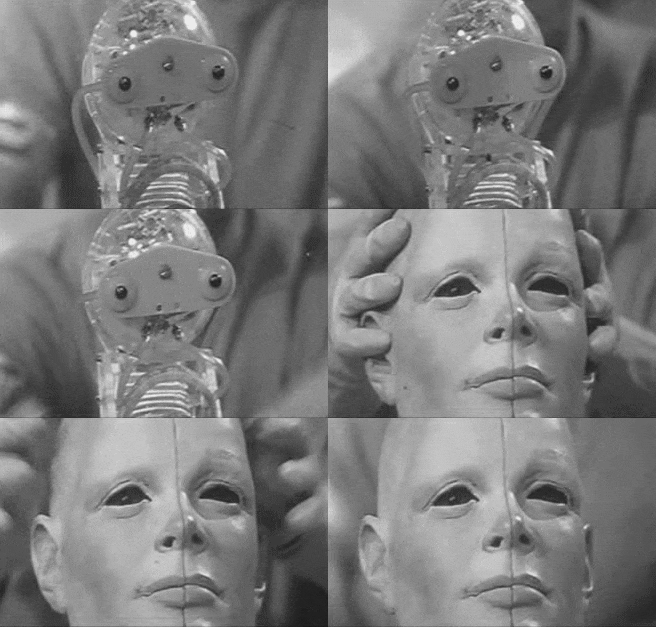
And then, another guest speaker; Bonnie Stewart. An expert on Twitter, and passionate about education, Bonnie completed her PHD on Twitter and currently holds the role of Assistant Professor of Online Pedagogy and Workplace Learning at the University of Windsor. Bonnie expresses many of her ideas through her blog, “The TheoryBlog” and continues to engage others in discourse around technology and education through Twitter. It’s all very fascinating. The discussion moves from “The shifting consequences of Twitter scholarship” to U-Tube algorithms (scary) and bots and suddenly, a remark is made about the quantity of researcher responses a classmate and I received; and, “maybe it was a bot” was stated, twitters ensue (the laughter kind), and my mind starts playing back scenes from “ I Robot” and “The Matrix”. I move uncomfortably on my chair. Bonnie goes on to talk briefly about bots and some of the roles they play online as the wheels continue turning in my heard.
“You just can’t differentiate between a robot and the very best of humans,” argues Dr. Lanning, director of U.S. Robots lab in Isaac Asimov’s I, Robot. This, stated in a movie, made in 2004 has become a reality. Ten years after “ I Robot” was produced, according to the article , Turing Test success marks milestone in computing history” , the Turing test was passed. This test, named after Alan Turing, requires computers to engage in conversation with human participants. If 30% or more of the humans believe the computer is a real person, the test has been passed. In 2014, the 13-year-old bot called Eugene was able to convince 33% of the judges that he was human. Professor Kevin Warwick made the following comment.
“Of course, the Test has implications for society today. Having a computer that can trick a human into thinking that someone, or even something, is a person we trust is a wake-up call to cybercrime. The Turing Test is a vital tool for combatting that threat. It is important to understand more fully how online, real-time communication of this type can influence an individual human in such a way that they are fooled into believing something is true…when in fact it is not.”
The overly trusting slightly naïve part of me is feeling a few twinges of concern. My baby blue perch not feeling as comfortable as before, I sit up and click the next link…… https://hapgood.us/2019/03/28/network-heuristics/
A few moments later I am reading an article written by Mike Caulfield on a researcher named Maisy Kinsley. I begin and am led into a tale of deception. Maisy Kinsley does not exist. Fake profiles on multiple social networking sites and an image generated by machine learning has brought Maisy Kinsley into existence. Caufield goes on to detail how easy it is to create a fake identity online and explains how people believe that they can tell if it is fake or not, but often their biases get in the way. He then goes on to discuss how he would make a point to show colleagues or students a site, ask them to identify why it was fake (to which they would list off a multitude of reasons ) and would then go on to tell them that in fact the site was real. Incredibly, a percentage of the people he did this to would not believe that it was a real site despite all the evidence he presented. In fact, they would vehemently disagree.
As this point, I get out of the chair and begin to pace the room.
Bots, trolling bots, bots that communicate like people, algorithms, biases, fake identities, hashtag activism, call out culture, echo chamber….and the list goes on.
I regress back to another article I read, “The Rise of Social Bots”. This article looks specifically at social bots, discussing the helpful or benign ones and then leading into a discussion of the malicious one and the damage they can cause: influencing the stock market, influencing the election, cybercrime, reputation destruction. According to the article, “These bots mislead, exploit, and manipulate social media discourse with rumors, spam, malware, misinformation, slander, or even just noise.”
The article claims that bots can:
Search the web for information to build fake profiles.
Post material to their profiles in a manner similar to humans.
Converse with people through social media
Strategically gather new followers.
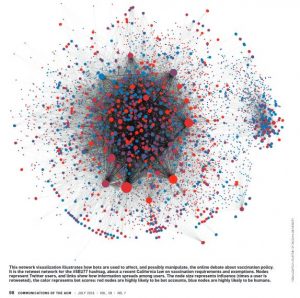
The image below shows, ” the retweet network for the #SB277 hashtag, about a recent California law on vaccination requirements and exemptions.” The red dots are highly likely to be bot accounts.….scary….
And I pause again…….
I filter through all the information I have read and received over the week and glance over at the blue chair in the corner. And suddenly I come to a realization. I need more, now than ever to be engaged on Twitter, to continue to educate myself on social media, to continue to share and to be a part of the discourse around these issues.
I now know that best thing I can do for my students in regard to this is to keep engaging on Twitter, to keep learning and to pass this knowledge to them. As Mike Cadfield said,
“knowing what is trustworthy as a sign on the web and what is not is, unfortunately, uniquely digital knowledge. You need to know how Google News is curated and what inclusion in those results means and doesn’t mean. You need to know followers can be bought, and that blue checkmarks mean you are who you say you are but not that you tell the truth. You need to know that it is usually harder to forge a long history than it is to forge a large social footprint, and that bad actors can fool you into using search terms that bring their stuff to the top of search results.”…………..“they need to be taught. Years into this digital literacy adventure, that’s still my radical proposal: that we should teach students how to read the web explicitly, using the affordances of the network.”
Students need to be taught these skills at schools in classrooms. This is important. This is digital literacy. This is discourse connected to content that affects students, that will affect their futures. Educating students creates knowledge and critical thinking skills that will help them to be better prepared for the 21 century.
I head back and resettle myself in my chair; tuck my pillow, that now shows a hint of color, beside me and get ready to learn, share and educate.
When I wander into the room now, I am no longer surprised. It looks like the chair is here to stay
Description of Action Research, A Qualitative study and An Examination of both with Respect to the Researcher, the Research, the Researched and the Reader.
And sorry I could not travel both …” (R, Frost , Foundation, 2019)
Robert Frost captures the idea of choosing between two equally appealing paths in his infamous poem, “The Road not Taken”. Much like the decision before the reader as to which path to take, the researcher also has a choice as to which method to choose to conduct their research: quantitative or qualitative. The variety of research methods within these two categories that are available to a researcher can be overwhelming. One should determine what they are interested in, what their questions is, what resources they have available and then which research method would best fit the proposed question. The difficulty lays in the fact that sometimes there may be more than one “right” way to conduct the research.
One type of Qualitative Research a researcher may decide to use is that of “Action Research”. Action Research (AR) is described in detail by Mary McAteer as “ a methodology, a way of understanding and generating knowledge about the complexities of practice.” (McAteer, 2013, p.2) What does this mean? What does this look like? According to McAteer (2013), this type of research is moral, philosophical, messy, the merging of theory and practice and is also rigorous and grounded in research. McAteer (2013) illustrates the concept with images that show the cyclical nature of this type of research: Begin with a question, plan, act, observe and reflect back to the original question. The question may then be revised as needed, and the process begins again. In this way the research does not have a set end; it may carry on for a few cycles or for many. The research gathered from this process is authentic and intellectual (McAteer, 2013). The perceived weakness of AR by both the reader and researchers is the illusion of an unstructured method and concerns/critiques about the subjectivity of it (McAteer, 2013). McAteer, (2013) argues that this type of research, like all good research, is founded in theory and is systematic and rigorous. The underlying characteristics of AR and justification for the validity of it is clearly illustrated when McAteer (2013) states,
Having an appropriate mindset is as important as having a road map. A willingness to listen to the data with an open mind, to uncover, articulate and challenge assumption, to consistently question ‘the way it is’, and a preparedness for uncertainty, will be of more use than having a clear set of rules and procedures which could be applied with little understanding. (p.19)
In addition, McAteer (2013) makes a strong case for the validity of the subjectivity within this type of research when she mentions that,
It would be difficult to imagine them describing knowledge of and in the classroom as objective, value free and not strongly bound up in the individuals involved. How should we begin to understand our role as educators were we to dehumanize it.
(p.16)
These two quotes leave no doubt that this research can be valid and reliable, and therefore may be a good option for the researcher who likes to get a little “messy”.
Using the framework of one type of research, like AR to do a side by side comparison of other types of research may be helpful when critically analyzing the four R’s within research; The Research, The Researcher, The Researched and The Reader. The following study, a quantitative research project will be overviewed and then analyzed through this lens.
The Study
The research, “The Impact of Teaching Presence on Online Engagement Behaviors” (Zhang, Lin, Zhan, & Ren, 2016) , identified a gap in published literature with regards to online learners and engagement; this study was conducted as a means to shed some light on this phenomena and is particularly important given the increasing number of online students worldwide (Zhang et al., 2016). “The purpose of the study was to investigate whether teaching presence would impact online learners’ passive, active, constructive, and interactive engagement behaviors”(Zhang et al., 2016, p.887 ). The researchers asked the following research questions:
Research questions:
(All questions were controlled for the potential effects of the demographic variables)
1. Does teaching presence impact online learners’ passive engagement behaviors,?
2. Does teaching presence impact online learners’ active engagement behaviors,
3. Does teaching presence impact online learners’ constructive engagement?
4. Does teaching presence impact online learners’ interactive engagement behaviors?
(Zhang et al., 2016)
218 middle school English teachers volunteered to participate in the study (Zhang et al., 2016). Of those 17 were males, 201 were females, 89% were married and 87% had participated in a online professional development course before (Zhang et al., 2016). Participants were not rewarded or penalized for their participation or lack thereof (Zhang et al., 2016). The online facilitators designed the courses that included lesson plans, videos, slides and scholarly publications (Zhang et al., 2016). Participants were asked to participate in a variety of different tasks: “studying learning resources, completing assignments, contributing to blog postings, contributing to voting activities, and participating in online discussions”(Zhang et al., 2016 p.891). Students had from March until December of one calendar year to complete the course (Zhang et al., 2016).
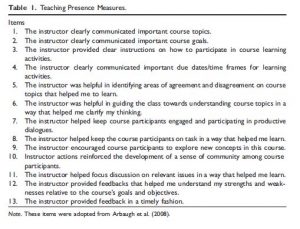
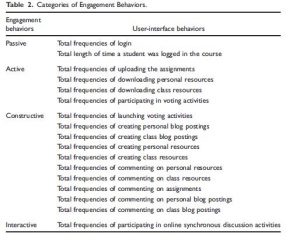
Data was collected from online surveys (personal demographics questionnaire/teaching presence questionnaire) and from log files (Zhang et al., 2016). Log files were categorized as passive, active, constructive, and interactive; teaching presence was measured by 13 self-reported items, and the website tracked user-interface behaviors (Zhang et al., 2016). “Online students were asked to participate in a series of tasks: studying learning resources, completing assignments, contributing to blog posts, voting activities and participating in online discussions” (Zhang et al., 2016, p.891). Participants were given a personal website and access to a class website (Zhang et al., 2016). The online facilitators interacted with the students through moderating, posting content, comments, messages, encouraging participation and responding to questions(Zhang et al., 2016). Table one and two below show the “Teaching Presence Measures” and “Categories of Engagement Behaviors” (Zhang et al., 2016).
To determine the results, “regression analysis was used to assess the impact of teaching presence on active engagement behaviors” (Zhang et al., 2016 p 895). The findings showed that for behaviors classified as Passive (totals for login frequency/time) and Active (total frequencies uploading/downloading assignments and participation in voting activities), the impact of teaching presence on these engagement behaviors was not significant. For behavior’s classified as Constructive (launching voting activities, creating: blog posts, personal and class resources, and commenting in all areas) and Interactive (“participation in online synchronous discussion activities” (Zhang et al., 2016, p. 894)), “the positive impact of teaching presence on the interactive engagement behaviors was significant”(Zhang et al., 2016. p. 896).
The authors conclude that the results indicate, “that significant teaching presence can lead online adult learners to enhance communications in the learning environment and to generate a substantial number of outputs that are beyond the learning materials.”(Zhang et al., 2016, p.897 ) More specifically the results showed “that teaching presence had a positive impact on learners’ constructive and interactive engagement behaviors” (Zhang et al., 2016, p.887 ). While this study focused on adult learners who would likely be more motivated and self-disciplined than high school learners, it could be argued that, given the results, further teacher presence in high school online classes through increased communication with students, blogs and other forms of communication (eg forums) might also lead to an increase in engagement. What this study does not test is whether the increased engagement also results in an increase in learning. However, in the pertinent literature shared by Zhang et al., (2016) it was noted that,
“when students are interactively engaged in learning, they receive information, activate prior knowledge, integrate new information, and make inferences by having a mutual dialog with others. Therefore, learning outcomes associated with interaction is believed to be better than learning outcomes associated with construction, which is better than activeness, which is superior to passiveness”
( p.888).
Given this information, it may be beneficial for students to spend more time involved in interactive and constructive tasks. The results of this study show that teacher presence is instrumental in the attainment of this and that this may lead to resulting successes for students.
The 4 R’s
The Research
“The Impact of Teaching Presence on Online Engagement Behaviors” (Zhang et al., 2016) is designed as a quantitative study that is rigorous, controlled, data driven and based in theory. Relevant literature was reviewed, justification for the research was given, a research question and hypothesis were formed and data in the form of questionnaires and server files were collected. The nature of this study was artificial and controlled; however, the researchers did attempt an authentic task; that of an online professional development course. The research has a defined beginning and end and produces clear results. Discussion of this research alongside the framework of the AR method is one way to provide clarity to both forms with the potential to create further insights and ways of knowing. Within an AR framework, a researcher teaching online could create a study of this topic that would also be rigorous and set in theory; the difference would be in the execution. An AR researcher dealing with these same phenomena may attempt to respond to this observed phenomenon in their classroom or teaching with a question like: Will an increase in teacher presence improve student engagement in online courses? After developing a plan that may include the implementation of a blog or other forms of online media/tools that would increase teacher presence, the researcher would then observe, reflect and then the original question would be re-evaluated. This may lead to one or many more cycles as the researcher attempts to gain understanding and improve their practice. The final results for the AR research would be based on observation regarding student interaction in opposition to the numerical data obtained in the Zhang et al study (2016). It is possible within the context of this specific question that the theories developed through both types of research would be similar; however, the methodology to get there would be drastically different.
The Researcher
According to the author biography, the researchers involved in “The Impact of Teaching Presence on Online Engagement Behaviors” Huaihao Zhang, Lijia Lin, Yi Zhan and Youqun Ren, are all employed in the faculty of Education at East China Normal University. All show involvement with technology and teaching; all have direct interest in and knowledge of the design and facilitation of online courses (Zhang et al., 2016). Likely, as all have experiences within these environments, this led them to their research and ultimately to the research question. In this manner, this initial process may vary little from an AR researcher who has identified a similar need in his/her practice. The experiences, however, of conducting this research would be drastically different. On one side we have the AR researcher who is working closely with students and is continually reevaluating the original question and revising as needed. This researcher is connected emotionally, intellectually and is looking for ways to improve their practice. On the other side are researchers who are connected with the question and with the theory but are distanced from it through their research. These researchers, due to the nature of the research would also require funding and a specific skill set to run and analyze data. These researchers may be detached from the process they designed; they collect, define, quantify and describe the data. Many researchers may prefer one process over another based on these effects; some researchers enjoy the “messy” aspect of AR and the emotion of it, other researchers enjoy the distance, and, possibly the preciseness of Quantitative research studies.
The Researched
Those researched play a vital role as researchers often need participants in order to answer their research questions. All research participants are impacted in some respects, the effect may be almost negligible, but argument can be made that this is still an impact. In the (Zhang et al., 2016) research, the participants, at a glance, appear to be unaffected by the research. On closer examination regarding the nature of the study and the expectations for the participants, they may have been affected in the following ways: the loss of time to do other things due to their participation, the potential to gain new skills as part of the class and the potential to create a new community and connections due to the nature of the tasks and the runtime of the course. Did participants continue to communicate after course completion? What effect might this have? All of these impacts may be deemed neutral or positive impacts, but without questioning the participants, it would be hard to determine with certainty. If this study was created as an AR study, the students would be impacted, as they would be directly involved as part of the research. Students involved in AR research may be impacted by requests to try new things as the teacher explores ideas; students may feel obligated to participate or to complete tasks as a result of the teacher/student relationship or because peers are participating. Considerations of participation involvement in either case should be thoughtful and ethical.
The Reader
The reader may be another researcher, a student or someone interested in the topic presented. As a reader, personal bias and beliefs may impact thoughts and ideas throughout. Some readers may dismiss the Zhang et al, (2016) study as it is not “authentic”. Some may embrace the objectiveness of it. Some readers may dismiss AR research as it is biased, subjective and is lacking in practical application. Some may embrace the authenticity and insights it provides. As a reader all research should be viewed carefully for critical issues that arise within each methodology: eg. all research is subject to bias and error/ participants need careful consideration, reliable isn’t always reliable. Readers should disseminate research with this in mind. That being said, as a reader, both types of research presented can develop new meaning, new ideas, new questions and new application. The reader may see the benefits and learning that is created through both types of research and may apply knowledge from both to create new understandings.
The benefits and learning that come from different methodologies has led to the creation of mixed methodologies where both quantitative and qualitative methods are used to create a more complete understanding. This merging of methodologies, while challenging in nature, may ultimately be the most effective way to approach a problem. Perhaps Robert Frost was wrong; one can travel both paths.
References
Foundation, P. (2019, July 14). The Road Not Taken by Robert Frost [Text/html]. Retrieved July 14, 2019, from Poetry Foundation website: https://www.poetryfoundation.org/poems/44272/the-road-not-taken
McAteer, M. (2013). Action Research in Education. https://doi.org/10.4135/9781473913967
Zhang, H., Lin, L., Zhan, Y., & Ren, Y. (2016). The Impact of Teaching Presence on Online Engagement Behaviors. Journal of Educational Computing Research, 54(7), 887–900. https://doi.org/10.1177/0735633116648171

 Photo by Oleg Magni from Pexels