Photo by Johannes Plenio from Pexels

Category: TIEgrad (Page 5 of 7)

Into the past: Exploring open and distance learning

“Study the past if you would define the future.”
― Confucius

This weeks research articles all contained historical aspects connected to open and e-learning; it makes sense to explore and understand the history of something before touching on the more current research. Whilst delving through these readings, posting and responding to the reading and comments on hypothes.is, I realized that before compiling this week’s post, I needed a better understanding of the definitions and terminology presented. While I have a good understanding of the terms online learning, distance and blended learning, particularly due to the school I work in (U-Connect); some of the other terms, I had rather fuzzy understandings of.

The first web page I encountered in my search appeared to contain the information I was seeking, so I decided to start here. I would like to reflect back on these terms to see if I would add anything to them or adjust them in any manner as I go through the material in the course.

e-Learning: I found it interesting that within this page, Bates ( 2008) identified it as encompassing all types of learning that have a digital component.

MOOC’s: “massive, open, online courses” (Bates, 2008).  These courses are free to take (although you may have to pay for a certificate at the end) and have no academic requirements but do not allow users to gain any credits (although it appears that for some you may receive a certificate). It seems to me these courses would be useful or certain things but also limiting as, based on this definition you would not be able to obtain a degree through the use of a MOOC. I am going to add onto this definition with some more specifics from one of the articles read this week;   Mapping research trends from 35 years of publications in Distance Education  where Zawack-Richter and Naidu (2016)  discuss two types of MOOC’s: cMOOC’s ( collaboration between teachers and learners) and, x MOOC’S run by experts (contains lecture videos, forums and quizzes).

Open Learning: This seems to be more of a philosophy for education where barriers are removed thus giving everyone an equal opportunity to learn.

Open Educational Resources (OER) Free digital learning material. This seems to be very connected to open learning in that if everyone has access to learning materials, it gives everyone an equal opportunity to learn.

Distance Education: “Students can study in their own time, at the place of their choice and without face-to face contact with a teacher” (Bates). An important distinction is made by Bates when he states that “distance education programs may not be open”. One example he gives is of UBC where students must meet the same admission requirements as a student attending a traditional face-to face class.

Flexible Learning: Creates increased access and openness as if allows for flexibility for the learner. May manifest in a variety of different ways.

I also looked up open university and retrieved this information from Wikipedia.

“An open university is a university with an open-door academic policy, with minimal or no entry requirements.[1] Open universities may employ specific teaching methods, such as open supported learning or distance education. However, not all open universities focus on distance education, nor do distance-education universities necessarily have open admission policies.[2] “  

This sounds pretty fuzzy to me still………but it appears the big factor for an open university is the lack of admission requirements.

One of the articles we looked at, Mapping research trends from 35 years of publications in Distance Education by Olaf Zawacki-Richter and Som Naidu (2016) found trends in the research around distance education connected to “professionalization and institutional consolidation (1980–1984), instructional design and educational technology (1985–1989), quality assurance in distance education (1990–1994), student support and early stages of online learning (1995–1999), the emergence of the virtual university (2000–2004), collaborative learning and online interaction patterns (2005–2009), and interactive learning, MOOCs and OERs (2010–2014)” (245).  One point the authors made that seems to be consistent in all of the literature I have looked at as well, is that predominantly all of the articles looked at higher education. The challenge here is, as a high-school blended- learning teacher looking to improve my practice, often what applies in higher education does not apply in high-school.  While there are still valuable connected learnings, this is, in my opinion a gap in the literature that I hope will be addressed in the future as more high-schools take on a blended approach.

Another connection I made to the article was around their discussion of attrition rates and how high they were in distance courses as opposed to the traditional courses. This is a concern where I work as well as the students enrolled in online courses only also have a higher attrition rate than our blended students. While this shows support for adding in components like synchronous learning, the authors make a good point when they discuss how this in a way defeats the purpose of distance learning as it takes away the flexibility and openness of it. While this is true, I wonder about how to balance this out within high-school courses as we do want the kids to be successful and for some students it may be argued that too much flexibility and openness leads to a lack of structure and accountability that may be needed for them to be successful. As quoted in the article, “Early in 2000 Garrison, Anderson, and Archer developed their widely cited community of inquiry model, which posits that learning occurs through the interaction of social presence, cognitive presence and teaching presence in computer conferencing educational settings (Garrison, Anderson, & Archer, 20002001).”.  If this is the case then perhaps, for high-schoolers at least, we should find a way to build in further social presence and teacher presence in fully online classes.

A couple of other interesting points brought up within this article was (1) when the authors referred to how open learning really is when learners a) need to be able to read and write and, b) are judged by western standards; and, ( 2) the comment about how “learners and instructors use and interpret silence”  ( i.e. non-participation, confusion, or thoughtful reflection) (260 ).  This point was interesting and one this I would like to explore further to determine what online silence means. Our LMS allows for us to collect user data on what they view, how long it is viewed for, how long they were logged in, or if they have not been logging in at all. I wonder how this data could best be used to help students be more successful when working at home.  When thinking back on the reasons for silence, a student who views the same content multiple times may be confused or may need more time to fully understand a topic.  I  also wonder how the age of the learner might come into play here as the high-school students I teach could fall equally into all three categories. I would say that most often in the classroom it would be “confusion”, while most often at home it would be non-participation. I like how they talk about the interpreting silence as it is applicable in both face to face and online teaching. For me, online silence would look like; kids not viewing the course and course contents, not reading messages and not completing their assignments. I wonder what would be the best way to discover if they are confused or just choosing not to participate as sometimes students do not like to share that they are confused.

As a whole, this article, while addressing research over the 35 years, also highlights how long some of the research has been going on for. While some have changed over time, most of the concepts researched, even those from earlier time periods are still topics of research today.

For the following two articles, I have included ideas from the annotations I created in hypothes.is.

In the article, On the role of openness in education: A historical reconstruction,  (Peter & Deimann, 2013), the authors discuss open education and the history of open education. Some of the points I connected with were as follows:

  1. The exact form that learners would choose (or not) to provide support for their individual learning is hard to infer. There is a risk of assuming that all learners require, or even prefer to be part of a larger community.” ( p.12 )

I found this interesting because the mini lit review I recently completed provided support for the idea that creating a community may lead to higher levels of engagement, satisfaction and success.  But, I then wondered,  perhaps some learners only want to learn a specific skill, for example, required for their jobs; and, as a result would rather not have the interactive community component. Potentially, one could theorize that including this component would add time to the course whereas, without it once could complete the course in a more efficient timeframe.  I think this depends on the age and the course. Adult learners should be given the choice while high school students may have greater success when involved as part of a community.

2. I found the discussion around open learning and money interesting. This led me to do some further research on some of the platforms mentioned in the article.  One platform I spent a little more time looking was Coursera. Coursera earned around 140 million in 2018; according to Forbes; definitely a lot of money involved here (Shah, 2018) . I looked at the cost for courses and while not free, they appeared to be substantially less expensive than most brick and mortar courses. This got me thinking about access, as online courses create access for a larger populations than standard courses. And as they often do not require any transcripts/pre-requisites, this again creates greater access and potentially provides personalized learning as you don’t have to take A to take B. The costs involved in taking these course would then be a limiting factor as again, some may not have the money to take a course. I’m also curious about the free courses and if they are comparable to the ones that students have to pay for…. I also wonder if our government would ever fund open access so that education could be free to all who wanted it? Is this even feasible?


The final article, Twenty years of EDtech, (Weller, 2018) provides a quick overview of some of the changes in edTech from 1998-2018.

I connected with the following key points:

  1. In 2016 several people independently approached me about blockchain—the distributed, secure ledger for keeping the records that underpin Bitcoin. The question was always the same: “Could we apply this in education somehow?” ( p)

Block chain was new to me and I wondered, Would this be more applicable for higher education? Is this being used in any universities? It sounds like it’s similar to some of the other ideas mentioned, but rather than a singular component it contains multiple components in one place with higher levels of security. Is it possible for something like this to address privacy issues/concerns in education? This is a big concern within my district as I’m sure it is in many others. If the use of blockchain would allow students to privately use online apps/ social media tools etc, I could see it having a future in education.

Again, as repeated in multiple articles and, something I’ve reflected on before in my blog posts is the ideas that trying to be constantly on top of new technology and trying to incorporate the newest greatest thing may also lead to the use of technology for technologies sake rather than for pedagogical reasons.  This may also lead administrators to purchase equipment that is never, or rarely used.

As I  use a LMS within my job, I found it interesting when the authors discussed the limitations of LMS’s.  The LMS we use also has limitations which can be frustrating for teachers as some programs are not compatible/embeddable within this system. However, the options for change are limited and building a new system is something that requires time and skill.

Now What?

While portions of each article were redundant in that some of these topics are common themes within research, the historical aspect was interesting and there were some components within each that had me thinking about my teaching as well as some further directions I could take with my research.




Week # 6 Post: Journey On


Photo by Pixabay from Pexels

And the journey continues………

This week we continued to explore the role of technology in education through summarizing and discussing a few connected articles from the “Second Handbook of Information Technology in Primary and Secondary Education“. 

After viewing the videos and summaries, and reflecting back on my prior posts, a few things stood out to me, and, I believe I have, as a result of this, created a new vision for myself as far as what I want my teaching to look like as well as what direction I would like to take with my literature review and further research.

A few things I found interesting….

One thing that I found interesting, particularly given that some of the groups discussed the use of games and multimedia, was the distractions I experienced as a viewer of these videos. One video in particular that affected me this way was the one created, appropriately, by the group ” Advanced Principals in Multimedia Learning”. The video contained, what I know was a very informative dialogue; however, with all of the exciting “Star Wars” action in the background, I’m sure if asked about the video after viewing it, I would only be able to tell you that it had to do with multimedia. I wonder about the intentionality of both the assignment and the way this particular assignment was put together as I received a very practical lesson in what happens to learning when cognitive overload in one domain occurs.  Interestingly, in addition to this group, a few other groups touched on this concept as part of their topic summaries.  One other group that that discussed this was the group that covered “The Basic Principals of Multimedia Learning “.  In their discussions around the “Split Attention Principle”, “Modality Principal” and the “Redundancy Principal”, they noted the benefits of mixed mode media but also discussed the negative impact of an excessive cognitive load.  When students experience excessive cognitive load due to the amount and type of media, learning will be hampered; sometimes, presenting information using a singular mode will be the most effective. I’m sure Clarke would have some thoughts regarding this!  One other interesting point this group made was in their discussion around the ” Signaling Principal”, in connection to eye tracking and fixation in order to lessen cognitive load.  I found the topics covered by this group to be both interesting and practically applicable. I would like to explore this area further to ensure that I am using best researched practices when it comes to using multiple forms of media. 

Photo by Pixabay from Pexels

Some commonalities…

Amongst the groups and sections reviewed, there were a few other commonalities that came up connected to teachers/schools inability to keep pace with new technologies, their uses/implementations and the lack of teacher training. The section we summarized also spent time discussing this along with the mismatch between how teachers think they should be teaching and how they are teaching.  These ideas were also mentioned in connection with assessment in the sections reviewed in the Technology and Assessment in the 21st Century group.

Technology and assessment…

Assessment is arguably a current hot topic when it comes to teaching and what is best for students. I often see Tweets connected to assessment and to what makes good assessment on my Twitter feed; the section we reviewed as a group also pointed out that assessment is one of the areas that needs significant revamping when it comes to 21st Century curriculum so I felt it important to include this within my post. The group that summarized information connected to Technology and assessment in the 21st Century discussed some of the technologies available to be used for assessment, particularly those built into games. They also note that technology is underutilized when it comes to assessment. 

My connections to technology and assessment may perhaps be different from many educators due to the platform we use to manage our classes. The assessment that is built into the courses may be different than traditional assessment as some assessment and feedback is instant.  Tests that contain multiple choice, matching or true and false questions give immediate feedback to the students as they self mark as soon as they are submitted. They also give immediate feedback to the teacher as the results clearly identify mastery as well any concepts that the class as a whole may still be struggling with.  Feedback can also be given in the form of feedback files; students are able to review the work they submitted along with corresponding comments.  The group that discussed Assessment in the 21st Century, ” Using Information Technology for Assessment: Issues and Opportunities”, also discussed the use of  video, text or audio to provide feedback. The options of video or audio is something I would like to explore further as the Moodle platform we use would have the option to upload video or audio feedback files for students instead of, or in addition to, text based feedback files.  I wonder about the benefits of some of these other options.

A connected podcast I listened to this week ( “On Purpose with Jay Shetty”. Laurie Santos: ON Teaching the most popular class at Yale University) discussed grades in relation to satisfaction and concluded that students who strive for A’s are the least satisfied/happy and enjoy learning the least…...interesting...…..  .  I am curious about assessment as a whole and would like to research this area further. 

Other thoughts….

Our group in particular discussed 21st century skills and the need to keep pace with technology as well as including curriculum that prepares students for the world they live in now and the one they will live in in the further.  One of the groups mentioned that current employers and employers in the future are looking for problem solvers, a 21st century competency.  This led me to wonder about teaching kids to develop problem solving skills, and about 21st century skills and the role of assessment. I wonder how to best sort and determine what is most useful when it comes to tech so that I am not using it just for the sake of using tech; and, that I am considering cognitive overload. I wonder about digital literacy and teaching this to students; training students to filter and to be critical viewers of information. I wonder about fostering self-regulation and self-motivation. And, I wonder about how Professional Development can be changed to reflect the needs of the teachers and students.

I found myself very interested in some of the research shared by the group that examined, ” The Learner and the Learning Process”.  I would like to further explore a few of the articles included by this group: the research article connected to technology and the enabling of collaboration “Computer-supported argumentation: A review of the state of the art.”, “Location matters: Leveraging knowledge building with mobile devices and web 2.0 technology.” ;
and, the article, ” A model driven framework to address challenges in a mobile learning environment”  that examined a newer model connected to incorporating technology, specifically mobile learning.  This article may have some application possibilities for the program I work in. 

Questions…

A few questions/ideas I have connected to topics presented by groups are:

What is the best way to implement technology and to make sure that I am including it with purpose? What is the framework I could use to guide my teaching? Is there one or should a combined method work best?

What is a way I can use the Moodle course platform to build on the idea of pervasive learning? Are there other tools I can use to build pervasive learning into my courses? How can I use this to create and foster community and collaboration?

When using online platforms, how do we protect student information?

I like the idea of community building within a classroom/cohort/school conjoined with technology while simultaneously building 21st century skills ….

This all led me to…….

Collaborative Cross-curricular Instruction using Technology and Mobile (Pervasive) Learning

These are some connected articles that I would possibly like to explore further as part of my Literature Review

Teaching in a Digital Age: How Educators Use Technology to Improve Student Learning

Computers and the Collaborative Experience of Learning  


Twenty First Century Cirriculum

Continuing to journey through the vast and cavernous world of technology and education, this week, we examined a section from the “Second Handbook of Information Technology in Primary and Secondary Education“. Below is a summary of one of the articles from the second chapter.

“Twenty First Century Curriculum: Issues and Challenges”

The article, “Twenty First Century Curriculum: Issues and Challenges” by Joke Voogt and Ola Erstad (2018), addresses some important topics connected to current curriculum and future curriculums. They explore the findings of meta reviews in order to answer their key question:

1.      What should be taught and learned in school curricula in the 21st Century?

Within this question Voogt and Erstad (2018) explore what “the key competencies important for the 21st Century” are, “ roles for new technologies in the curriculum”, connected issues and challenges and “new perspectives on curriculum and curriculum development”.

Voogt and Erstad (2018) discuss rationales for curriculum change and identify a variety of key competencies, skills that should be taught and learnt in the 21st Century; these are some of the main ones they identify:

1.      Ways of thinking (Creativity and innovation, critical thinking, problem solving, decision making, leaning to learn, metacognition)

2.      Ways of working (communication, collaboration)

3.      Tools for working (Information Literacy, ICT literacy)

4.      Living in the world (citizenship, life and career, personal and social responsibility- including cultural awareness).                                                                                                  (p. 24)

They note that, “Assessment is key and important for creating these transformations” (24); that, “the core idea of what we do as educators has not changed”; and, they present an interesting point when including a study that argued that students still need to know content in order to be able to obtain deep understanding. 

In order to successfully implement these, Voogt and Erstad (2018) note that, “technology as a tool [can] support the acquisition and assessment of 21 century skills” ( 27) and can create learning that is both personalized and differentiated.

After defining what should be taught and why, Voogt and Erstad (2018), discuss the roadblocks connected to changing and implementing these ideas. They discuss the mismatch between research on how people learn and how schools are organized, the lack of professional development, the overcrowding of the curriculum, access to and availability of technologies, the differing agendas of  stake holders (public, educational and private), lack of teacher skill, issues connected to assessment and, they present the point that many barriers are “psychological, political and cultural”(23).

Voogt and Erstad, note that many countries have or are in the process of changing curriculum to meet the needs of 21st century learning, but they note progress is slow and that most uses of technology are still just a means of “increasing the effectiveness of traditional approaches”.

Some recommendations they make, based on the research, is the inclusion of interdisciplinary learning, further research and discussion around “ what can and should be attained by students of different ages and across educational levels”, the imbedding of digital literacies within all subjects, pervasive learning and the building of “strategies for implementation and assessment”

They conclude with final thoughts on the “future of the curriculum in the digital age” and discuss some important questions: “What does the implementation demand from teachers, administrators and others? What supports do teachers need? How prepared are they? How [can] Information and Communications Technology (ICT) can contribute to bridging the formal and informal? And finally, how [does] the integration changes the what and how of what is being taught?”

My Thoughts and Questions

  1. How do we bridge the gap between what teachers believe they should be teaching and what they are teaching?
  2. Would the introduction of specific technology during staff meetings by administration help to foster further use of technology in the classroom?
  3. How can professional development  PD) change so that it is better at addressing the current needs of teachers? Or is this moving to (PL)?
  4. How do we change assessment?
  5. How can teachers best determine what technology to use in the classroom?
  6. How do models like TPACK and SAMR connect to these readings? Can the use of such models help to bridge the gap?
  7. The curriculum here has changed in the last few years. Other countries, for example Norway, made the changes a decade or more earlier than here in Canada. Can lesson learnt by this country be applicable here?

This reading also left me particularly interested in assessment strategies. This may direct my further research as I would like to explore this topic further. I wonder also about the concept of “ungrading” and how this fits with 21st century curriculum and how this might connect to technology…….

Infographic below is a summary of the articles looked at within my group this week.
Summary created and complied by myself, Faune Nicolas and Rochelle Smith.


Drip, Drip, Drop…..Models for Technology Integration (TPACK and SAMR)

My last post discussed best practices for teaching in the 21st century with a focus on the necessity of including technology. It seems natural that this would be followed with a now what?  And, yes that is exactly what this post hopes to accomplish. Now what?

Integrating technology is not easy. In fact, it can be quite difficult, especially if you do not have a lot of tech know how and limited amounts of time and resources. Clearly, this is an area that I have some knowledge of, but in reality, it is a small drip. The kind that clings to the other few water molecules that are still holding firmly to the tap in an attempt to save itself from falling into the depths of the technology pool below, for who knows what lurks beneath the surface.

Well, I’ve fallen in, willingly, and am now faced with the incredible amount of technology options available. Fortunately, there are some models that may be used as navigational guides for technology integration. Two of these models are  SAMR (Substitution, Augmentation, Modification and Redefinition) and TPACK (Technological Pedagogical Content Knowledge). After reading through a few papers, and doing a little googling, these are my thoughts on these two models.

SAMR

The SAMR framework consists of four stages of integration. According to, Romrell, Kidder and Wood ( 2014),  “ the SAMR Model consists of the following four classifications of technology use for learning activities”:

  1. Substitution: The technology provides a substitute for other learning activities without functional change. An example of this might be substituting the reading of a hard copy of a text with the reading of a digital version of the text.
  2. Augmentation: The technology provides a substitute for other learning activities but with functional improvements. An example of this might be substituting the reading of a hard copy of a text with the reading of a digital version of the text but this time the text has hyperlinks and the ability to be an audiobook. So students can listen and read and connect/extend their thinking in other ways through the hyperlinks.
  3. Modification: The technology allows the learning activity to be redesigned.  An example given by   Hamilton et al. (2016) was:  “in a secondary science class an instructor shifts how students learn about light a modification that shifts from showing a diagram of light traveling to providing an interactive computer simulation of light with variables students can change.”
  4. Redefinition: The technology allows for redefinition: The technology allows for the creation of tasks that could not have been done without the use of the technology. Hamilton et al. (2016) gives the example of: “instead of assigning a social studies-based persuasive essay, a fifth-grade teacher requires students to create and present their arguments through individually created and edited videos.”

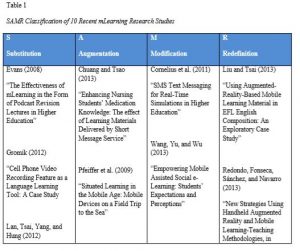
Hamilton et al. (2016 ) and Romrell et al ( 2014) both give examples for each stage of the model and illustrate them as a hierarchy with the modification and redefinition models sitting at the top of the model.  Romrell et al (2014)looked at SAMR and how it could be used to complement/guide mLearning (mobile learning). The authors clearly illustrated ideas for including mLearning across the four levels in the following chart they included as part of their discussion.

The SAMR method seems well structured and clearly defined with the ultimate goal of incorporating technology within the top two levels as often as possible ( Redefinition and Modification). When reading this paper, I felt drawn to what appeared to be a straightforward way of navigating the tech pool. I expected many other educators would agree.  A google search did not disappoint me; the structure seemed to be appealing to many educators. This paper and the ideas presented within in it had me thinking about ways I could include similar activities within my teaching practice, particularly as the students have 1:1 devices. One that resonated with me was the concept of sending messages with definitions at particular times to further facilitate the learning of terminology. While my initial impression was one of excitement and a conviction that this was model for me, further reading and analysis began to create questions and concerns in my mind.

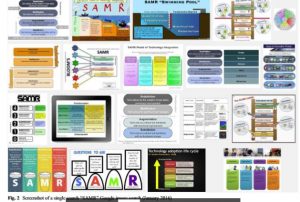
The first concern I had was connected to the push to reach the top two levels. When examining some of the examples given for the top tier as illustrated in Figure 2 above, I began to wonder about the practicality and functionality of this model.  Augmented reality tasks? With what equipment? What training? Software?  Other concerns arose while reading through the Hamilton et al. (2016) paper. While the overall concept and the levels of learning seem straightforward, the image below was included in their paper to show that there are many different interpretations of SAMR and many different illustrations for visualizing how this concept works. Suddenly this model became more complex.

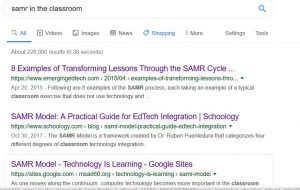
The authors argue that the variety of understandings may lead to misinterpretation. For example, they discuss Brubakers (2013) model of “ SAMR, [where] the four levels represent different types of coffee-based drinks (e.g., black coffee [Substitution]; latte [Augmentation]; caramelmacchiato [Modification]; and, pumpkin spice [redefinition]”. While they argue that the variety of understandings of SAMR may lead to confusion and misunderstandings, a google search of “ SAMR in the classroom” led me to multiple pages that all shared the same information about SAMR. While they state that the multiple modes is a negative aspect of SAMR, based on the google search and subsequent readings, I disagree as all of the models represented bore the same four levels with discussion of how to integrate technology and what each level looked like. As most teachers do not have open access to journals connected to SAMR, they likely get their information from the internet; the search I conducted resulted in a number of similar finds. 

 A few other concerns that were brought up in the Hamilton et al ( 2016) paper caught my attention. One mentioned previously is connected to the hierarchy of the model and the push to move to the top two levels. This is concerning as rather than integrating technology to increase learning or to extend and create new learning, the push to create learning in the top two levels may lead to a singular focus on the technology. They note that, ” In the SAMR model the emphasis remains on the levels of technology use teachers should align themselves with in order to move themselves along the hierarchical continuum of SAMR. This minimizes the more important focus on using technology in ways that emphasize shifting pedagogy or classroom practices to enhance teaching and learning”.  The biggest concern I had after reading this paper was the issue of context. The authors note that,

” the SAMR model includes no accommodation for context. As a result, important contextual components, such as technology infrastructure and resources, community buy-in and support, individual and collective student needs, and teacher knowledge and support for using technology are not recognized.” 

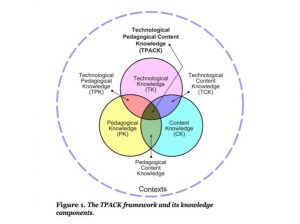
Now unconvinced that SAMR would be the best model, I began to examine TPACK.  The paper, “What is Technological Pedagogical Content Knowledge” (Koehler, M. & Mishra, P. 2009), along with the Hamilton et al. (2016) paper shed some light on the workings of this model.  My initial reaction to TPACK was, what? and how?  As I began to wrap my head around this simple, yet incredibly complex model, I found myself drawn to its underlying principles. The interconnected and overlapping circles of technology, pedagogy and content knowledge made sense to me. The image presented below clearly illustrates the components of this model (Koelher et al. 2009).


One important inclusion within this model that was not included within the SAMR model is context. The model shows that the three components overlapping within context. The authors state that, 


  “ TPACK is the basis of effective teaching with technology, requiring an understanding of the representation of concepts using technologies; pedagogical techniques that use technologies in constructive ways to teach content; knowledge of what makes concepts difficult or easy to learn and how technology can help redress some of the problems that students face; knowledge of students’ prior knowledge and theories of epistemology; and knowledge of how technologies can be used to build on existing knowledge to develop new epistemologies or strengthen old ones.”

The authors go on to discuss the method of using TPACK and clarify that it is a method that is ever changing based on the classroom.  While TPACK does not appear to have the same defined structure as SAMR, it does contain all of the components I believe are essential for effective teaching. It may be argued that the addition of context to SAMR would resolve one of the key issues of this model. In fact Hamilton et al .(2016), noted this when they stated, “this could include adding context as a formal aspect of the framework, as is the case in the TPACK framework”. However, even with the addition of context, the SAMR model still contains some concerning elements. “Moreover, [TPACK] allows teachers, researchers, and teacher educators to move beyond oversimplified approaches that treat technology as an “add-on” instead to focus again, and in a more ecological way, upon the connections among technology, content, and pedagogy as they play out in classroom contexts.”. ” ( Kohler et al., 2009)

Final Thoughts

At this point, my preference is likely quite clear.  I was initially drawn to SAMR. The nice illustrations and what appeared to be clear cut applications pulled me in whereas the fuzziness and dynamic appearance of TPACK felt intimidating, like trying to find my way through a maze with a plethora of options. After further readings, a little googling and some further contemplation, I began to see the potential possibilities of using TPACK as a framework and the limitations of SAMR.  However, while I prefer TPACK as a whole over SAMR, I still believe SAMR to be useful and believe that a combination of the two with TPACK as the guiding structure, would be most beneficial.  Now, armed with a flotation device and a map, I look around, ready to explore the depths; excited to see what lies below.


Technology in Education: Blog post #1 ( EDCI 570/571)

Photo by Pixabay from Pexels

Technology in Education

Schooling has changed in many ways from the days when I attended school. I recall sitting in my desk, an island in a classroom of islands, paper and pencil in front of me, half-listening to the teacher, while trying to sneak in a few more pages of the book I was reading. The one piece of technology in the entire school, the one Apple computer that existed, at least in my memory, lived in a dimly lit cubicle sized room. Most often the door was closed, but when opened the eerie glow pulsated through the shadows of the dimly lit room and the humming that emitted from the alien machine drew glances from the energetic students that chattered by. I never got more than a glance, never saw this mysterious machine up close and never touched it.  Over time, computers grew to be more commonplace and became a sight that failed to grab my attention or thoughts other than for a brief moment during the weekly trek down the hallway to the computer lab where rows of uniformly bulky grey machines waited for the next student to attempt the required typing challenge. Soon after, a computer appeared in my home and was magically connected to an outside world; the internet. I can still hear the grating sounds of the computer connecting and frustration connected to the instant loss of signal the moment someone answered the phone.

In a flash, the pervasiveness of technology and the concept of anytime, anyplace learning became the new normal. The use of technology to enhance lessons, to capture attention, to encourage and develop collaboration became commonplace. Now, as an educator, the technology incorporated as part of the education students receive at my school is drastically different from the education I knew and received. So, what are the differences? What are the trends? Why is technology and the use of technology in classrooms so often a part of teacher and PD (professional development) or PL (professional learning) discussion? 

The top trends connected to the use of technology in educational settings may be identified differently according to differing perspectives, locations and lenses. Were you to google “Top educational trends in Technology” you would get about 831,000,000 results.  The staggering amount of information one has access to as well as the many applications of technology may become overwhelming. So, what are some of the trends according to pages you may encounter in a google search? Are these identified trends also trends within my workplace? Are they common trends in educational settings around me?

Trends

The following six blogs/ webpages discuss education and technology. While all have their own ideas and connected discussions, some common themes can be identified.

  1. According to Labullier  the top trends are: 1:1 learning devices, mobile devices, wearable technology, cloud computing, collaborative computing, robotics, internet of things and game based learning, STEAM/STEM and AR (augmented reality).  
  2. Randles identified computational thinking, PL , AR, VR (virtual reality) and mixed reality, AI ( artificial intelligence) and global learning, learning sciences and digital citizenship and student centered learning. 
  3. Jobanputra identified them as customizable learning experiences, cloud computing, speech to text options, VR/AR, 3-D printing, learning analytics.
  4. Lambda Solutions identified coding, seamless resource access, remote learning and gamification and learning management systems. 
  5. According to Technology in Education 2019: 5 Trends to watch, the top trends are classroom learning as a supplement to online learning, MOOC’s ( Massive online open courses), AR, 5G ( faster networks), content on demand, inclusivity/ exclusivity and collaboration.
  6.  Jarman sees them as: Smartboards, AI, AR, VR, blockchain technology, learning analytics and adaptive learning.

The commonalities between all of these are: AI, AR, VR, anytime/ anyplace learning (enhanced by mobile devices, 1:1 devices) , global/collaborative computing/ learning and student centered/focused learning. results. 

When examining the environment I work in, U-Connect, many of these trends exist in the day to day education of the students taught here. However, the setting I work in is not a typical school and some of the trends mentioned exist only in specific classes. For example, technologies such as gaming, VR and AR are used in the technology pathway but are otherwise not used. Students have 1:1 devices, so students have the ability to collaborate using tools like google docs and to meet and collaborate both inside and outside of class time. However, my understanding is that many high schools still use COWS (computers on wheels) and have only small amounts of time with them. The Moodle courses used at the school I teach at use online textbooks, videos and often have interactive components. Built into the courses are a variety of accessibility options. eg text to speech.  The students are blended learners, who attend class 2 days a week and complete learning and work at home on the other three days.  This lends itself nicely to trends connected to flipped classrooms, remote learning, content on demand and inclusivity . While there are many aspects of student focused learning within the program, due to smaller class sizes/school size, I wonder how this could be further improved.

While the setting I work in utilizes many of the tech trends mentioned, I am curious about other educational settings as some of these trends are likely not prevalent in many schools due to cost and skills. The cost to equip all students with devices within a district, I imagine, would be more than the available budget. Most students have smart phones which could be used for online collaboration and for some of the other trends mentioned, but then what of the students who do not have a device, or do not have a device that is able to handle the application? Skill set would be another barrier to the inclusion of many of these Tech trends. For myself, this would also apply as some I do not have the skills required to incorporate some of the tech trends mentioned in the readings. 

Connected to education, technology in the classroom and tech trends, the article by Holland, J. & Holland, J. (2014). Implications of Shifting Technology in Education.  makes an important point regarding the implementation of technology in the classroom.  


“Often, however, a snazzy new technology becomes the sole focus, not the ideas or innovative uses that lead to improved learning” .  It is important to consider instructional needs alongside new and emerging technologies aligned to desired outcomes”

The authors also wonder about what might be lost when including technology in education. A perspective of, if I replace a with z what do students lose and what do they gain, may help when considering this.  Their discussion of key trends in technology includes ones similar to those mentioned earlier. According to the authors, the hot trends for 2019 would be:

“augmented reality, natural user interfaces, semantic applications, and tools for assessing 21st century learning skills. Key trends are reflecting the shift towards more access, mobility, online, hybrid, and authentic active challenge-based collaborative learning models to develop leadership and creativity.”

And are they?

My Thoughts:

I think they are to an extent, but often only in specific environments (classes or schools). For example, AR is found in some schools and programs/classes but would not be prevalent. Natural user interfaces again may be used in some instances for example, within specific programs or in specific classes or students may encounter them within the devices they work on or at home in games but, I think we are far away from the creation of classrooms with natural user interfaces.

On the other hand, there is a trend towards creating more of what was described by the authors as, “authentic active challenge-based collaborative learning models to develop leadership and creativity”. This is seen in the design of the new curriculum and is often included in PD and PL. Teachers are looking for ways to incorporate this type of  learning/ teaching within their classrooms. The connection between technology and learning for the 21st century is mentioned in this paper and has me thinking about other ways I can learn about and implement new technology within my teaching practice in ways that create improved learning and develop skills needed in today’s world. However, as much as technology can improve learning, without a skilled teacher to design the learning and to guide students along the way, they may just end up with 831,000,000 ideas/results/pieces of tech and no way to filter or Boolean search through them.

 Closing thoughts

It was interesting to discover that may of the trends, including those predicted in the Holland & Holland article exist in the setting I work in. In addition to learning some new terminology and becoming curious about exploring some new uses of tech in my practice,  I have decided that I should try out “Rocksmith”, a natural user interface game that may ultimately lead me to accomplish one goal on my bucket list: to learn to play the guitar! I’m anticipating the event to be far more stimulating than shooting the letters that fell from the black abyss in the game I used to play in my high school typing class. Now if I could just remember the name of that game…… 

“Where Am I Now?” Final Blog Post


The Introduction

I recall a story I shared with my students, one you have probably heard before; of the blind men and the elephant. As the story goes, each man was touching one part of the animal and using what they felt to create an overall impression of the animal; this led to arguments. Each person was convinced that they were right and the others were wrong. They were unable to listen to anyone else’s point of view.  The discussion I had with my students centered around only seeing one perspective and not opening your eyes to other perspectives; being blinded by beliefs. This idea of perspectives and blinded beliefs has intertwined itself through many of the research papers, class discussions, my blog posts and my many late night ponderings.

The Beginning

We always start somewhere. My start was with a pile of enthusiasm and a jarful of ideas and biases I held about research and social media, amongst other things. These were not verbalized or highly passionate ideas, they were simply beliefs that resided quietly in the periphery of my mind only coming to the forefront as we began to explore ideas. My ideas about research were simple. Researchers researched to gather data and information that created knowledge. Quantitative and clinical studies were superior, the best and most trustworthy sort of research, and qualitative, perhaps they shared some interesting ideas about people’s thoughts, but they were not the gold standard and were certainly not as rigorous and valid.  The researcher along with their research were the most important aspect of all this; I liken this to “Folke on his towering chair in the corner of Isak’s kitchen in the movie Kitchen Stories.

My ideas about Social Media were apprehensive and filled with a combination of wariness, untrustworthiness, and a conviction that it was a waste of time. I had no interest in putting myself out there on Twitter and couldn’t see any reason to do so. Shortly after, I found myself reopening my Twitter account and talking about PLN’s. A what, I thought?  Personal Learning Network. What do I need that for? And now a blog? Okay, and we can choose to make it public or private, and we can choose to go on Twitter or not. And, I begin thinking and remembered that I came into this program to learn, to try new things, to take risks. So, I and my jumbled piles of ideas and beliefs, jumped on. We jumped into exploring research with new lenses, we jumped into new ways of thinking about learning and teaching and sharing through social media.

The Middle

I began working through papers and connecting on social media. I remember the nerves around sending the first tweet; Is there a,  “this is a terrible tweet” button? Can I delete it? I recall discourse around social media and privacy and open learning. I recall one of the first presenters we had, Dr. Christine Younghusband. She talked about creating an online presence and the importance of including an image and some information about yourself. So I added these components in.

I remember reading through the first few research papers on Research Diaries and Autoethnography and my discussion around journaling and writing; how this can lead to greater reflection. I made some interesting assumptions with regards to my discussion around the written word; now when I look back I can see some of my biases connected to the written word. Were I to read this article now with the understandings I have gained, I believe my response would reflect this changed point of view. I would hold the spoken language in as high regard as the written. I might also argue that each has its own inherent value and that they should be examined independently rather than compared to each other.

I recall the visit from Dr. Shauneen Pete, the discourse about her work, and the impact this made on me. I had never thought about indigenous perspectives this way; I had never thought of myself as a settler. And I began to wonder what other knowledge I was missing. I recall the inspirational visit from Jeff Hopkins that had me looking at education with a new lens, that had me wondering how I could try this out, how I could find out more.

In the midst of all this, in the midst of learning about teaching pedagogies and educating students about digital citizenship, I suddenly realized that I was tweeting and asking questions and beginning to connect with others online. And, I was enjoying it; I was seeing the benefit of it.

I then recall the visit from John Willinsky and the public knowledge project (PKP) and how my mind opened up to this idea of open access. And I thought; yes, research should be public; globally available to all. This is amazing; amazing for learning, for sharing, connecting and researching. Research is so important for improving practice, for opening minds. To have open access, what an impact this can make!

In one of the last classes we looked at Métissage reading, the idea of braiding by breaking apart, by breaking pieces down and then taking these pieces and re-braiding; creating something new. And I thought, this is what this learning has been like, I think back to the ideas I came in with and the ideas that were broken apart, and the new ideas that began to enter and the re-braiding of these new pieces.

The end and a new beginning

I was introduced to new ideas and ways of thinking, of sharing and of learning, the community within the class, the new community I am building on line, the discourse that keeps me thinking and wondering, the new teaching pedagogies, the learning from research, the new types of research that I didn’t realize existed: the mixed method studies, the action research, the narrative research, phenomenology. The different perspective’s; the 4 R’s. Through all of this I learnt about myself, what I want my teaching practice to be.  I learnt that there are multiple ways to understanding and of understanding and viewing. I reflect back on a quote that really impacted me from the reading, “Indigenous knowledge systems and science and technology education: A dialogue”,

 I am suggesting that the two systems are different and therefore require different forms of verification. These verification methods and processes can actually be equated and be made to be of similar standards, however they have to be appropriate for each system, otherwise we would compromise one system at the expense of another and in the process lose the beauty of what the two systems could provide alongside each other.”

Onwu,G & Mosimege, M (2004)

When I think about my teaching, I realize this quote applies to my students as well. The work and assessment that takes place for each student needs to be appropriate for each student; it does not need to be the same. I reflect on the beauty of teachers and students working alongside each other.  And I am suddenly brought back to the elephant story told at the beginning and I wondered…

What if in fact, these people talked to each other and shared their ideas. What if one man said, rather than you are wrong because I am right, what if they said, take me, show me what you feel. Show me what you see. Tell me what you see.

This same idea is illustrated beautifully in the following statement taken from the podcast below.

“We’re always coming from a mindset of where we know best and we have an answer, and we’ll consult on it, but it’s what we come up with. And so to me, until we can actually say ‘We don’t know what this answer is. What do you think?’ and talk together to build something… I don’t know if that’s even do-able. I mean, obviously it’s a very scary thing.”

Duration: 34:08 minutes

Had the individuals feeling the elephant used this idea, had they said, I don’t know what the answer is, what do you think? Had they talked together, they may have been able to build the whole elephant in their minds. For is it possible to know the other side if your voice is the only voice you listen to, and the only voice you hear, is your own?  In my teaching, this connects to listening to student voices, to think, is this what I think the students need or is this what the students need?. It’s asking, what do you think?, It’s saying, I don’t know, let’s see if we can find out, let’s see if we can find someone who does know, and, then it’s building together.

And I reflect again on research and on social media and I realize that both allow for the listening of other ideas, both allow for the voicing of ideas, both allow for the creation of new meaning and understanding; the creation of a voice online, a practice informed by research. Both build connections. This simple word with so many meanings.  And I looked back at the picture I had just changed on my blog’s header. The picture that, to me, seemed to communicate both knowledge and technology, but was missing the essence of teaching, the essence of learning. And, I found a new image, one that showed connectedness, community, communication, and collaboration because this is what ties it all together. This is important.

I am filled with excitement. Excitement for how I will learn and grow over the next few months and years. Excitement for how this will impact and change my teaching. Excited for the questions I want to pursue; excited, scared and apprehensive, I’m not sure what this will look like at this point, I’m not sure how messy it may get, I’m not sure how comfortable I feel about any of it, but, as a friend once told me, “at times you may feel uncomfortable, lean into this as that is when your growth will happen” (Burnham, L).


« Older posts Newer posts »