Photo by Johannes Plenio from Pexels

Category: Uncategorised (Page 2 of 2)

Ed Camp

Ed Camp

This week our class was run as an EdCamp. What is an ED Camp?

According to wikipedia,

“An edcamp is a participant-driven conference – commonly referred to as an “unconference”. Edcamps are designed to provide participant-driven professional development for K-12 educators. Edcamps are modeled after BarCamps, free participant-driven conferences with a primary focus on technology and computers.”

This was the second Ed Camp I have participated in and, having had two positive experiences with this style of conference, I would recommend it as an effective method of professional development.

Both EdCamps I have participated in took place in an online environment; one in Bluejeans and the other in Zoom.  For an Edcamp, I would say, that between the two, Bluejeans is more suited to this style of Professional Development. The main reason for this is that, within the BlueJeans system, users can come and go as they please from room (topic) to room (topic), whereas in Zoom, the moderator has to assign them to a room, so every time a participant wants to switch, they would need go back to the main room and ask the moderator to send them to a different room.

While I have not attended a physical EdCamp, I would think that there are some benefits to attending an Online EdCamp. One of the larger benefits of an online EdCamp is that visitors can be invited in from all over the world to share ideas, answer questions and contribute to discussions.

I wonder about trying out the Blue Jeans system with some of the classes I currently teach. And I wonder how different the experience would be as compared to something like google hangouts.

The room I stayed in for the duration of the EdCamp was connected to engaging students in online and blended learning. It was interesting to hear others questions, ideas and experiences connected to this. A couple of the topics that arose were connected to teachers understanding of how to teach online and students understanding of how to learn online. These topics lead to many questions that I would like to do some research on as part of my literature review. In addition, as a result of this discussion, we spoke as a group about designing a required credit course that teaches students how to learn online. I’m excited about the possibilities!


Educational Utopias?

GIF from Giphy.com

A trend I have come to notice within some of the research we have looked at connected to education and the future of education is dialogue about systems and structures that will create the idealized personalized educational experience for every student. These utopian educational ideas created by academia, likely researchers who have no classroom experience,  can be perceived by the classroom teacher ( myself) as overwhelming and unachievable. What is missing in this research is the how. How do we create the educational system discussed within these papers? Is it even possible? What are small steps that could be taken to progress in this direction? It’s easy to talk about an idealized education, it’s like storytelling; just use your imagination and wipe the barriers away with your magic wand.

This short rant was inspired by many class readings but came to fruition after reading this week’s readings.

Reading #1

Siemens, G., Gasevic, D., &Dawson, S. (2015). Preparing for the Digital University: A Review of the History and Current State of Distance, Blended, and Online Learning. Retrieved from Bill & Melinda Gates Foundation website:

My Notes.

Learning Management Systems

This article included some interesting information about Learning Management Systems (LMS). One in particular, Canvas, looked as though it may have some promising features that may help to create blended courses that are more intuitive and less of a read/respond/write a test type of structure as many of our pre-built Moodle classes are structured to be. The challenge, and the benefit that Moodle has is that many courses are pre-built. From a teacher time perspective, building every course from scratch is not manageable. However, this looks like a LMS that it worth exploring a little further. Perhaps even to get some ideas that could be incorporated within our existing platform. Although it was noted that this is U.S based and therefore licensing may be an issue here in Canada.

Can we structure our moodles to adapt and personalize learning based on what students need and where they are ? E.G you write a test and it checks off what you know and then you are placed and work according to where you are rather than separated by age..

This is a great concept!  PROSOLO

“ProSolo unpacks the rigidity of existing programs to cater to alternate educational pathways, pro-viding students with new opportunities to gain recognition for prior learning and achieved credentials and relevant life and work experiences. ProSolo doesn’t just break the concept of the credit hour — it totally removes it.” –Prosolo 

” ProSolo  recognizes that  learners  may not  be  prepared for  self-directed  learning and may require a different form of scaffolding. To support learners with different levels of prior knowledge, study skills, and cultural backgrounds, ProSolo offers features for supporting self-directed learning through three types of scaffolds” – Prosolo 

I wonder how and if this concept could also be applied to high school education? Is this another unachievable utopia?

Considerations when teaching online:

Comfort and skill level of learners

I recall reading a few articles connected to this, that also specifically looked at the impact of gender and cultural differences connected to comfort and skill level.  This is an important barrier to consider. This is one area that I would like to do some more research on.

Will trends lead to less face-to-face classes and more online classes? Could we, one day, potentially only take classes online/virtually?

I wonder if this will ever happen as students value the face-to-face time. The research I looked at in my lit review also supports this. At the same time,  I wonder if this would change, especially as people are looking for more and more flexibility. I also wonder if, in the future, communicating online has the potential to create the same valuable experiences as face to face. What will technology look like in 10-15 years?


Reading #2

Neil Selwyn, Thomas Hillman, Rebecca Eynon, Giselle Ferreira, Jeremy Knox, Felicitas Macgilchrist & Juana M. Sancho-Gil (2019) What’s next for Ed-Tech? Critical hopes and concerns for the 2020s, Learning, Media and Technology.

My Notes

Decolonizing Technology

An interesting blog connected to this concept. https://beatricemartini.it/blog/decolonizing-technology-reading-list/

Ethical and Environmental Impacts of Technology

A really important point that may not always be fully considered. Ethical impacts seem to be more commonly considered than environmental impacts; at least there seems to be more conversation around ethics. Both are important considerations and are concepts that I would like to introduce and discuss with students.


Reading #3

Downes, S. (2019). A Look at the Future of Open Educational Resources. International Journal of Open Educational Resources, 1(2).

Notes

A quote that stood out to me.  

I admit, this may have been the quote that inspired my rant at the beginning of my post. 

“Again, it’s a shift in focus from the content to the interactions and operations. It’s about how to merge this data with this application or this capacity or this bit of artificial intelligence to create a learning experience for a person. This is a very different way of thinking about instruction and instructional design than what instructors and designers may be used to, and it will require practice and application on new leading design systems in order to support this transition.”

I love this concept, but wonder how this shift can be created. What would it look like? What steps would need to be taken? What skills would the instructor and course creator need? It seems quite complex. This is a Utopian ideal.


And….that’s all folks……well until next week.   Perhaps my ensuing literature review will shed some light on how we may realize a Utopian educational educational system. Although, I must admit, based on my experience with novels that contain Utopian societies, they are all Dystopia’s; perhaps we shouldn’t be questing for a Utopia at all!

The Implications of Openness

For this post I wanted to flesh out some of the topics that caught my attention while reading and, that I would like to explore further in relation to some of my thoughts as well as ideas brought up in this weeks meeting. The topics for this week were, Open Scholarship, Open Data, Open online courses and Open research. Wow that’s a lot of Openness. One thing that I have come to realize over the past few weeks is that contrary to my initial thoughts, the  term Open has a vast number of meanings and, comes with a vast number of questions, concerns, debates and intricacies. Far from being a black and white concept, there are many shades of grey.

The first article,  Open Data as Open Educational Resources: Towards Transversal Skills and Global Citizenship   ( Atenas, J., Havemann, L., & Priego, E., 2015) defined Open Data as ” the name given to datasets which have been generated by international organizations, governments, NGOs and academic researchers, and made freely available online and openly-licensed”(377). The authors bring up some points connected to open data; the ones that I gravitated towards were the connections made to democracy and the reinforcement of our role as educators in this knowledge age. This article piqued my interest in that I was easily able to make connections to the ideas presented and began to examine my practice to see if in some manner these ideas were being executed within my teaching, or if this was indeed, something I should begin to foster and develop as part of my practice. While many of the ideas for implementation show connections to science, math and some socials, the examination of data and then ensuing discussions and explorations is applicable across all subjects and may be an effective way to create cross disciplinary inquiry projects….Now I’m getting excited !

I found this resource online: Common Online Data Analysis Platform.  This platform looks intriguing and is designed for Grade 5 and up.
Has anyone used this resource? Does anyone out there have other resources they have used to explore Open Data with their students?

One of the other articles we looked at was Academic Publishing at a Crossroads.  ( Couture, M., 2017)

As stated by Couture, “The open access movement’s vision for the free use of academic papers is to see researchers regain control of key aspects of the publishing process”. While this sounds lovely, there are many questions and debates that can arise as part of this concept. This also came up in class and the concern about eliminating the publishers is the fear that we may not know how reliable or trustworthy an article is. While this may be in part attributed to a fear of the unknown and resistance to change, these are valid points. What will be used to fairly asses articles and research? How will I, the researcher, know how to find reliable articles? How will they be sorted? How will an individual be able to able to filter through articles quickly to find reliable article connected to topics of interest?. If anyone can publish and peer review is eliminated or changed to an open peer review, what might be the potential implications?

Another article we explored this week was, Scholars in an increasingly open and digital world: imagined audiences and their impact on scholars’ online participation  (Veletsianos, G & Shaw, A,. 2017). This “study examined how scholars conceptualize their audiences when participating on social media and how that conceptualization shapes the ways in which they participate and express themselves online”.  One quote that captured my interest was,  “By monitoring responses, reactions, and feedback from their audience, individuals emphasize or de-emphasize certain aspects of their selves to create a desired impression”.  Based on what I have seen posted online, this could have drastic impacts on what is being shared with a given audience. This quote also lends itself to a discussion around online identify. If this is truly the case, can anyone truly have an authentic online identity? What are the implications of this? Does it matter? When discussing this topic in class this week, we also discussed the teaching of digital literacies as well as the education of teacher to teach digital literacies. The common consensus was that these are often not being taught to students and that teacher education programs are not teaching students how to teach these skills. It’s easy to argue for the teaching of these skills as they are important in the world we live in.

The last article was connected to open courses (MOOC’s). MOOC’s and the Claim of Education for All: A Disillusion by Empirical Data. (Rohs, M & Ganz, M., 2015). This article, in particular, really impacted me in the manner that it clearly showed that MOOC’s, while (I believe) useful and important, are not doing what they purportedly set out/claimed to do. Rather than deceasing the education gap, they are only widening it as the majority of people using MOOC’s are those who already have an education. The article also highlighted the disparity that exists within education and really established the many barriers those who live in third world countries face when it comes to education. It left me feeling hopeless, so many insurmountable barriers, many that may begin with governments, and with some wonderings about the education that we as Westerners want to be consumed by the world.  I could probably write an extensive post connected solely to this article, but due to having created an already lengthy post, I will save that for another time.


Reflecting on Theories and Practice in Online Learning


GIF from @GIFY by @criswiegandt

It was with great earnest that I began to survey the weeks reading’s, questing for the magical bean that would thereby only need to be planted to sprout into something of enormity that would transform the landscape and potentially lead to magical kingdoms in the sky.  And, while the readings produced some concepts of interest that may begat further study, the magical bean was left uncovered.  The sections below are my attempt to make sense of this literature and to determine its potential usefulness or,……. uselessness.

Key Reading Points:

Reading 1: Learning Design and Open Education

This article, by Conole (2018) examined the design of open education (MOOC’s and OER’s) and, the author argues that more engaging designs are needed, a comment I would agree with.   A comprehensive look at the in’s and out’s of both provides the reader with an understanding of how each works, who uses each, what the barriers are and finally, why they are important.  Also included is a detailed discussion around learning theories. One visual by Millwood that was included in this article and posted below; while, overwhelming to say the least, outlines these theories.  If you are finding this hard to read and digest, it is more than just the terrible pixelation; here is a direct link, should you wish to peruse each in further detail.   Learning Theory Diagram
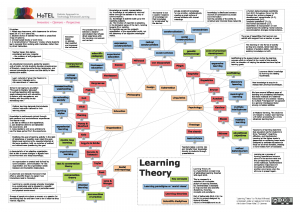


What is even more amazing is the number of pieces represented within this diagram; it truly illustrates the complexity of teaching and learning.


Reading 2: Pedagogical Models for E-Learning: A Theory-Based Design Framework

“This paper presents a theory-based design framework for E-Learning that emphasizes the transformative interaction between  pedagogical models, instructional  strategies, and learning technologies” (Dabbagh,. 2005, p.25).   After reviewing a number of theories, Dabbagh argues for distributed cognition to be used as the basis for E-learning.  Dabbagh names three interconnected components required for effective implementation of E-Learning in connection with this : (1) pedagogical models or constructs, (2) instructional and learning strategies, and (3)  pedagogical tools or online learning technologies.  Dabbagh goes on to list a vast array of strategies, strategies that one could argue could also be connected to effective teaching in any situation, online or otherwise:

“(a) promoting or  supporting  authentic  learning  activities;  (b)  facilitating  problem-solving,  exploration,  and  hypothesis  generation;  (c)  promoting  collaboration  and  social  negotiation;  (d)  supporting or facilitating role-playing activities; (e) promoting articulation and reflection; (f)  supporting  multiple  perspectives;  (g)  supporting  modeling  and  explaining;  and (h) providing  scaffolding.” (p.33)

This paper also illustrates the complexity of teaching, and the quest to find a fitting framework for E-Learning.  As a nice addition, the author provides specific examples for each strategy.  These specific examples may be helpful for all teachers, not only those who teach in an E-Learning environment.

Reading 3:  Teaching online is different:  Critical perspectives from the literature

Although based on higher education, this paper by Shé Ní, C., Farrell, O., Brunton, J., Costello, E., Donlon, E., Trevaskis, S., and Eccles, S. (2019) posited some interesting discussions and information connected to online teaching, online learning and the online teacher.  While many of the strategies mentioned would be applicable regardless of the teaching environment, the authors do include aspects that would be unique to the online environment.  One large consideration, when teaching online, are the skills needed, not only to run the class, but also to build and change courses.  While we received little connected training on this at the school I currently work at, I am curious if other schools provide training, or if this is something typically only provided to those teaching higher education.

Also, as an online teacher, I found that some of the points made within this paper did not apply to my situation. For example, discussions around the inflexibility of the curriculum; not an issue in my workplace as we have full control over the content and the teacher has the authority to add, omit and adjust as needed.  I believe that the larger challenge here is the teacher time it takes to create and modify courses, and the little time given to teachers to do this.  Another point I connected with that was brought up within this paper, something that can be a quite a challenge, is accessibility.  While this paper speaks to the importance of the accessibility of the teacher, one might argue that the accessibility of the student is equally important when it comes to success within the course.  In the Moodle learning management system (LMS) we use, teachers and students have the ability to message each-other through the Moodle message system; however, one may wonder if there is a more effective messaging system that could be used as messages are often not responded to (in my experience with messaging ‘absent’ students).  As students are not in front of you, it can become very challenging to help them to complete and submit assignments; perhaps a more effective messaging system or other forms of collaboration/community building could help with this.  While these may be applicable and perhaps even necessary in high-school education, I wonder about the applicability of collaboration and community building within higher education, and would argue that while specific courses and programs lend themselves to this, others may not.  I found it interesting that within this paper, as has been mentioned in a number of papers viewed recently, the TPACK model was mentioned as a possible construct for online learning and teaching. To see more of my thoughts and further details on this model, follow the link here.

Reading 4:  Mapping Pedagogy and Tools for Effective Learning Design. 

This paper by Conole, G., Dyke, M., Oliver, M., and Seale, J. (2004), looked at effective pedagogy and design by examining existing theories and models and their application to E-Learning.  Within the discussion, overview charts were included that contained specific details connected to a variety of theories and models. The framework in Figure 2 below,  was used in conjunction with learning theories mentioned: behaviourism, pre-conscious learning, reflective learning, experiential learning, learning in HE, conversational framework and communities of practice. The concluding thoughts presented are that the provision of a model such as this will give teachers a practical framework to help them navigate the many existing theories and models which may result in more thoughtfully informed pedagogy within an online construct.  One benefit this framework may have is its apparent simplicity.
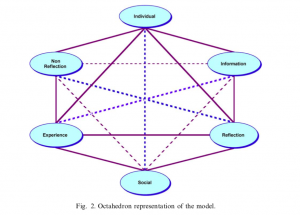
 

(p.24)


Now WHAT?

After reflecting on this week’s readings, I would like to spend further time exploring some of the strategies included within these papers, a perceivably daunting task, to see if I can find ways to further develop, embed and include them within both the face-to face classes I teach and the online courses. While I often reflect on the pedagogy and strategies I use within the classroom, my reflection connected to the online components has primarily been connected to the content.  Advances within the constructs and capabilities of the LMS system we use as well as thoughtful changes in the way I deliver both the face-to-face and online content, may allow for the creation of learning experiences that are more authentic, collaborative and engaging; and, that combine elements of the online and face-to face world in an effective, pedagogically based construct.

Perhaps the magical bean will be uncovered.


References

Conole, G., Dyke, M., Oliver, M., & Seale, J. (2004). Mapping pedagogy and tools for effective learning design. Computers & Education, 43(1–2), 17–33. Retrieved from https://doi.org/10.1016/j.compedu.2003.12.018

Conole, G. (2018). Learning Design and Open Education. International Journal of Open Educational Resources. Retrieved from https://www.ijoer.org/learning-design-and-open-education_doi-10-18278-ijoer-1-1-6/

Dabbagh, N. (2005). Pedagogical Models for E-Learning: A Theory-Based Design Framework. International Journal of Technology in Teaching and Learning, 1(1), 25–44. http://citeseerx.ist.psu.edu/viewdoc/download?doi=10.1.1.475.4593&rep=rep1&type=pdf

Huston, L (2019). Drip, drip, drop…. Models for technology integration (TPACK and SAMR). Teacher Talking Technology. Retrieved from https://teachertalkingtechnology.opened.ca/2019/09/23/drip-drip-drop-models-for-technology-integration-tpack-and-samr/preview_id=342&preview_nonce=20a83893c3&post_format=standard&_thumbnail_id=-1&preview=true

Millwood, R (n.d). Learning theory.  Retrieved from https://proto-knowledge.blogspot.com/2015/09/overview-of-theories-of-learning.html

Shé Ní, C., Farrell, O., Brunton, J., Costello, E., Donlon, E., Trevaskis, S., & Eccles, S. (2019). Teaching online is different: Critical perspectives from the literature. Retrieved from Dublin City University website: http://doras.dcu.ie/23890/

Wiegandt, C (n.d). Tree growing GIF. Retrieved from https://giphy.com/gifs/plant-leaves-world-environment-day-ZZweDJbmPPLYiwQuf9


 

Social Media as a Professional Learning Tool

Today we had the pleasure of two guest speakers who shared their experiences with using social media as a professional learning tool and as a way to connect with other educators. An avoider of many forms of social media, I recently resurrected my Twitter account and have decided to to do some of my own experimentation with using Twitter.

I am posting this as a means to create some accountability to myself as well as to reflect on my experiences using social media.

Week #1

I tackled the first hurdle, publishing my first tweet as an educator; my finger hovering over the tweet button, eyes closed as I stabbed blindly at the small blue bird icon. And just like that, I had entered into another realm. I was officially a tweeterer… Is that even a term?

Next step: Adding to my lists

First: hashtags

  1. #blendedlearning
  1. #engchat
  1. #onlinelearning
  1. #distributedlearning
  1. #edtech

Second: Twitter handles

  1. @blendedlearningnetwork
  2. @nelliemuller
  3. @insdpire
  4. @thinklangley
  5. @uconnect35

Third: Blog addresses

1. lornacampbell.org

2. Veletsianos.com

3. Couros.ca/blog

These were a lot harder to find, but I’ll be keeping my eye on my feed in hopes of finding more to follow…

Now to see how well this app works …

#postingfrommyphoneforthefirsttime

Newer posts »