Photo by Johannes Plenio from Pexels

Category: EDCI 572 (Page 1 of 2)

Ethical Dilemmas

Image from Pixabay

One of my big passion areas is ethics and the ethical dilemmas we continuously face both as educators and citizens living in todays ubiquitous age of technology.  So, when scanning through some of the readings for the week, I was immediately drawn to the topic of social media and education.  Do we embrace the pervasive nature of social media and utilize it to further enhance our teaching and the learning done by students, or are we jumping on a bandwagon too fast without a thorough understanding of the ramifications this could have. What are the true benefits of using social media? What are the true costs? Do the benefits outweigh the costs in such a significant manner that they need to be included?  Are we unable to provide a meaningful educational experience without the use of social media?

To be clear, my concerns are primarily directed towards the K-12 educational system as it is my belief that post secondary ethics are a different beast than the ethics that need to be considered within a K-12 system. My objective, therefore, for this post, is to explore these ideas further in connection to research on either side, perhaps to come to a conclusion. Hopefully to further discussion and debate around these ideas.

The topic for my blog post was sparked while reading through, “Social media in K-12 schools”.  This blog post, by Rothwell, D. (2017) discusses the potential benefits of using social network sites (SNS) in education,  the minimal use of SNS in education and the lack of understanding by teachers with regards to; if they should use it and if they do use it, how to use it effectively. The big question asked was:

Should school policies be framed in safety (to monitor and block student access to new technologies) or should policies be framed in media literacy (to integrate and teach students how to utilize new technologies within the classroom)?”   

What a great question!

According to the research they examined, there are benefits to using SNS:

  1. The supporting of “collaborative knowledge construction”
  2. “Timely access to information” and “academic help-seeking”
  3.  The “development of communication competencies”
  4.  “Blurring the lines between learning, social, and leisure spaces” (Intro; para 2)

However, the benefits discussed with regards to learning in an informal environment were mixed, with some studies recording positive results and others recording negative results, due to its ability to distract students.

Within a formal learning environment, the studies reported on showed positive results, however they noted that less than a third of teachers “integrated SNS into their teaching” (Section 2).

With regards to connecting students pervasive learning, connecting at school and at home learning, the research indicated that students would benefit from using SNS and would experience higher levels of engagement. However, teachers primarily used social media for “grade management and submission of assignments” ( Section 3).

Both pre-service and in-service teachers seemed to exhibit a willingness to try to incorporate these technologies; however, it seems that the training that may be required is lacking.

Within their conclusions they noted that while the benefits to using SNS has been recorded, little data/research exists on the  “social impact of SNS”  and there were few studies that established that the use of SNS increases student learning. I imagine Clark would have a few words to say about this. In fact, they noted that a current hole in the research is that there are no studies that show, ” ‘best practices’ for integrating this social media into pedagogy, tied to student learning outcomes” (Greenhow & Askari., 2017, p. 642).

So my takeaway from this is that while there are potential benefits to using SNS, there is little research to fully support the use of it at this time and little training to teach teachers how to use it in a manner that will increase student learning and engagement. Is this then just another “technology push” that will lead to teachers adding tech just for the sake of adding tech? Is this another strategy that may or may not be effective for already overworked teachers to try to figure out? Or is there, in fact, a whole avenue for student learning that has yet to be throughly explored? If we choose to explore this avenue, what are the potential ramifications?

This segways nicely into a discussion on ethics and SNS. While I wish I had more time to delve deeply into this research, I chose one article that seemed appropriate. Written by Keith Howard (2013), the article “Using Facebook and Other SNSs in K-12 Classrooms: Ethical Considerations for Safe Social Networking” discusses some of the very topics that we as educators should be concerned about.  Howard examines the risks through “the lens of Moor’s (1999) just-consequentialist theory” (p40). Howard discusses and acknowledges the benefits of using SNS in the classroom as well as the differences in understanding between the students (digital natives) and the teachers (digital immigrants).  Howard notes that while the use of SNS may lead to students who are more prepared to live and work in the 21st Century there are associated risks, as there is the potential for, ” SNS to provide an avenue for bullies, pedophiles, and other antisocial individuals to gain access to students who, while digital natives with technology, may be naive and unsuspecting from a social standpoint” (42). He then goes on to discuss the risks that may occur if SNS are not included in the classroom stating, “if schools block access,….only those with home access to the Internet will be in a position to develop proficiency in using them, leaving an element of the digital divide intact” (42). Below are some of Howard’s arguments for the use of SNS in education followed by some identified risks.

Benefits of use:

  1. Teacher’s have the opportunity to instruct and guide students in the appropriate use of SNS.
  2. Teachers can instruct students on the ” how to’s” of building an online identity.
  3. The use of SNS can create deeper engagement and higher order thinking skills.

Risks of use:

  1. Psychological safety
    1. Offensive content (while blocked at schools, can be encountered at home) I wonder…How do we ensure that filters are set up in homes?
    2. The self-regulation nature of many SNS. It is left up to the individual to “report threats, promotions of self-harm, bullying and harassment, hate speech, sex and nudity and violations of identity privacy” (p 45). In addition, while SNS sites may remove offensive images, text etc after the fact, students have already viewed them and the damage is still done. With school districts lacking control over these sites, how do we protect kids?  Howard mentions the use of education specific sites as possible alternatives; however, this does not take away from the exposure of students to offensive content found in the SNS they use at home on their own time.
  2. Appropriateness of student-teacher interactions.
    1. The use of SNS opens up more opportunities for inappropriate communication. This can be teacher to student OR student to teacher OR student to student. When student to student interactions at home occur using SNS, is it the schools responsibility to step in if the use of SNS is promoted? Or is it a parenting responsibility? What about the right to free speech?
  3. Protection of privacy.
    1. The use of SNS may lead to the sharing, OR “unintended sharing of information with unknown people” (49).

Howard’s concluding thoughts are connected to the following:

1. How to prepare whilst protecting.

2. How to prepare teachers.

3. Implementing policies.

4. Weighing the risk and reward.

Overall, between these two readings, it seems fairly clear that many of the risks can be mitigated and the rewards are many. However, if teachers are not properly prepared, if students do not have internet access/technology at home or do not have filtering settings on their home devices, (and this doesn’t even address phones), if school districts do not implement policies that keep students safe but also allow for the development of necessary skills, the benefits may be small and the risks large.

When going back to the original question posed in Rothwell’s (2017) blog,

Should school policies be framed in safety (to monitor and block student access to new technologies) or should policies be framed in media literacy (to integrate and teach students how to utilize new technologies within the classroom)?”   

I wonder if it has to be one or the other. I wonder if aspects of both should be included. Part of ensuing the safety of our students is making sure that we teach students how to navigate and effectively use the SNS that they are already investing so much of their time in; teaching students safeguards, teaching them that SNS are more than just a place to post engineered pictures and to give and receive likes and that they are places to engage, to learn, to inspire and to potentially evoke change. Perhaps, I as a digital immigrant, do not have the capability to see or understand technology in the same manner as my students. Perhaps students as digital natives, do not understand the potential risks of their SNS usage; perhaps they don’t understand the impact it can have on relationships, self-esteem/mental health and their understanding of the world around them.

What may be deemed a much larger concern, one that I started to wonder about as I read through these articles, is the potential for the further use of technology in our teaching, including SNS, to increase the digital divide.  While Howard (2013) might argue that including this in our teaching decreases the digital divide, given the ubiquity of technology, students who only have access at school to a technology designed for use both in formal and formal learning situations will still be at a great disadvantage.  It is evident, in our current COVID 19 educational system that those who have technology access have a huge advantage over those who do not, and this divide has been further exacerbated.  Perhaps we should be more concerned about addressing the digital divide issue rather than the issue of to use or not use SNS in our teaching.


Below I have included a few other connected articles and a video that piqued my interest.  ……..Perhaps the makings of a future blog post…….

Rowsell, J., Morrell, E., & Alvermann, D. E. (2017). Confronting the digital divide: Debunking brave new world discourses. The Reading Teacher, 71(2), 157-165. doi:10.1002/trtr.1603

Van Den Beemt, A., Thurlings, M & Willems, M. (2020) Towards an understanding of social media use in the classroom: a literature review, Technology, Pedagogy and Education, 29:1, 35-55, DOI: 10.1080/1475939X.2019.1695657


References


Greenhow, C. & Askari, E.  (2017).  Learning and teaching with social network sites: A decade of research in K-12 related education.  Education and Information Technologies, 22(2), 623-645.  Retrieved from  https://www.researchgate.net/profile/Emilia_Askari/publication/284232937_Learning_and_teaching_with_social_network_sites_A_decade_of_research_in_K-12_related_education/links/5723690c08aef9c00b81124a/Learning-and-teaching-with-social-network-sites-A-decade-of-research-in-K-12-related-education.pdf

Howard, K. E. (2013). Using Facebook and other SNSs in k-12 classrooms: Ethical considerations for safe social networking. Issues in Teacher Education, 22(2), 39-54.

Rothwell, D. (2017). Social Media in K-12 Schools. BOLT Multi-authored Blog. [Weblog]. Retrieved from http://bolt.athabascau.ca/index.php/2017/09/01/social-media-in-k-12-schools/

Awesome Things


Image by Pexels from Pixabay

This week’s post will be short, for now.  After spending some time considering what to write about, I have decided to include some awesome things from this week,  as many weeks in my present history have not been so awesome. The inspiration for the use of the word awesome, is a book I have shared with my students, a book writen by Neil PasrichaI , called, “The Book of Awesome”

Awesome Thing #1:

Communicating with a student through Moodle messages and creating a plan to help them successfully pass term one of a course that they have been unable to achieve success with in the past. The same student completing the work and checking in to see if they needed to complete anything else. And finally, this student completing enough work to pass term one of the course!  AWESOME!

Awesome Thing #2

Persistently calling a family and finally having them reach out and as a result being able to offer and send them help for some of their needs. Receiving an e-mail from them with the comment, ” Your thoughtfulness and caring has brought me to tears”. This brought me to tears! So many people around the world are doing this kind of Awesome work right now. It is AWESOME!

Awesome Thing #3

Completely re-vamping our project so that we are now working on a, ” How to Support At home Learning with Digital Tools” project that will incorporate stories from the perspectives of teachers, parents and students. It’s going to be AWESOME!

Awesome Thing #4

In class this week we discussed privacy and security and ethics connected to using technology. This was just the conversation we needed as we had been talking about this with regards to our project. This gave us some ideas to build off of, consider and use. How AWESOME is that!

I have also include the reading and a connected blog post. I would like to get some of my students discussing some of the ethical challenges presented within these and plan to set up a forum for them to share their thoughts and respond to others ideas.

Regan, P., & Jesse, J. (2019). Ethical challenges of edtech, big data and personalized learning: Twenty-first century student sorting and tracking. Ethics and Information Technology, 21(3), 167-179. DOI: 10.1007/s10676-018-9492-2

Maciej Cegłowski An AWESOME Blog post!

Awesome Thing #5

Balloons. They have been a source of physical activity, science and art for my kids this week. AWESOME!

Awesome Thing #6

My family and friends are all healthy and safe. Truly AWESOME!


“Not Yet”


Image by S K from Pixabay

“Imagine, Create, Play, Share, Reflect and back to Imagine”, the kindergarten approach for learning discussed in Resnick’s (2007) paper is applicable not only to the students we teach but to teachers themselves, especially within the transition from face-to face to online teaching currently happening due to the COVID-19 crisis. This ties in perfectly with “The power of yet” discussed by Dweck (2014) in the TED Talk, “The power of believing that you can improve”.


This week and in the coming weeks, teachers have been put out of their comfort zone into a new and challenging situation where they can fall to the “tyranny of now” discussed by Dweck or they can use the words, also stated by Dueck of, “not yet”.  We are not there yet, but we can imagine, create, play, share, reflect and then imagine again. We will get there, or maybe we won’t (yet), but continuing to work towards solutions to the “wicked problem” teachers face, will lead to new ideas, lead to improvements and lead to new connections.  Additionally, students who see teachers modelling a “not yet” approach to teaching, may begin to also say “not yet”.  Changing mindsets from I’ll never figure this out and I’m not smart enough and I can’t do this to I’m working on it and it is hard, but I’m going to keep working on it and I can get there, but I’m not there yet may be the most important thing we could ever teach our students.


References

Resnick, M. (2007). All I really need to know (about creative thinking) I learned (by studying how children learn) in kindergarten. In Proceedings of the 6th ACM SIGCHI conference on Creativity & Cognition (pp. 1–6). New York, NY, USA: ACM. http://dor.org/10.1145/1254960.1254961

Dweck, C.[TED]. (2014, November). The power of believing you can improve. [Video]Retrieved from URL https://www.ted.com/talks/carol_dweck_the_power_of_believing_that_you_can_improve


Mindful Designs, Wicked Problems, Data and Digital Stories

Image by Gerd Altmann from Pixabay

The initial shock and panic of the last few weeks has now settled into new routines of living; my new normal.  Within this new normal are the constant streams of COVID 19 data fed through the internet and the “wicked problems” that have arisen as part of this crisis. This data and the wicked problems both tell many stories and after this week’s reading and Ted talk, I wonder what story is being told and how many other stories many be embedded within the data shared or revealed through the solving of some of these impossible problems. I wonder about critical thinking when it comes to interpreting this data, approaching these problems and I wonder about how this data and these problems are shown to the public.

Wicked problems in design thinking”by Buchanan, R. (1992) and Rosling’ s (2016) Ted Talk “The best stats you have ever seen” both illustrated how there are multiple ways to approach a problem and multiple ways to show things. The way a problem is approached, the question one asks, may give the opportunity for many different answers. This does not mean one is right or wrong as the design and the problem being explored are different. However, it could be argued that any design problem, approach and answer only shows the answer to a particular problem and cannot always be transferred to a new problem, and it may only show a partial or singular view of any story/problem; thereby also potentially creating a solution to only one aspect of a wicked problem. It also shows that there are multiple ways to design something and that the solutions are often not linear or singular. In addition, Rosling’s presentation illuminated that data, surprisingly, is more than just fact and figures, more than just numbers; data talks, data shares stories. 

Rosling’s Ted talk video below illustrates very clearly how data can tell many stories, it’s a matter of knowing how to look at it. This in turn creates critical thinking as the designers of the data, or those who pull the data apart, use critical thinking when they explore the many ways data can be looked at. The data exposed in the video illustrates the many different stories that can be told.  In this moment I pause to think about digital stories.

I want to have a clear understanding of what digital stories are before progressing further. A classmate of mine created a blog post connected to this idea; this got me thinking further about what digital stories are.

Digistories defines digital stories as: 

A digital story is a personal event or experience made into a short piece of television or internet video. It is created by the storyteller without professional mediation. Participants are taught new skills to enable them to tell their story. They use mainly still images processed and compiled with software like Adobe Photoshop, Adobe Premiere, Final Cut Express or iMovie”

 It has also been defined by wikipedia and definitions.net as:

“Digital storytelling is a short form of digital media production that allows everyday people to share aspects of their life story. The media used may include the digital equivalent of film techniques, animation, stills, audio only, or any of the other forms of non-physical media which individuals can use to tell a story or present an idea.”


Both of these definitions could be further expanded to include data.  Within the context of data, the data shared within the Ted talk showed how it could be manipulated to tell a variety of different stories. This illustrates clearly how the data regarding the COVID virus, could be looked at in a variety of different ways to tell stories other than the main ones being communicated through the media. This also illustrates how critical thinking can lead to solving problems, problems illuminated through data, problems revealed though questioning, perhaps even wicked problems and how ultimately this can build new stories, stories that can be shared as digital stories.

Finally, I have included below, some of the resources and ideas both shared and discovered this week connected to both data and wicked problems that can be further explored as ways to create and critically examine, and to have students create and critically examine, a variety of data. This exploration may potentially lead to the design of new digital stories; digital stories told by students connected to their understanding and exploration of data. Perhaps the exploration of data, questioning, the exploration of design and the transferring of these understandings can help to develop approaches to solving “wicked problems” where students work in tandem with a variety of different approaches to solve them. Perhaps this is true development of 21st century skills; these are skills that students will need to successfully navigate the world as an adult; skills that may allow for solutions to the many “wicked problems” that continue to arise.


1.Designing Learning

2. Citizen Science

3. The Power of Data Analysis

4. Digital Timelines

5. GapMinder

6. #wickedproblems 

7. Catrien J.A.M Termeer, Art Dewulf & Robbert Biesbroek (2019) Policy and Society, 38:2, 167-179, DOI: 10.1080/14494035.2019.1617971


References

Buchanan, R. (1992). Wicked Problems in Design Thinking. Design Issues, 8(2), 5-21. doi:10.2307/1511637

Rosling, H. [TED]. (2006, February).The Best Stats You Have Ever Seen. [VIDEO]. Retrieved from URL https://www.ted.com/talks/hans_rosling_the_best_stats_you_ve_ever_seen?language=en

The Internet: Helping or Hurting?

Image by Gerd Altmann from Pixabay

I wake up and roll over, determined to sleep further and then wonder if things have suddenly improved overnight. Pulling myself out of bed, I grasp my phone, quickly flipping it over to see what I’ve missed throughout the night. Yes, I know grabbing your phone first thing in the morning is not the best way to start your day. I scan one alert, followed by another; a news report on closed borders, deaths, what to do if you think you have COVID 19, flattening, no planking the curve. I check my flight tracker to see how close my parents are to home and start to worry about all of the people on the plane and my 73 year old mothers respiratory issues.  Suddenly, I feel like I might be a little feverish, is my throat sore? What if I’m infected and I infected someone unknowingly? My mind plays over images of the last few days as I recall things I may have touched, where I was and who I saw.  As the rope around my chest begins to tighten, I remind myself to breathe. Swallowing a few gulps of air, I relax my shoulders and begin to inhale and exhale deeply.

Over the past few weeks,  the world has changed. Changed due to a virus;  a virus named COVID-19. It sneaks into places unaware and lies quietly, but actively on innocent looking surfaces awaiting its next victim. A cough sends out thousands of tiny little warriors just looking for a new home, a new body to invade. This microscopic, invisible virus has managed to turn the entire world on its head. Businesses, schools and all aspects of social life has been abruptly halted, leaving many unemployed, lonely, scared, bored and trapped in their homes, their only connection to the outside world through what they see or find online.

If isolated people worldwide have only one contact to the outside world, via the internet, the issue of what is found online becomes vitally important. What may be found online? How do we know what if what we see online is true? This week’s reading by Rheingold (2012) connects directly to the current state of the world, as knowing how to find what you are looking for online as well as how to decide if what you are reading is indeed fact or fiction may be vitally important as it may influence the direction people take in response to the COVID-19 virus.  Could the information found and shared on the internet impact the spread and management of the virus?  Could it impact how people mange themselves during this crisis? Does one article stating that you need to stock up on supplies for two months cause pandemonium at stores? Does a facebook post telling people that they need to stay home impact an individuals movements?  Does a video plea from Italy change someones decision? Does a statement that the virus is no big deal and that more people die from the seasonal flu impact someones choice to go out or stay home? Does information stating that you won’t get sick if you drink lots of water,  or drink bleach (hopefully no one is drinking bleach!), or don’t eat ice-cream influence decisions and change thoughts about the virus?

Does access to the internet help, or hurt?

It could be argued that these may all influence an individuals decisions. As an educator, understanding the in’s and out’s of the internet and how to determine if something is fact or fiction and teaching this to my students can help them to make informed decisions. Teaching students tools to navigate the web, teaching them how the web works and how it filters information is important for decision making,  building knowledge and broadening perspectives.

Rheingold’s (2012) book chapter, Crap detection 101: How to find what you need to know and how to decide if it’s true, offers some strategies to use with students to help them to sort through all of the information they see on the internet. The ideas presented connect in multiple ways to the BC digital literacies framework and were reminiscent of work I have had students complete: the CRAPP test students complete when conducting research and the effective searching strategies tasks that students carry out; however there were also a few new ideas and tools that I have not used.

For example:

    1.  Alexa.com (I found it fascinating that their slogan is “Find, Reach and Convert your Audience” ) can be used to see how much traffic a site receives.
    2. Using “In the context of web context: How to check out any web page” can give students and teachers further tools to use when reviewing information found online.
    3. Plugging your URL into networktools.
    4. Looking at Global Voices to gain a variety of world views.

One of the big ideas I pulled from this chapter was to always be skeptical, to always question and to always look for opposing ideas.

Students can learn to be skeptical, students can learn to conduct effective research and can be taught many of the tools mentioned, but what if they are not even being given all of the information in the first place?  What if all of the information they receive is filtered based on their preferences as determined by an algorithm. The video below, outlines the reality of this as well as the issues that may arise as a result. The search results I see as an educator may be drastically different than the results a 16 or 17 year old will see. The social media feeds I am exposed to would also be different than those my students see and different from those others in the world would see. This explains why the the fake news circulating on social media did not show up on my social media feed and why I had to do a search for “corona virus”+ “fake news” to discover it.


Within our group project, teaching students all of these tools prior to them conducting any research is important. Teaching them to look for opposing points of view is important. Showing students how algorithms work and how the internet has the potential to, rather than create further discourse and understanding of world views, create further support for a singular personal world view is also vitally important, not only for effective research but also to, as Pariser (2011) says, “preserve democracy”.

So does the internet help or hurt? The answer is not definitive as it has the capability to do both. However, overall, I think most would agree that it is more helpful than hurtful. The more we teach students the working of the internet and how to navigate the information found, how to destroy filter bubbles and how to question, the more helpful it can become.   In this current crisis the internet is a powerful tool that can be used for information, entertainment and arguably, more importantly, for communication; communication with friends and family, communication for work purposes, communication for education.  The internet will be, and is already being used as a tool by many to communicate with their students as we move to the continuation of learning through online methods.  As such, it is important that we as educators understand how the internet works, that we teach students these tools, that we continue to question what we read and see and, that we continue to share and explore opposing views.


References

Rheingold, H. (2012). Chapter 2 Crap Detection 101: How to Find What you Need to Know, and Decide if It’s True. In Net Smart: How to Thrive Online. (pp. 77-111). Cambridge, Mass. MIT Press.

Pariser, E. [TED]. (2011, March). Beware online “filter bubbles”. [Video] Retrieved from URL https://www.ted.com/talks/eli_pariser_beware_online_filter_bubbles?referrer=playlist-how_to_pop_our_filter_bubbles&language=en


The Importance of Digital Literacy


Image by Krzysztof_War from Pixabay

What changes can occur in just a few short days. I’m sure that for most of us, our visions of how the week would unfold, were different than the reality that emerged.  For me, my vision of an intense week of musical theatre rehearsals followed by two productions on the weekend was halted the moment this announcement was made on the news, “mass gatherings of 250 or more people are banned in BC”. Pulling my car over to the side of the road, I paused and then immediately contacted my co-director followed by the vice-principal, then the principal. A flurry of discussions and e-mails ensued, culminating with a lengthy e-mail to all of our hardworking students and families headlined, “IMPORTANT NEWS ABOUT THE MUSICAL-PLEASE READ ASAP”. As you may imagine, the emotions ranged from a mix of understanding, some relief (for those who had grandparents attending), and deep sadness. So now, rather than sitting in a dark theatre, I am at home writing my blog post and thinking about what may ensue over the next month.

You may be wondering how this all connects to digital literacy, and, as I’m sure the anticipation is killing you, I will tell you.

Given what is happening around the world right now as a result of the COVID 19 virus, the potential for K-12 students to resume learning after Spring Break in a new manner is plausible. And, this is where digital literacies come into play as those who have developed certain digital skills, may find the transition to a new type of learning easier than those who have not. This includes both teachers and students alike.

According to Tim Winklemans, executive directory at the BC Ministry of Education, The Digital Literacy Framework was developed about 10 years ago in response to a promise made by Christy Clark to ensure that every student was digitally literate at a young age.  As there was no set definition at the time for digital literacies, this allowed for the creation of a unified definition that included multiple aspects; from the ethical to coding. The framework was developed using the ISTE national standards as its basis, with a couple of changes. Interestingly, the ISTE national standards has been updated recently (2016). This would then lead me to assume that the BC Digital literacy framework we have in place is based on an outdated model that is being phased out.  It is also interesting that the ISTE standards also include standards for educators, coaches and education leaders.

The following video, connected to digital literacy made some important connections to essential elements of digital literacy: cognitive, constructive, communicative, civic, critical, creative, confident and cultural. Within the Digital literacy framework, the following two components are not explicitly included; confident and cultural.


Students, and teachers who do not feel confident when using technology, will struggle with building their skills and trying new types of technology. It may make sections like, “e. Learning About And With Digital Technologies” (BC’s Digital Literacy framework) harder for students to experience success with.

The missing cultural component was also mentioned by Tim Winklemans as he noted that the framework doesn’t pay enough attention to world-views, indigenous populations and inclusion.

Although the framework contains material that is still relevant and may still be useful for teachers, the framework is in desperate need of a revision.

While the future is uncertain and the fog may be thick, that new learning will occur as we travel through is certain. Once on the other side, we will be able to more fully assess what this learning was, and we may, as a result make changes in our teaching that may create a shift in our current educational system.

One certainty within my future is the project that my group and I are currently working on. I am excited to see how this project unfolds as we will have an opportunity to try out and gain new expertise with a variety of digital tools in the process. I am also excited about the potential future uses of this project especially as we have had many conversations about ways to create cross-curricular learning within our program. And, yes, in case you didn’t pick up on it already, I am very excited about our project!

After this week’s discussions around digital literacy, I think that one component to consider more deeply as part of this project would be the “confidence” component. How do we specifically build and/or scaffold students’ learning connected to technology so that they build confidence in connection to the tools they are using for this project while simultaneously strengthening their overall feelings about their own digital competencies?

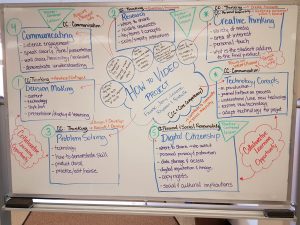
The project framework is a ‘How to’ Video Project.  In the overview below, core competencies are in black and the specific core competencies are in orange. The BC digital Literacy framework headings are in blue. We will be creating the teacher-centered portion of the project.

Please feel free to ask questions and/or give feedback on it.

« Older posts