I recall a story I shared with my students, one you have probably heard before; of the blind men and the elephant. As the story goes, each man was touching one part of the animal and using what they felt to create an overall impression of the animal; this led to arguments. Each person was convinced that they were right and the others were wrong. They were unable to listen to anyone else’s point of view. The discussion I had with my students centered around only seeing one perspective and not opening your eyes to other perspectives; being blinded by beliefs. This idea of perspectives and blinded beliefs has intertwined itself through many of the research papers, class discussions, my blog posts and my many late night ponderings.
The Beginning
We always start somewhere. My start was with a pile of enthusiasm and a jarful of ideas and biases I held about research and social media, amongst other things. These were not verbalized or highly passionate ideas, they were simply beliefs that resided quietly in the periphery of my mind only coming to the forefront as we began to explore ideas. My ideas about research were simple. Researchers researched to gather data and information that created knowledge. Quantitative and clinical studies were superior, the best and most trustworthy sort of research, and qualitative, perhaps they shared some interesting ideas about people’s thoughts, but they were not the gold standard and were certainly not as rigorous and valid. The researcher along with their research were the most important aspect of all this; I liken this to “Folke on his towering chair in the corner of Isak’s kitchen in the movie Kitchen Stories.
My ideas about Social Media were apprehensive and filled with a combination of wariness, untrustworthiness, and a conviction that it was a waste of time. I had no interest in putting myself out there on Twitter and couldn’t see any reason to do so. Shortly after, I found myself reopening my Twitter account and talking about PLN’s. A what, I thought? Personal Learning Network. What do I need that for? And now a blog? Okay, and we can choose to make it public or private, and we can choose to go on Twitter or not. And, I begin thinking and remembered that I came into this program to learn, to try new things, to take risks. So, I and my jumbled piles of ideas and beliefs, jumped on. We jumped into exploring research with new lenses, we jumped into new ways of thinking about learning and teaching and sharing through social media.
The Middle
I began working through papers and connecting on social media. I remember the nerves around sending the first tweet; Is there a, “this is a terrible tweet” button? Can I delete it? I recall discourse around social media and privacy and open learning. I recall one of the first presenters we had, Dr. Christine Younghusband. She talked about creating an online presence and the importance of including an image and some information about yourself. So I added these components in.
I remember reading through the first few research papers on Research Diaries and Autoethnography and my discussion around journaling and writing; how this can lead to greater reflection. I made some interesting assumptions with regards to my discussion around the written word; now when I look back I can see some of my biases connected to the written word. Were I to read this article now with the understandings I have gained, I believe my response would reflect this changed point of view. I would hold the spoken language in as high regard as the written. I might also argue that each has its own inherent value and that they should be examined independently rather than compared to each other.
I recall the visit from Dr. Shauneen Pete, the discourse about her work, and the impact this made on me. I had never thought about indigenous perspectives this way; I had never thought of myself as a settler. And I began to wonder what other knowledge I was missing. I recall the inspirational visit from Jeff Hopkins that had me looking at education with a new lens, that had me wondering how I could try this out, how I could find out more.
In the midst of all this, in the midst of learning about teaching pedagogies and educating students about digital citizenship, I suddenly realized that I was tweeting and asking questions and beginning to connect with others online. And, I was enjoying it; I was seeing the benefit of it.
I then recall the visit from John Willinsky and the public knowledge project (PKP) and how my mind opened up to this idea of open access. And I thought; yes, research should be public; globally available to all. This is amazing; amazing for learning, for sharing, connecting and researching. Research is so important for improving practice, for opening minds. To have open access, what an impact this can make!
In one of the last classes we looked at Métissage reading, the idea of braiding by breaking apart, by breaking pieces down and then taking these pieces and re-braiding; creating something new. And I thought, this is what this learning has been like, I think back to the ideas I came in with and the ideas that were broken apart, and the new ideas that began to enter and the re-braiding of these new pieces.
The end and a new beginning
I was introduced to new ideas and ways of thinking, of sharing and of learning, the community within the class, the new community I am building on line, the discourse that keeps me thinking and wondering, the new teaching pedagogies, the learning from research, the new types of research that I didn’t realize existed: the mixed method studies, the action research, the narrative research, phenomenology. The different perspective’s; the 4 R’s. Through all of this I learnt about myself, what I want my teaching practice to be. I learnt that there are multiple ways to understanding and of understanding and viewing. I reflect back on a quote that really impacted me from the reading, “Indigenous knowledge systems and science and technology education: A dialogue”,
“ I am suggesting that the two systems are different and therefore require different forms of verification. These verification methods and processes can actually be equated and be made to be of similar standards, however they have to be appropriate for each system, otherwise we would compromise one system at the expense of another and in the process lose the beauty of what the two systems could provide alongside each other.”
Onwu,G & Mosimege, M (2004)
When I think about my teaching, I realize this quote applies to my students as well. The work and assessment that takes place for each student needs to be appropriate for each student; it does not need to be the same. I reflect on the beauty of teachers and students working alongside each other. And I am suddenly brought back to the elephant story told at the beginning and I wondered…
What if in fact, these people talked to each other and shared their ideas. What if one man said, rather than you are wrong because I am right, what if they said, take me, show me what you feel. Show me what you see. Tell me what you see.
This same idea is illustrated beautifully in the following statement taken from the podcast below.
“We’re always coming from a mindset of where we know best and we have an answer, and we’ll consult on it, but it’s what we come up with. And so to me, until we can actually say ‘We don’t know what this answer is. What do you think?’ and talk together to build something… I don’t know if that’s even do-able. I mean, obviously it’s a very scary thing.”
Duration: 34:08 minutes
Had the individuals feeling the elephant used this idea, had they said, I don’t know what the answer is, what do you think? Had they talked together, they may have been able to build the whole elephant in their minds. For is it possible to know the other side if your voice is the only voice you listen to, and the only voice you hear, is your own? In my teaching, this connects to listening to student voices, to think, is this what I think the students need or is this what the students need?. It’s asking, what do you think?, It’s saying, I don’t know, let’s see if we can find out, let’s see if we can find someone who does know, and, then it’s building together.
And I reflect again on research and on social media and I realize that both allow for the listening of other ideas, both allow for the voicing of ideas, both allow for the creation of new meaning and understanding; the creation of a voice online, a practice informed by research. Both build connections. This simple word with so many meanings. And I looked back at the picture I had just changed on my blog’s header. The picture that, to me, seemed to communicate both knowledge and technology, but was missing the essence of teaching, the essence of learning. And, I found a new image, one that showed connectedness, community, communication, and collaboration because this is what ties it all together. This is important.
I am filled with excitement. Excitement for how I will learn and grow over the next few months and years. Excitement for how this will impact and change my teaching. Excited for the questions I want to pursue; excited, scared and apprehensive, I’m not sure what this will look like at this point, I’m not sure how messy it may get, I’m not sure how comfortable I feel about any of it, but, as a friend once told me, “at times you may feel uncomfortable, lean into this as that is when your growth will happen” (Burnham, L).
I chose this image because it connects to how I imagine my research in a number of ways. The first connection is fairly obvious, and that is the lens. To start with the lens illustrates my new understanding of research as I, like many of you, came from a place of understanding “good research “to be clinical and quantitative; if you look closely you will see that the image within the lens is flipped. This connects to my flipped (new) understanding of what research can be. I now know that good research comes in many forms. This lens also allows me to look closer at something, to look deeply into something to gain a new insight or understanding. It allows me to see things in a new light, from a new angle; a new viewpoint. It also gives me the ability to put it down, to look around, walk around, turn around, breathe in the air, feel the air, and then zoom in on something.
“This looks interesting, let’s take a closer look at it.
I also think the lens allows for examination without judgement. This in turn opens up the possibilities and allows for new knowledge and understandings. This naturally connects to the idea that this lens can be used to explore research from each of the 4R’s (the research, the researcher, the researched and the reader); these would be different filters/ lenses.
I made two other connections to this image. The first connection is to the road; to the journey. The feeling I had when I first looked at this image was that this was the beginning, the beginning of a journey. This is where I am; at the beginning of my new research/teaching journey, at the beginning of my journey through this program, and its exciting. The second connection I made with this image was with the trees. In fact, when I first started looking at images, I was looking at trees; trees with roots that were deep and intertwined. This to me illustrates the intertwining and connectedness of ideas, the messiness that can come with research and teaching, the intertwining of different methods, of relationships, and the beauty of all of these, and perhaps if you were to close your eyes, you could imagine me moving the lens in that direction and zooming in to see this beauty.
The persistent idea I will carry forward, is that of the lens, both within my teaching practice and within my research journey in this program over the next two years. This idea of looking from many angles, zooming in and then out, trying on different filters, different viewpoints and then putting the lens down, looking around, seeing, touching, listening and then pulling it up again. Within my practice I may be thinking…is that what the student needs or is that what I think they need? I may be thinking… It’s always been done this way; but maybe there’s a new way, a different way or a way to blend ideas together. I may be thinking this can’t be done…but maybe it can, what else can I look at, who else can I talk to? So ultimately, I want to use these ideas and new understandings to continue my journey and further build my practice by exploring the use of further technology within my classroom, cross-curricular teaching, inquiry, and problem-based learning. I want to use this lens as a tool to guide me as I work towards reaching my goal of preparing students for the future. As Tom Whitby said, “We as educators need to shift the education dynamic of teaching kids what to learn to teaching kids how to learn. This is the best way we can provide for them a way to live in their world and not ours.”
In the study, “Pervasive Learning and Technology Usage for Creativity Development in Education”, Shubina and Kulakli (2019), looked at pervasive learning, the benefits of creativity and the use of technology to foster and develop creativity in students by reviewing and analyzing relevant literature. Their focus question was: “How [a] technology-pervasive learning environment can enhance stimulation and development of creativity among students” ( p.95).
Research Questions
Shubina and Kulakli (2019), specifically asked three research questions connected to this larger focus question.
1.“How creativity is related to students academic and career achievements?”
2.“Does external and internal factors enhance or lessen creativity?”
3.“How technology and pervasive learning environment can enhance stimulation and development of creativity among students?”
( p. 95)
Literature Review
In the Literature Review, Shubina and Kulakli (2019) first discuss the literature connected to creativity and education. They note that the analysis of creativity can grouped into process-oriented models, product-oriented models, and what is referred to as the 5 C model. After discussing each in detail, Shubina and Kulakli (2019) conclude that, creativity is “important [for] developing the following skills”:
1.The ability to judge the usefulness of a new idea or solution
2.The ability to generate new ideas, skills or to improve or modify ideas to make them more useful.
3.The ability to solve problems in combination with critical thinking, communication and negotiation skills as well as evaluation skills and analytical thinking.
( p.97)
In addition, the authors conclude that “creativity at the little “c” is a good starting point for implementing creativity in education” ( p.97). They define little “c” as; “creativity, which occurs at [a] personal level as a unique, novel and meaningful interpretation of experiences, actions, and events by an individual” (p.96). Following the discussion of creativity in education, Shubina and Kulakli (2019), go on to discuss again the purpose of the study, the research questions, and then the methodology of their study (conducted by relevant literature review).
1st Focus: “Factors that Enhance Creativity Development”
Shubina and Kulakli (2019), discuss research connected to “motivation, self-determination, teaching approach and individual differences” (p.98). They first concluded that “educational institutions can enhance creativity development” by “applying policies, developing assessments and preparing teachers” ( p.98). Within this, they discuss the promotion of non-traditional teaching methods, collaboration, supports for teachers, etc. The second conclusion they make is that when teachers provide feedback to students that is “perceived as informative, constructive or useful” this “may have a positive impact on their intrinsic motivation to be creative”(p.99). The third and final conclusion they make is that, “positive mood, openness to experience, positive self-image and high self-efficacy are all related to greater creativity” (p.99)
2nd Focus: “Barriers to developing Creativity in the Classroom”
This focus is “divided into three groups: teacher’s attitude and practice, types and structure of assessments, and students’ beliefs regarding creativity.” (Shubina & Kulakli, 2019, p.99). What Shubina & Kulakli (2019) conclude is the following:
1.Traditional teaching methods provide few “opportunitie[s] for students to share “unusual ideas” and to discover insights.
2.The social role of the teacher and biases the teacher may have about creativity may suppress creativity (Teachers may think of only big C -creativity; connections to creative geniuses; they may be result focused and may miss/ignore the process)
3.External motivators primarily connected to social factors may suppress creativity e.g. social comparisons, competitions.
4. Students who doubt themselves and their abilities are less likely to exhibit creativity.
“Pervasive learning and technology usage for creative development”
Shubina and Kulakli (2019) discuss pervasive learning as defined by Pontefract. They state that this type of learning is characterized as “collaborative, inter-connected, continuous, communicative and social community-based” (p.100) . Shubina and Kulakli go on to discuss multiple types of technology available now that supports pervasive learning. Current and future technology supports pervasive learning as it, more than ever, allows for continuous, collaborative and social learning that extends beyond classroom walls.
“Studies on the relationship between pervasive learning, technology usage and creativity”
Shubina and Kulakli (2019) discuss the following key findings:
1.“Technology use may help to develop creative and critical thinking skills, problem-solving skills, and study skills as [an] additional benefit of its usage” ( p.102).
2.The combination of digital and non-digital sources may “enhance the learning process as students have to search, select, retrieve and share opinions or discoveries based on analysis of information from multiple sources” ( p.102).
3.Pervasive learning may lead to an increase in engagement and may increase intrinsic motivation.
4.“Intrinsic motivation is measured based on such constructs as interest, curiosity, attention, and creativity” ( p.103).
5.“Triggered curiosity” which can be brought about through the use of technology, “is supposed to enhance creativity development as well as to maintain interest and cognitive engagement” ( p.103).
6.Technology may help to increase the “intrinsic motivation of [the] learner through increasing student’s interest, attention and cognitive engagement” ( p.103). Based on the research provided, the use of technology may lead to further student successes.
They concluded this section with an overall comment regarding the benefits of technology, but also mentioned that it has the potential to become a distraction.
Conclusion
Shubina and Kulakli (2019), concluded that the research examined showed that there was a “strong relationship between technology use and creativity enhancement through reinforcing students’ intrinsic motivation, self- regulation, curiosity, self-efficacy and knowledge exchange” (p.104). In addition, technology further allows for pervasive learning. Based on the research findings the authors also note the importance of creativity and state that “creativity [should be moved] to one of the center points in educational programs” ( p.105).
References
Shubina, I., & Kulakli, A. (2019). Pervasive Learning and Technology Usage for Creativity Development in Education. International Journal of Emerging Technologies in Learning (IJET), 14 (01), 95–108. DOI: 10.3991/ijet.v14i01.90679.
My Story
I currently work in a blended program ( U-Connect) teaching grade 8-12 students ( English, Foods, Musical Theatre). Within my practice, I often think about the importance of preparing students for the future and, I believe that I have met this agenda in some areas. To further my practice, I would like to work on building more opportunities for students to develop “soft skills;” and, I would like to further incorporate technologies and create more authentic tasks. When teaching with Moodle created courses, I find that they have some strengths; however, they are still primarily based on the system of stand and deliver to; now produce a product. These courses also contain an incredible number of assignments, leading to what I believe is a surface skimming of many things and little time spent in deep understanding. It is my belief that creativity, an important 21st century skill, may be destroyed through the vast quantity of work students have to “get through” in some of these courses; and, it is highly unlikely to be fostered. One course that I teach that I have spent some time reflecting on over the past month is Foods and Nutrition 11/12 (FDN). This course has an effective practical component connected to learning how to cook but is lacking when it come to the exploration of emergent and important topics (food availability, food justice, GMO’S, nutrition, technology and food); these topics are being covered in a traditional teaching method. And so, I set out to find the perfect paper on integrating technology into Foods classes as a means to deepen engagement and build 21st century skills.
To find a paper that met my needs that was connected to (FDN), technology and 21st century learning was like looking for a needle in a hay stack. At that point, I chose to look for a paper that contained general ideas around technology, and 21st century skills. While searching, I continued to run across the word “creativity” and the need/importance of creativity. This paper resonated with me as it addressed creativity as well as my initial search for the benefits and uses of technology and 21st century leaning. I was intrigued by the concept of pervasive learning as it fits nicely with 21st century learning and with the blended program I work in. This paper included relevant details that support the benefits of including technology as well as the process of creativity and the link between technology and creativity. The discussions around fostering creativity and barriers to creativity gave me some clarity around steps I would need to take with my students and myself in order to build creativity through the use of technology. These are skills that will help to better prepare my student for the future. My hope is that including these components within my FDN class will give students the opportunity to collaborate, communicate, analyze, create, take risks and to problem-solve; these are vital 21st century skills.
Further specific details regarding the research problem(s)
1.The Teaching Platform: Moodle. Although it has some positive aspects to it; videos, forums, messaging, and options for some assignments, there are also negatives: a stand and deliver style of teaching (the online component), a lot of text and material for students to sift through, little choice (unless students take the initiative to talk to the teacher about other options), too many small assignments, and structures in place that make it challenging to engage with online learners. As such, the fully online learners are often disconnected and are less likely to successfully complete classes. Based on the paper discussed and the importance of technology and creativity, I wonder what changes could be made to provide a learning experience that is meeting the needs of the students and preparing them for the future. I wonder about the use of social media, blogs, podcasts and other tech tools that are connected to pervasive learning and to building skills like creativity.
2.In-class: Face To face Teaching. Although this teaching portion has a lot more positives than negatives; there are still aspects to it that I feel are not meeting the needs of the students. One that I spoke of earlier was again connected to Moodle as we deliver our course material this way. Although the concepts are connected to important and emerging topics (FDN11/12), they are taught in a manner reminiscent of traditional teaching. The practical part of the course is, well, practical and works well as students learn to work as a group to complete Foods labs. This portion builds skills like: collaboration, problem solving, creativity and practical life skills. Again, for the concept portion, I wonder what technology I could begin to include to further engage students and to provide the opportunity to further build soft skills like creativity. I wonder what skills/scaffolding students need to further develop their self-confidence so that they can engage in the creative process.
3.The Compartmentalization of Subject(s), particularly again in FDN. As mentioned earlier, I believe that the skills that we want students to learn should be taught across all subject areas. With regards to Foods, STEM (Science, Technology, Engineering, Mathematics), would be a natural fit for the emergent topics in Foods class.
The list below is of research questions I have been adding to over the last few weeks. I was surprised and pleased to see that many of them fall into the larger research question I have asked here. I have noted the connections/ideas for each below.
Blog List of Research Questions.
How do I create meaningful learning in an online (Moodle) environment?Based on the research I looked at the use of social media or other social constructs may be one way. I wonder how I might build these structures within the courses. I wonder about building community within these courses?
Can the use of animations create higher levels of student participation? Again, this could be connected to the use of social media and may even be used as a scaffolding tool. Students could start with animation and them once they have built skills and confidence, could move away from the animation.
Can the use of social media increase student participation and engagement in online and blended classes?This may be possible as the research demonstrated an increase in engagement with the use of technology. This use of social media, as pervasive technology, may also increase engagement. This engagement may lead to higher levels of participation and may lead to higher level of creativity.
Can teacher presence increase student engagement in online classes?Again, this could connect to the use of social media or other tools like pod casts or vodcasts.
How can I create a community with my online learners?Again, this is connected to social media and other tools that create opportunities to collaborate with others. I wonder what this might look like…
What is the best way to implement cross-curricular/inquiry projects/project based learning?
Technology is not incorporated as often into electives like music despite the benefits it may provide to students. This journal article does a good job of discussing, providing examples and detailing specifics around how to include podcast projects in music classes.
My Thoughts:
This article is very specifically geared towards one type of project. Teachers could find this useful if they were wanting to add tech to their music program as it contains specific implementation instructions. Practically, this project could be used across a multitude of electives and academics as another way for students to engage with and show their learning. This project may also be used in courses like ADST as it would be easily adapted and could be created by all students regardless of their musical background or aptitude.
Overview: The article discusses the lack of food technology components covered in class with concerns that foods is falling behind as far as evolving and that students are not developing 21st century skills.
My Thoughts: Is not a very useful resource as far as looking at ideas to incorporate technology. Rather it talks more about different aspects of food technology such as food science, food sustainability, food industry and food availability, GMO’s, nutrition- these are components where technology could be used to engage students with some of these ideas. This may lead to the development of critical thinkers prepared for food challenges that the world/ country /community may face. It may be useful for teachers to review in order to evaluate their own program of teaching to ensure that these important topics are being covered. It could also be used to create guiding questions for students based around inquiry: create a question around sustainable food sources, create a question around food availability or GMO’s or Local Food Sources.
Overview: Discusses using technology to engage students with Shakespeare. Discusses remix: combining the traditional Shakespeare with current ideas (could be connected to music, video games, movies etc.). Discusses the benefits and outlines some sample projects. Discusses the idea of a participatory culture with reference to social media. The big idea is that if kids participate, they engage.
My Thoughts: This is a great resource for Music, English, Drama, Art and ADST teachers especially as teachers can address one area specifically or can pull in multiple components.
Overview: Discusses the use of podcasts as a means to introduce students to new recipes/ ingredients etc. so that they are prepared when they come to class and are able to build more skills.
My Thoughts: This reminds me of a flipped classroom idea. This could be used in conjunction with the idea of creating podcasts as it could be a combination of both. Providing students with the ideas and the know-how for specific cooking assignments ahead of time would allow for students to come to class better prepared thereby furthering their skills. It may also allow them to showcase certain skills. I think the ideas of using this as a flipped classroom for labs would be successful. I also think that using the idea of podcasts, vodcasts etc. would be a good way to examine some of the other aspects of the FDN curriculum.
I bought a new chair recently, it’s a bright baby blue color and it sits in my room. On the chair sits a small plain cushion. Both look a little strange still in the corner of my room; often I wander in and am surprised to see them there. And then I remember, my decision to bring Twitter and my Public blog into my life. I remember my commitment to try it out, to experiment and to be open to seeing what it could become.
And so, my continued journey with social media this week has been…. engaging, educational and surprisingly friendly. My tweet asking for some ideas around teaching was responded to quickly and with unanticipated enthusiasm.
My tweet to a researcher regarding her research; I received not one but a multitude of responses followed by a kind offer to continue dialogue through e-mail.
That’s great! I really appreciate you sharing all of these thoughts with me. I hadn’t picked up a few of the ideas you mentioned so this also helps me to have a better understanding of what AR is all about!
Surprised, shocked and very pleased, my mind begins shifting into a comfortable spot on this brand-new baby blue chair; with my pillow snuggled beside me. While I’m sure this is due to the very small and specific group I follow; nevertheless, it is a nice foray into a new world.
And then, another guest speaker; Bonnie Stewart. An expert on Twitter, and passionate about education, Bonnie completed her PHD on Twitter and currently holds the role of Assistant Professor of Online Pedagogy and Workplace Learning at the University of Windsor. Bonnie expresses many of her ideas through her blog, “The TheoryBlog” and continues to engage others in discourse around technology and education through Twitter. It’s all very fascinating. The discussion moves from “The shifting consequences of Twitter scholarship” to U-Tube algorithms (scary) and bots and suddenly, a remark is made about the quantity of researcher responses a classmate and I received; and, “maybe it was a bot” was stated, twitters ensue (the laughter kind), and my mind starts playing back scenes from “ I Robot” and “The Matrix”. I move uncomfortably on my chair. Bonnie goes on to talk briefly about bots and some of the roles they play online as the wheels continue turning in my heard.
“You just can’t differentiate between a robot and the very best of humans,” argues Dr. Lanning, director of U.S. Robots lab in Isaac Asimov’s I, Robot. This, stated in a movie, made in 2004 has become a reality. Ten years after “ I Robot” was produced, according to the article , Turing Test success marks milestone in computing history” , the Turing test was passed. This test, named after Alan Turing, requires computers to engage in conversation with human participants. If 30% or more of the humans believe the computer is a real person, the test has been passed. In 2014, the 13-year-old bot called Eugene was able to convince 33% of the judges that he was human. Professor Kevin Warwick made the following comment.
“Of course, the Test has implications for society today. Having a computer that can trick a human into thinking that someone, or even something, is a person we trust is a wake-up call to cybercrime. The Turing Test is a vital tool for combatting that threat. It is important to understand more fully how online, real-time communication of this type can influence an individual human in such a way that they are fooled into believing something is true…when in fact it is not.”
The overly trusting slightly naïve part of me is feeling a few twinges of concern. My baby blue perch not feeling as comfortable as before, I sit up and click the next link…… https://hapgood.us/2019/03/28/network-heuristics/
A few moments later I am reading an article written by Mike Caulfield on a researcher named Maisy Kinsley. I begin and am led into a tale of deception. Maisy Kinsley does not exist. Fake profiles on multiple social networking sites and an image generated by machine learning has brought Maisy Kinsley into existence. Caufield goes on to detail how easy it is to create a fake identity online and explains how people believe that they can tell if it is fake or not, but often their biases get in the way. He then goes on to discuss how he would make a point to show colleagues or students a site, ask them to identify why it was fake (to which they would list off a multitude of reasons ) and would then go on to tell them that in fact the site was real. Incredibly, a percentage of the people he did this to would not believe that it was a real site despite all the evidence he presented. In fact, they would vehemently disagree.
As this point, I get out of the chair and begin to pace the room.
Bots, trolling bots, bots that communicate like people, algorithms, biases, fake identities, hashtag activism, call out culture, echo chamber….and the list goes on.
I regress back to another article I read, “The Rise of Social Bots”. This article looks specifically at social bots, discussing the helpful or benign ones and then leading into a discussion of the malicious one and the damage they can cause: influencing the stock market, influencing the election, cybercrime, reputation destruction. According to the article, “These bots mislead, exploit, and manipulate social media discourse with rumors, spam, malware, misinformation, slander, or even just noise.”
The article claims that bots can:
Search the web for information to build fake profiles.
Post material to their profiles in a manner similar to humans.
Converse with people through social media
Strategically gather new followers.
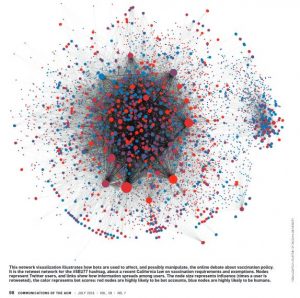
The image below shows, ” the retweet network for the #SB277 hashtag, about a recent California law on vaccination requirements and exemptions.” The red dots are highly likely to be bot accounts.….scary….
And I pause again…….
I filter through all the information I have read and received over the week and glance over at the blue chair in the corner. And suddenly I come to a realization. I need more, now than ever to be engaged on Twitter, to continue to educate myself on social media, to continue to share and to be a part of the discourse around these issues.
I now know that best thing I can do for my students in regard to this is to keep engaging on Twitter, to keep learning and to pass this knowledge to them. As Mike Cadfield said,
“knowing what is trustworthy as a sign on the web and what is not is, unfortunately, uniquely digital knowledge. You need to know how Google News is curated and what inclusion in those results means and doesn’t mean. You need to know followers can be bought, and that blue checkmarks mean you are who you say you are but not that you tell the truth. You need to know that it is usually harder to forge a long history than it is to forge a large social footprint, and that bad actors can fool you into using search terms that bring their stuff to the top of search results.”…………..“they need to be taught. Years into this digital literacy adventure, that’s still my radical proposal: that we should teach students how to read the web explicitly, using the affordances of the network.”
Students need to be taught these skills at schools in classrooms. This is important. This is digital literacy. This is discourse connected to content that affects students, that will affect their futures. Educating students creates knowledge and critical thinking skills that will help them to be better prepared for the 21 century.
I head back and resettle myself in my chair; tuck my pillow, that now shows a hint of color, beside me and get ready to learn, share and educate.
When I wander into the room now, I am no longer surprised. It looks like the chair is here to stay
The topics and research reviewed this week led me to a discussion of this paper as I made connections with the ideas presented and discovered applications that would be useful in guiding my future research as well as current teaching practices. In addition to this, this paper reflected specific topics presented and discussed throughout course discourse this week, leading me to the belief that it would be particularly useful and relevant to discuss multiple aspects of this research.
We were able to have a face to face visit with one of the authors of this paper, George Veletsianos. The visit was beneficial in many ways as we were given the opportunity to engage with him regarding his research through questions and discussions. When discussing the 4 R’s this is directly relevant as it gave insight into who George is a researcher and what has led him to become involved in the work he does. According to his “About Me” page on his blog, one of the larger influences for his work was his parents’ direct experiences with war and their beliefs in education. Veletsianos shared as part of class discourse how within his research he wants to know people and hear their stories. “My research aims to understand and improve teaching, learning, and participation in digital environments” (Veletsianos.com/About Me). This study does exactly that.
In the introduction, Veletsianos et al (2018) reviewed current literature to provide background research justifying why this study was important and needed. The discussion of relevant literature led to the conclusion that there was a gap in the research and this experiment was justified in that manner. As a reader, I found this literature review to be interesting in a new way as I was now reading through it with a deepened understanding of what a literature review was.
After exposing this gap, their research object was stated as follows.
“To investigate these issues, we examined the strength of positive and negative sentiment expressed in response to TEDx and TED-Ed talks posted on YouTube (n = 655), the effect of several variables on comment and reply sentiment (n = 774,939), and the projected effects that sentiment-based moderation would have had on posted content.” (Veletsianos et al,.2018)
The importance of this research is discussed in a practical manner as more and more students, teachers and others are encouraged to go online and to build online digital identities. Further research that outlines these ideas as well as a discussion around the practical implications and application of the findings of this study are discussed. Based on discussions and topics covered this week in class regarding Twitter, Blogging, using social media in the classroom and creating professional online digital identities; I agree, this research and future connected research is needed.
Sentiment is the topic [term] primarily under investigation for this study and as such Veletsianos et al (2018) spend time discussing the term so the reader is familiar with it. In addition to the discussion of sentiment, Veletsianos et al, (2018) go on to explore the concept of moderation in depth. Again, as a reader, I am connecting to the literature that is reviewed through these sections.
……I wonder why people choose to post negative comments, I wonder why these begat further negative comments, I wonder about the ease with which one person can post a comment that can make or break another human, I wonder about the disassociation with humanity, the lack of kindness/of thoughtfulness, and then I wonder about the rich and deep connections people build…..
This literature review gives an overview of some of the current and past research associated with both sentiment and moderation as well as some of the general findings resulting from this research further establishing the necessity of the research they are conducting. This is important because it not only gives the reader (myself, and other educators, researchers) a broader understanding of the terms, it also addresses connected and relevant research.
The research investigated Ted-X and Ted-ed talks and resulting comments to answer their research questions. Those researched were not directly impacted in anyway; only data they had posted or responded to was included; personal interviews, questionnaires or any other form of communications with those involved was not a part of this study. Interestingly, this contrasts with another Veletsianos study we investigated this week: Women scholars’ experiences with online harassment and abuse: Self-protection, resistance, acceptance, and self-blameby George Veletsianos, Shandell Houlden, Jaigris Hodson and Chandell Gosse. This study focused on a small group of participants who were interviewed individually. In this study, both the researcher and the researched would have been impacted through their participation in these interviews. For the researchers, conducting this research may have provided a sense of connection with these women and a deeper understanding of the issues they had faced/were facing. It may have impacted them on an emotional/personal level. For those researched, the interviews may have become a coping skill itself as their voices are heard (their stories are important) or it may have been therapeutic or may have created further anxiety. Given Veletsianos’s background information as well as insights gained in class, I am curious about his experiences with both studies as the research methodology differed. I am also curious about whether the unknowing participants of the Ted-X and Ted-ed study would have been affected had the result of this study been shared with them. What, if anything would they change going forward? This would be interesting to explore further.
Within this study, justification is given for using only Ted-x and Ted- ed talks; however, I do find it to be a limiting factor as they look at only one type of video and arguably, one type of audience. The three research questions for this study were then given:
RQ1. What is the strength of positive and negative sentiment in response to TEDx and TED-Ed Talks posted on YouTube?
RQ2. How does the gender of the video presenter, the delivery format (presentation vs. animation),
and comment threading influence the sentiment of comments and subsequent replies?
RQ3. What would be the likely impact of moderating negative comments upon community participation?
One thing I wondered about these questions is: Are three questions too many to address within a piece of research? Does it make more sense or is it more appropriate to delve deeply into one question? It makes some sagacity to include the first two questions are they are explicitly connected. I do wonder about the reasoning and validity of including the third question as this seems to begat its own study.
My other question, as mentioned previously, was the limiting factor of only using one type of video for the study. I questioned whether it had to do with the amount of data being analyzed but upon further examination of the methods of analyzing the data I noticed that they used a piece of statistical software called “SentiStrength”. “We then generated sentiment scores for all comments and replies in the dataset, by using the open source sentiment analysis tool SentiStrength” (Veletsianos et al., 2018). According to http://sentistrength.wlv.ac.uk/, SentiStrength is capable of analyzing “up to 16,000 social web texts per second with up to human level accuracy for English”. In this case, why not analyze a larger data set that includes multiple types of educational videos? Perhaps this had to do with the manual coding that also took place as well as the fact that they were examining both quantitative and qualitative data. This limitation was addressed within their study leading me to the belief that the researchers felt, that despite this limitation, the study would still provide valuable information. Upon reading through their results, I would agree.
The results of their study are listed below:
1.Overall, comments and replies were categorized as neutral.
2.Some video topics were more likely to lead to positive comments and replies (beauty, passion, career) and some were more likely to lead to negative comments and replies (cancer, college, pain).
3.Male presenters were more likely to receive neutral comments and replies.
4.Female presenters were more likely to receive positive and negative replies.
5.“Animations neutralized both the negativity and positivity of replies at a very high rate”
6.Positive responses were more likely to lead to further positive responses. The same was true for negative responses.
7.Comment moderation did not significantly reduce negative responses.
The conclusions went on to discuss each found phenomena in further detail along with potential applications and a call for more research in some of these areas. These results, as the reader and an educator impacted me in multiple ways. I was surprised, especially given pre-existing research, that the results found for comments overall were categorized as neutral overall. I wonder if the researchers had chosen to view multiple types of educational videos, if these results would be the same. I also wonder, if other educational videos were examined, perhaps the same results would be found as it may be that all educational videos would have the same specific type of viewer. I found the results regarding topics interesting. This could lead to a greater understanding of what topics may cause negative or positive responses within the classroom OR when educational videos are viewed. The information regarding gender is applicable in many ways, both as a female venturing into the online world …..this can feel scary at times…. and as a teacher with both male and female students. It is important to understand that online experiences for males and females is not the same. It is also important to remember that social media as a tool can be both a positive and a negative experience. This reminds me of a recent twitter feed post:
This is important. When I teach about academic blogging now, I highlight the benefits of social media but also mention the drawbacks and make it clear that no one should feel obliged to engage with social media. #femedtechtwitter.com/KAMWright/stat…
I think this post contains vital information. It is so very important to remember that no one should feel obliged to engage with social media. I view this idea with a new lens now as recently, as a result of discussions and readings in class, I had begun thinking of the ways I could incorporate social media in my blended and online classes as a means to engage, promote discussion and community within the online learning environment. Keeping this idea close as I begin to explore the use of social media in my classes is very important. This also connects to concepts and ideas presented this week in class through both the readings on privacy and through the information shared by the guest speaker Jesse Miller from Mediated Reality
One idea for application that arose as part of this study is student use of animations to share information rather than a video or live presentation of themselves. This eliminates the male/female phenomena and, according to research presented as part of this study, also creates anonymity which can increase overall participation. This would benefit the student as they would be given a voice. This would benefit other students in the class as they would have new ideas to listen to. And with that I circle back to my thoughts at the beginning and my purpose for writing; that of knowledge.
Two articles read this week in class appear to show opposing points of view; two different styles of teaching. Both are correct and both are incorrect as neither article gives the reader a clear understanding of the whole. The meaning I pulled from the articles was that both styles of teaching are valid and necessary. Students need skills taught through direct instruction and they need freedom to explore and grow and build their “soft skills” without direct instruction. In a way, the ideas presented, while drastically different on the surface, have some common ground.
The first reading, a book excerpt, Teaching for Meaningful Learning: A review of research on Inquiry-Based and Cooperative learning, by Dr. Brigid Baron and Dr Linda-Darling Hammond, argues for the benefits of Inquiry based and Cooperative learning. A strong emphasis is placed on preparing students for jobs that do not exist yet and arguments are made against what is referred to as traditional methods of “memorization and application of simple algorithms” (p.1). Baron and Hammond state that these skills will not “develop students who are critical thinkers or students who can write and speak effectively” (as cited in Bransford, Brown, & Cocking, 1999; Bransford & Donovan, 2005, p.1). A strong argument, for who could argue that pure memorization would lead to any of the skills mentioned. Baron and Hammond also discuss the benefits of authentic learning. This is another point that would be challenging to argue, as any teacher who has experienced this with their students will argue that authentic learning is engaging and purposeful in a way that memorization is not.
The article in opposition, Why Minimal Guidance during Instruction does not work: An analysis of the failure of constructivist, discover. Problem based, experiential and inquiry-based learning, by Paul A. Kirschner , John Sweller & Richard E. Clark (2010) argues the converse. Kirschner et al (2010) argue that students need direct instruction to learn effectively and that Inquiry based learning is not only ineffective but may be detrimental. One interesting point I took away from this article is that the learners they appear to be referring to are novice or intermediate; without a clear definition for either term, the exact nature of each is unknown. It is then made clear that a student who was considered to be an “expert” was not included as part of this report. Kirschner et al (2010) also delve into some discussion around learning a discipline versus practicing a discipline; both of which would require differing teaching strategies. It therefore could be argued that the research they shared as a basis for their claims, deals with novice/intermediate learners who have not yet learned the skills necessary for the discipline.
It would be hard to argue against traditional teacher-led activity as an effective mean of building skills in novice and perhaps intermediate learners. One may also say that given the research on inquiry based learning and personal experience, that it may be hard to argue against inquiry-based or collaborative learning for students who have a base set of skills (they may be classified as experts) that they can take and extend further.
Contrary to the claims of the use of minimal instruction in Inquiry based learning discussed by Kirscher et al., the excerpt by Baron and Hammond states that, “Teachers also offer instruction in more traditional ways, such as lectures and explanations that are crafted and timed to support inquiry” (p.3). Interestingly, this supports the idea that minimal instruction is not always appropriate nor the best for student learning even within an Inquiry based method, leading to the conclusion that while outwardly appearing in opposition to each other, these two readings perhaps share more in common than it may initially seem.
Personal experiences and connections
My personal experiences with inquiry-based learning supports the idea that students in an open inquiry require guidance and scaffolding. Students involved in Problem Based Learning or a subject focused inquiry require basic skills before they can move on to the more authentic, self-directed tasks. Having a solid understanding of the basics allows for students to use them/ discredit them or pick them apart and create new understanding that may be more relevant and authentic. Having a solid understanding of basic skills builds confidence in students thereby giving them the ability to tackle more challenging tasks where they can apply the skills and build on them in new and different ways.
For example, musical theatre students within our class this year had the opportunity to be involved in the creation of this year’s musical. Students were involved in promoting, directing and the creation of script, music and lyrics. The students involved were actively engaged in an authentic task, they were given opportunities to lead and to make decisions. We, the teachers, were the facilitators and guides of this learning; not the instructors. These students; however, had they not had the background knowledge of music, script and directing would have been unable to successfully complete these projects. These students, without the guidance of the teachers would also have struggled to successfully complete these projects. Years of building a base of knowledge and understanding along with teacher guidance allowed them to be successful with this. The benefits the students gained as part of this project are immeasurable.